p.56 抽出テキスト
(1) when they present with an inadequate response to treatment despite optimized combination therapy; (2) when they present with an intermediate–high or high risk of death (i.e. 1-year mortality .10% when estimated with established risk-stratification tools)471 (see Section 6.2.7), which exceeds the current mortality rate after LTx;472 (3) when patients have a disease variant that poorly responds to medical therapy, such as PVOD or PCH. Both heart–lung and bilateral LTx have been performed for PAH. Currently, most patients receive bilateral LTx, while combined heart–lung transplantation is reserved for patients who have additional non-correctable cardiac conditions.473 With the introduction of the lung allocation score (LAS), waiting list mortality has decreased and the odds of receiving a donor organ have increased.474 In some countries, an ‘exceptional LAS’ can be obtained for patients with severe PH. Some other countries not using the LAS have successfully implemented high-priority programmes for these patients.475 The patient and their next of kin should be fully engaged in the transplant assessment process and informed of the risks and benefits, and the final decision should be jointly made between the patient and medical team (see Section 6.3.1.8). For patients with PAH who survive the early post-transplant period, long-term outcomes are good. A study found that for primary transplant patients with IPAH who survived to 1 year, conditional median survival was 10.0 years.476

6.3.9 Evidence-based treatment algorithm

A treatment algorithm for patients with IPAH/HPAH/DPAH or PAH-CTD is shown in Figure 9. The evidence supporting this algorithm has mainly been generated in patients with IPAH/HPAH/ DPAH or PAH-CTD who present without cardiopulmonary comorbidities. Patients with HIV-associated PAH, PoPH, and PAH associated with congenital heart disease were not enrolled or under-represented in most PAH therapy trials. Treatment recommendations for these patients are provided in Section 7.

6.3.10 Diagnosis and treatment of pulmonary

arterial hypertension complications 6.3.10.1. Arrhythmias The most common types of arrhythmias observed in PAH are supraventricular, mainly atrial fibrillation and atrial flutter, while the frequency of ventricular arrhythmias and bradyarrhythmias appears to be considerably lower.477–479 Of note, age is an independent risk factor for atrial arrhythmias. In prospective studies, the incidence of atrial arrhythmias was 3–25% over an observation time of 5 years in cohorts primarily containing patients with IPAH.479–481

In the absence of specific evidence for PAH, managing anticoagulation in patients with PAH and atrial arrhythmia should follow the recommendations for patients with other cardiac conditions.477 Patients with PAH are especially sensitive to haemodynamic stress during atrial arrhythmias due to tachycardia and loss of atrioventricular synchrony. Maintaining sinus rhythm is an important treatment objective in these patients. New-onset arrhythmias frequently lead to clinical deterioration and are associated with increased mortality.481 Observational studies have shown that a variety of rhythm control strategies are feasible, including pharmacological cardioversion with anti-arrhythmic drugs, electrical cardioversion, and invasive catheter ablation procedures. To achieve or maintain a stable sinus rhythm, prophylaxis with anti-arrhythmic drugs without negative inotropic effects, such as oral amiodarone, should be considered, even if specific data regarding their efficacy are lacking. Low-dose beta-blockers and/or digoxin may be used on an individual patient basis. Catheter ablation is the preferred approach in managing atrial flutter and some other atrial tachycardias, although catheter ablation in patients with PAH is often more technically challenging than in patients with a structurally normal right heart chamber.482 The safety and efficacy of ablation techniques for atrial fibrillation specifically in the PAH population are uncertain, and it is possible that, due to remodelling of the RA, non-pulmonary vein triggers may play a more important role than in patients without PAH.483

6.3.10.2 Haemoptysis

Haemoptysis, ranging from mild to life-threatening, may occur in all forms of PH but is particularly common in HPAH and PAH associated with CHD. Pulmonary bleeding frequently originates from enlarged bronchial arteries;484–486 hence, the diagnostic evaluation of patients with PAH and haemoptysis should include a contrast-enhanced CT scan with an arterial phase. Even if the source of bleeding cannot be determined, embolization of enlarged bronchial arteries is recommended in patients who present with moderate-to-severe haemoptysis or recurrent episodes of mild haemoptysis. Lung transplant should be considered in patients with recurrent and severe haemoptysis despite optimized treatment.

6.3.10.3 Mechanical complications

Mechanical complications in patients with PAH usually arise from progressive dilatation of the PA and include PA aneurysms, rupture, and dissection, and compression of adjacent structures such as the left main coronary artery, pulmonary veins, main bronchi, and recurrent laryngeal nerves.487–492 Pulmonary artery aneurysm was independently related to an increased risk of sudden cardiac death in one study.492 Symptoms and signs are non-specific; in most cases, patients are asymptomatic and these complications are incidentally diagnosed. Pulmonary artery aneurysms are usually detected during echocardiography and best visualized by contrast-enhanced CT or MRI. Treatment options for asymptomatic PA aneurysm or PA dissection are not well defined. LTx has to be considered on an individual basis.490,493

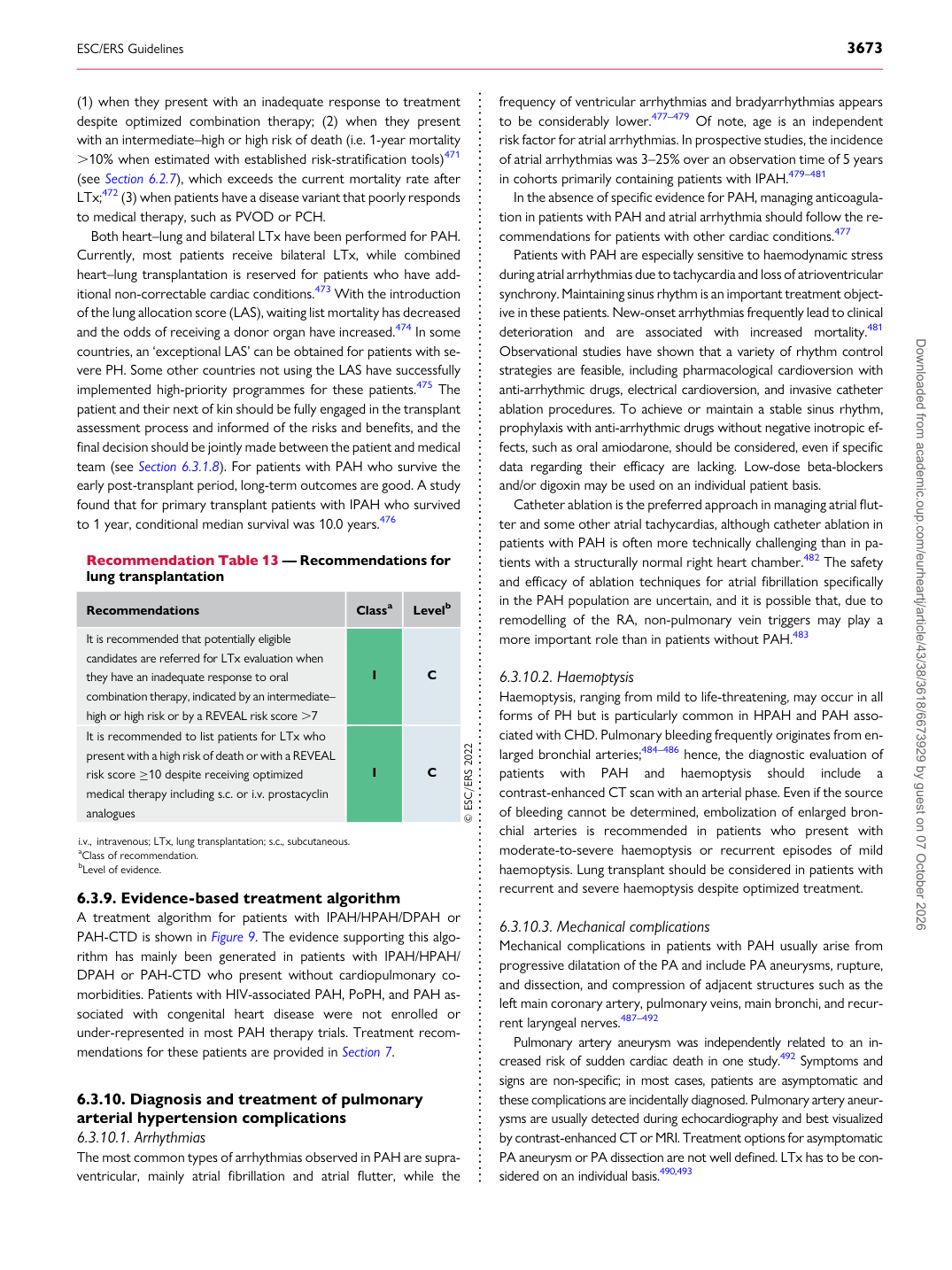
Recommendation Table 13 — Recommendations for lung transplantation

Recommendations Classa Levelb

It is recommended that potentially eligible candidates are referred for LTx evaluation when they have an inadequate response to oral combination therapy, indicated by an intermediate– high or high risk or by a REVEAL risk score .7 I C It is recommended to list patients for LTx who present with a high risk of death or with a REVEAL risk score ≥10 despite receiving optimized medical therapy including s.c. or i.v. prostacyclin analogues I C © ESC/ERS 2022 i.v., intravenous; LTx, lung transplantation; s.c., subcutaneous. aClass of recommendation. bLevel of evidence. Downloaded from academic.oup.com/eurheartj/article/43/38/3618/6673929 by guest on 07 October 2026