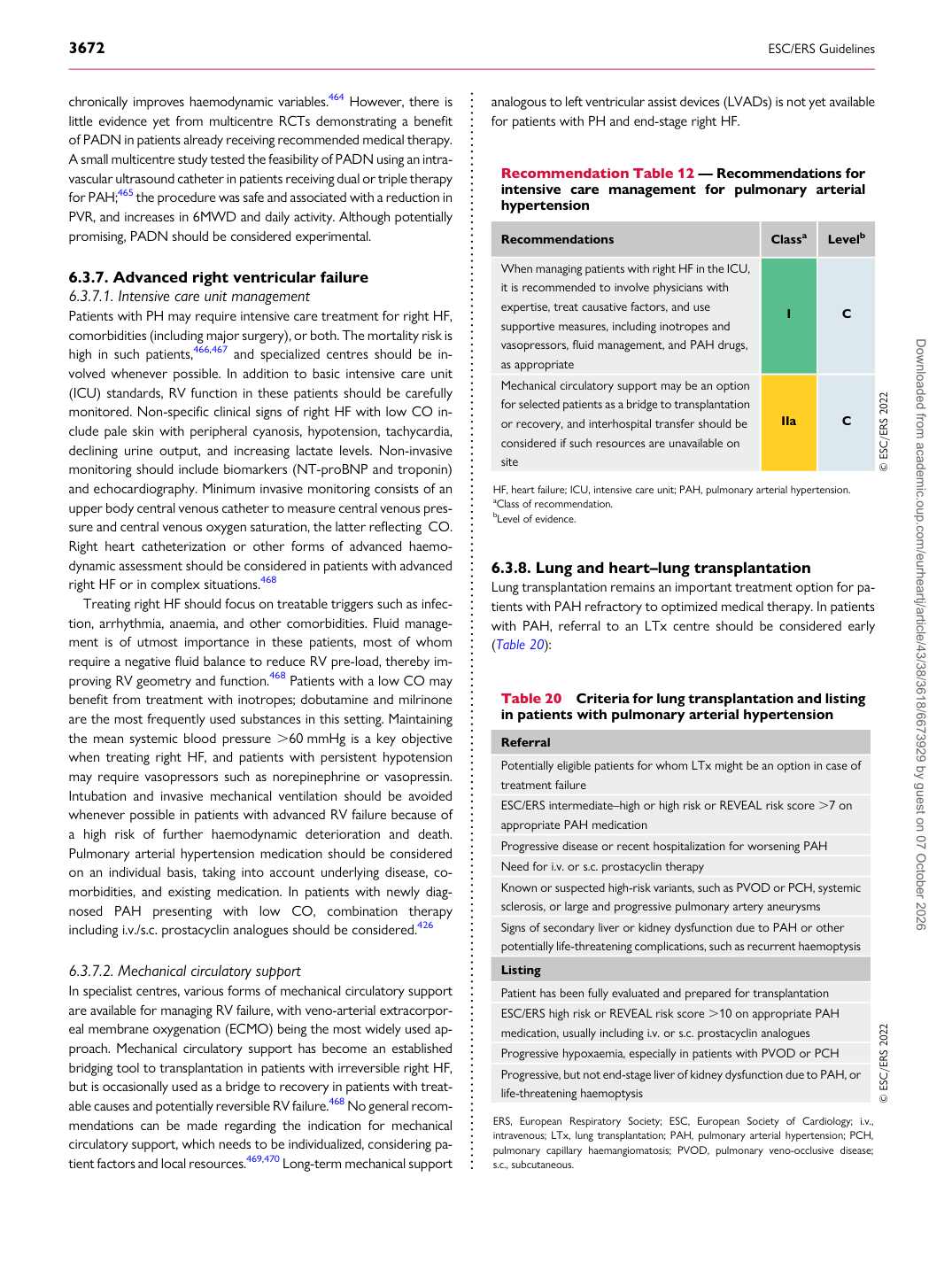
p.55 抽出テキスト
chronically improves haemodynamic variables.464 However, there is little evidence yet from multicentre RCTs demonstrating a benefit of PADN in patients already receiving recommended medical therapy. A small multicentre study tested the feasibility of PADN using an intravascular ultrasound catheter in patients receiving dual or triple therapy for PAH;465 the procedure was safe and associated with a reduction in PVR, and increases in 6MWD and daily activity. Although potentially promising, PADN should be considered experimental.

6.3.7 Advanced right ventricular failure

6.3.7.1. Intensive care unit management Patients with PH may require intensive care treatment for right HF, comorbidities (including major surgery), or both. The mortality risk is high in such patients,466,467 and specialized centres should be involved whenever possible. In addition to basic intensive care unit (ICU) standards, RV function in these patients should be carefully monitored. Non-specific clinical signs of right HF with low CO include pale skin with peripheral cyanosis, hypotension, tachycardia, declining urine output, and increasing lactate levels. Non-invasive monitoring should include biomarkers (NT-proBNP and troponin) and echocardiography. Minimum invasive monitoring consists of an upper body central venous catheter to measure central venous pressure and central venous oxygen saturation, the latter reflecting CO. Right heart catheterization or other forms of advanced haemodynamic assessment should be considered in patients with advanced right HF or in complex situations.468 Treating right HF should focus on treatable triggers such as infection, arrhythmia, anaemia, and other comorbidities. Fluid management is of utmost importance in these patients, most of whom require a negative fluid balance to reduce RV pre-load, thereby improving RV geometry and function.468 Patients with a low CO may benefit from treatment with inotropes; dobutamine and milrinone are the most frequently used substances in this setting. Maintaining the mean systemic blood pressure .60 mmHg is a key objective when treating right HF, and patients with persistent hypotension may require vasopressors such as norepinephrine or vasopressin. Intubation and invasive mechanical ventilation should be avoided whenever possible in patients with advanced RV failure because of a high risk of further haemodynamic deterioration and death. Pulmonary arterial hypertension medication should be considered on an individual basis, taking into account underlying disease, comorbidities, and existing medication. In patients with newly diagnosed PAH presenting with low CO, combination therapy including i.v./s.c. prostacyclin analogues should be considered.426

6.3.7.2 Mechanical circulatory support

In specialist centres, various forms of mechanical circulatory support are available for managing RV failure, with veno-arterial extracorporeal membrane oxygenation (ECMO) being the most widely used approach. Mechanical circulatory support has become an established bridging tool to transplantation in patients with irreversible right HF, but is occasionally used as a bridge to recovery in patients with treatable causes and potentially reversible RV failure.468 No general recommendations can be made regarding the indication for mechanical circulatory support, which needs to be individualized, considering patient factors and local resources.469,470 Long-term mechanical support analogous to left ventricular assist devices (LVADs) is not yet available for patients with PH and end-stage right HF.

6.3.8 Lung and heart–lung transplantation

Lung transplantation remains an important treatment option for patients with PAH refractory to optimized medical therapy. In patients with PAH, referral to an LTx centre should be considered early (Table 20):

Recommendation Table 12 — Recommendations for intensive care management for pulmonary arterial hypertension

Recommendations Classa Levelb

When managing patients with right HF in the ICU, it is recommended to involve physicians with expertise, treat causative factors, and use supportive measures, including inotropes and vasopressors, fluid management, and PAH drugs, as appropriate I C Mechanical circulatory support may be an option for selected patients as a bridge to transplantation or recovery, and interhospital transfer should be considered if such resources are unavailable on site IIa C © ESC/ERS 2022 HF, heart failure; ICU, intensive care unit; PAH, pulmonary arterial hypertension. aClass of recommendation. bLevel of evidence.

Table 20 Criteria for lung transplantation and listing in patients with pulmonary arterial hypertension Referral Potentially eligible patients for whom LTx might be an option in case of treatment failure ESC/ERS intermediate–high or high risk or REVEAL risk score .7 on appropriate PAH medication Progressive disease or recent hospitalization for worsening PAH Need for i.v. or s.c. prostacyclin therapy Known or suspected high-risk variants, such as PVOD or PCH, systemic sclerosis, or large and progressive pulmonary artery aneurysms Signs of secondary liver or kidney dysfunction due to PAH or other potentially life-threatening complications, such as recurrent haemoptysis Listing Patient has been fully evaluated and prepared for transplantation ESC/ERS high risk or REVEAL risk score .10 on appropriate PAH medication, usually including i.v. or s.c. prostacyclin analogues Progressive hypoxaemia, especially in patients with PVOD or PCH Progressive, but not end-stage liver of kidney dysfunction due to PAH, or life-threatening haemoptysis © ESC/ERS 2022 ERS, European Respiratory Society; ESC, European Society of Cardiology; i.v., intravenous; LTx, lung transplantation; PAH, pulmonary arterial hypertension; PCH, pulmonary capillary haemangiomatosis; PVOD, pulmonary veno-occlusive disease; s.c., subcutaneous. Downloaded from academic.oup.com/eurheartj/article/43/38/3618/6673929 by guest on 07 October 2026