p.54 抽出テキスト
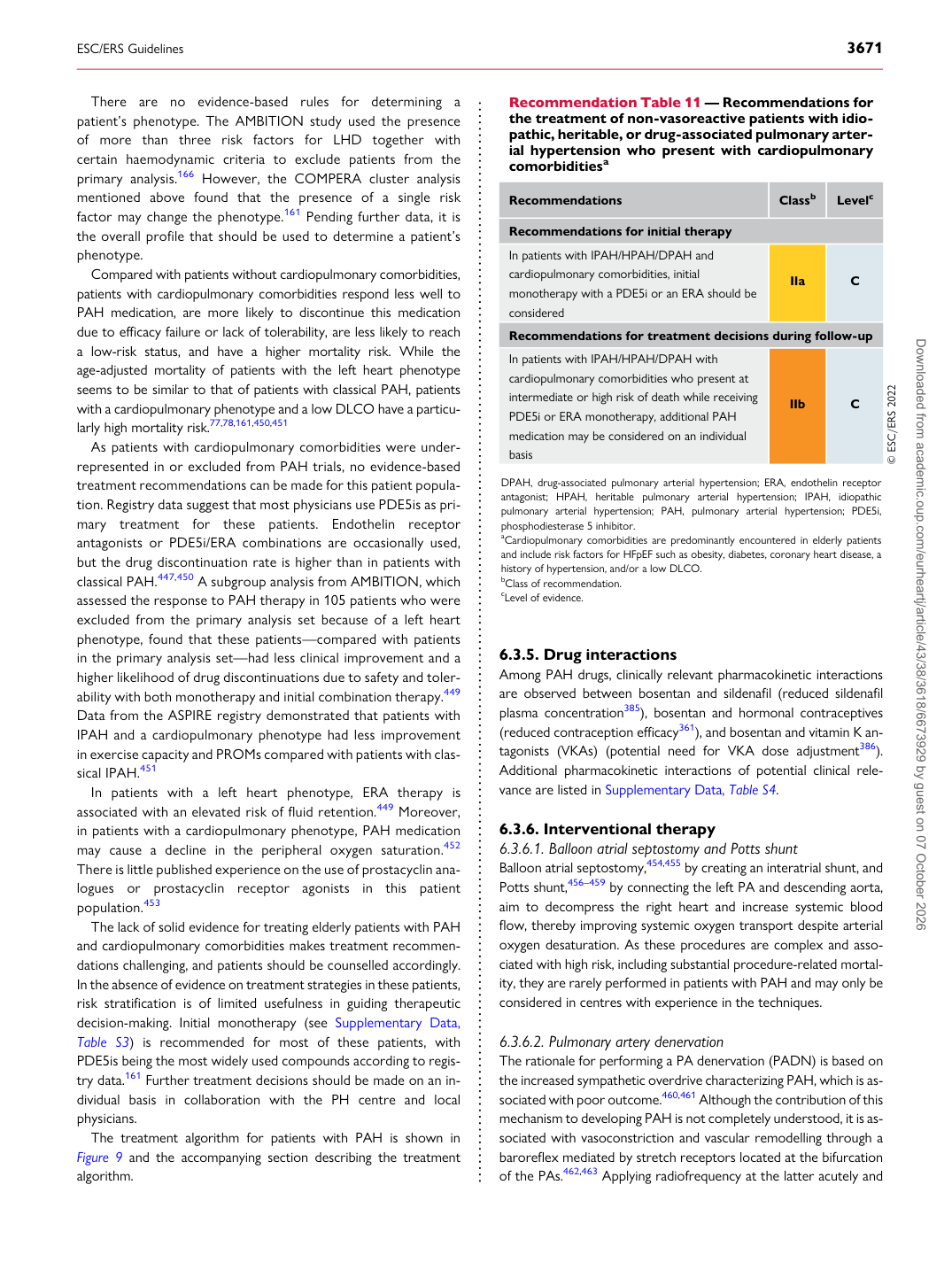
There are no evidence-based rules for determining a patient’s phenotype. The AMBITION study used the presence of more than three risk factors for LHD together with certain haemodynamic criteria to exclude patients from the primary analysis.166 However, the COMPERA cluster analysis mentioned above found that the presence of a single risk factor may change the phenotype.161 Pending further data, it is the overall profile that should be used to determine a patient’s phenotype. Compared with patients without cardiopulmonary comorbidities, patients with cardiopulmonary comorbidities respond less well to PAH medication, are more likely to discontinue this medication due to efficacy failure or lack of tolerability, are less likely to reach a low-risk status, and have a higher mortality risk. While the age-adjusted mortality of patients with the left heart phenotype seems to be similar to that of patients with classical PAH, patients with a cardiopulmonary phenotype and a low DLCO have a particularly high mortality risk.77,78,161,450,451 As patients with cardiopulmonary comorbidities were underrepresented in or excluded from PAH trials, no evidence-based treatment recommendations can be made for this patient population. Registry data suggest that most physicians use PDE5is as primary treatment for these patients. Endothelin receptor antagonists or PDE5i/ERA combinations are occasionally used, but the drug discontinuation rate is higher than in patients with classical PAH.447,450 A subgroup analysis from AMBITION, which assessed the response to PAH therapy in 105 patients who were excluded from the primary analysis set because of a left heart phenotype, found that these patients—compared with patients in the primary analysis set—had less clinical improvement and a higher likelihood of drug discontinuations due to safety and tolerability with both monotherapy and initial combination therapy.449 Data from the ASPIRE registry demonstrated that patients with IPAH and a cardiopulmonary phenotype had less improvement in exercise capacity and PROMs compared with patients with classical IPAH.451 In patients with a left heart phenotype, ERA therapy is associated with an elevated risk of fluid retention.449 Moreover, in patients with a cardiopulmonary phenotype, PAH medication may cause a decline in the peripheral oxygen saturation.452 There is little published experience on the use of prostacyclin analogues or prostacyclin receptor agonists in this patient population.453 The lack of solid evidence for treating elderly patients with PAH and cardiopulmonary comorbidities makes treatment recommendations challenging, and patients should be counselled accordingly. In the absence of evidence on treatment strategies in these patients, risk stratification is of limited usefulness in guiding therapeutic decision-making. Initial monotherapy (see Supplementary Data, Table S3) is recommended for most of these patients, with PDE5is being the most widely used compounds according to registry data.161 Further treatment decisions should be made on an individual basis in collaboration with the PH centre and local physicians. The treatment algorithm for patients with PAH is shown in Figure 9 and the accompanying section describing the treatment algorithm. 6.3.5 Drug interactions

Among PAH drugs, clinically relevant pharmacokinetic interactions are observed between bosentan and sildenafil (reduced sildenafil plasma concentration385), bosentan and hormonal contraceptives (reduced contraception efficacy361), and bosentan and vitamin K antagonists (VKAs) (potential need for VKA dose adjustment386). Additional pharmacokinetic interactions of potential clinical relevance are listed in Supplementary Data, Table S4.

6.3.6 Interventional therapy

6.3.6.1. Balloon atrial septostomy and Potts shunt Balloon atrial septostomy,454,455 by creating an interatrial shunt, and Potts shunt,456–459 by connecting the left PA and descending aorta, aim to decompress the right heart and increase systemic blood flow, thereby improving systemic oxygen transport despite arterial oxygen desaturation. As these procedures are complex and associated with high risk, including substantial procedure-related mortality, they are rarely performed in patients with PAH and may only be considered in centres with experience in the techniques.

6.3.6.2 Pulmonary artery denervation

The rationale for performing a PA denervation (PADN) is based on the increased sympathetic overdrive characterizing PAH, which is associated with poor outcome.460,461 Although the contribution of this mechanism to developing PAH is not completely understood, it is associated with vasoconstriction and vascular remodelling through a baroreflex mediated by stretch receptors located at the bifurcation of the PAs.462,463 Applying radiofrequency at the latter acutely and

Recommendation Table 11 — Recommendations for the treatment of non-vasoreactive patients with idiopathic, heritable, or drug-associated pulmonary arterial hypertension who present with cardiopulmonary comorbiditiesa

Recommendations Classb Levelc

Recommendations for initial therapy In patients with IPAH/HPAH/DPAH and cardiopulmonary comorbidities, initial monotherapy with a PDE5i or an ERA should be considered IIa C Recommendations for treatment decisions during follow-up In patients with IPAH/HPAH/DPAH with cardiopulmonary comorbidities who present at intermediate or high risk of death while receiving PDE5i or ERA monotherapy, additional PAH medication may be considered on an individual basis IIb C © ESC/ERS 2022 DPAH, drug-associated pulmonary arterial hypertension; ERA, endothelin receptor antagonist; HPAH, heritable pulmonary arterial hypertension; IPAH, idiopathic pulmonary arterial hypertension; PAH, pulmonary arterial hypertension; PDE5i, phosphodiesterase 5 inhibitor. aCardiopulmonary comorbidities are predominantly encountered in elderly patients and include risk factors for HFpEF such as obesity, diabetes, coronary heart disease, a history of hypertension, and/or a low DLCO. bClass of recommendation. cLevel of evidence. Downloaded from academic.oup.com/eurheartj/article/43/38/3618/6673929 by guest on 07 October 2026