p.53 抽出テキスト
(i) In patients who achieve a low-risk status with their initial PAH therapy, continuation of treatment is recommended. (ii) In patients who are at intermediate–low risk despite receiving ERA/PDE5i therapy, adding selexipag should be considered to reduce the risk of clinical worsening. In these patients, switching from PDE5i to riociguat may also be considered. (iii) In patients who are at intermediate–high or high risk while re-

ceiving oral therapies, the addition of i.v. epoprostenol or i.v./ s.c. treprostinil and referral for LTx evaluation should be considered.309,436 If adding i.v./s.c. prostacyclin analogues is unfeasible, adding selexipag or switching from PDE5i to riociguat may be considered.

6.3.4.3 Pulmonary arterial hypertension with cardiopulmonary

comorbidities Over the past decade, the demographics and characteristics of patients with IPAH have changed, especially in industrialized countries.447 In several contemporary registries, the average age of patients diagnosed with IPAH is ≏60 years or older.161,295,299,447,448 Many elderly patients have cardiopulmonary comorbidities, making the distinction from group 2 and group 3 PH challenging. Among elderly patients diagnosed with IPAH, two main disease phenotypes have emerged. One phenotype (herein called the left heart phenotype) consists of elderly, mostly female patients with risk factors for HFpEF (e.g. hypertension, obesity, diabetes, or coronary heart disease) but pre-capillary PH rather than postcapillary PH;449,450 ≏30% of these patients have a history of atrial fibrillation.161 The other phenotype (called the cardiopulmonary phenotype) consists of elderly, predominantly male patients who have a low DLCO (,45% of the predicted value), are often hypoxaemic, have a significant smoking history, and have risk factors for LHD.77,78,161,451 In a cluster analysis of 841 newly diagnosed patients with IPAH from the COMPERA registry, 12.6% had a classic phenotype of young, mostly female patients without cardiopulmonary comorbidities, while 35.8% presented with a left heart phenotype and 51.6% with a cardiopulmonary phenotype.161

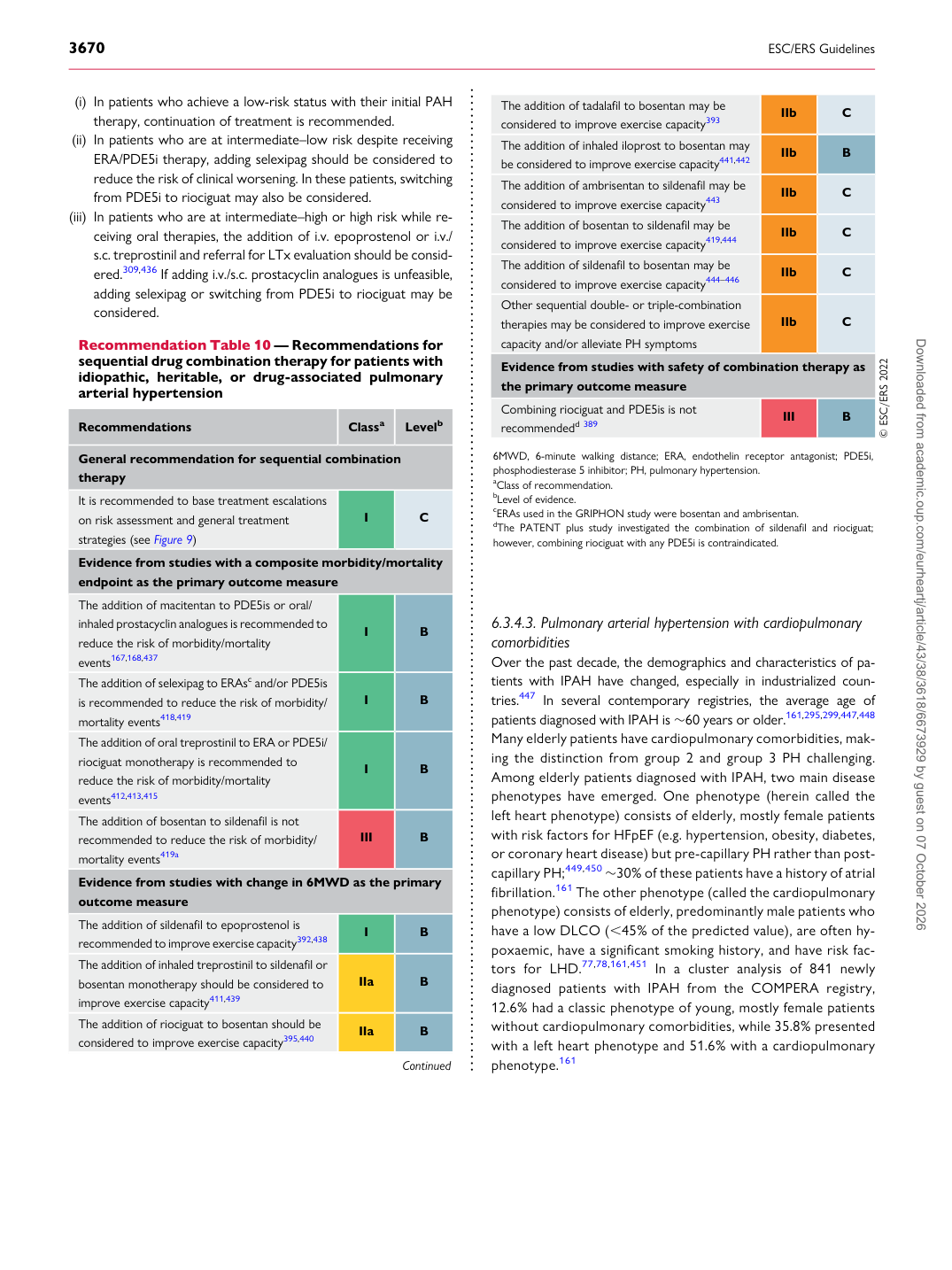
Recommendation Table 10 — Recommendations for sequential drug combination therapy for patients with idiopathic, heritable, or drug-associated pulmonary arterial hypertension

Recommendations Classa Levelb

General recommendation for sequential combination therapy It is recommended to base treatment escalations on risk assessment and general treatment strategies (see Figure 9) I C Evidence from studies with a composite morbidity/mortality endpoint as the primary outcome measure The addition of macitentan to PDE5is or oral/ inhaled prostacyclin analogues is recommended to reduce the risk of morbidity/mortality events167,168,437 I B The addition of selexipag to ERAsc and/or PDE5is is recommended to reduce the risk of morbidity/ mortality events418,419 I B The addition of oral treprostinil to ERA or PDE5i/ riociguat monotherapy is recommended to reduce the risk of morbidity/mortality events412,413,415 I B The addition of bosentan to sildenafil is not recommended to reduce the risk of morbidity/ mortality events419a III B Evidence from studies with change in 6MWD as the primary outcome measure The addition of sildenafil to epoprostenol is recommended to improve exercise capacity392,438 I B The addition of inhaled treprostinil to sildenafil or bosentan monotherapy should be considered to improve exercise capacity411,439 IIa B The addition of riociguat to bosentan should be considered to improve exercise capacity395,440 IIa B

Continued The addition of tadalafil to bosentan may be

considered to improve exercise capacity393 IIb C The addition of inhaled iloprost to bosentan may be considered to improve exercise capacity441,442 IIb B The addition of ambrisentan to sildenafil may be considered to improve exercise capacity443 IIb C The addition of bosentan to sildenafil may be considered to improve exercise capacity419,444 IIb C The addition of sildenafil to bosentan may be considered to improve exercise capacity444–446 IIb C Other sequential double- or triple-combination therapies may be considered to improve exercise capacity and/or alleviate PH symptoms IIb C Evidence from studies with safety of combination therapy as the primary outcome measure Combining riociguat and PDE5is is not recommendedd 389 III B © ESC/ERS 2022 6MWD, 6-minute walking distance; ERA, endothelin receptor antagonist; PDE5i, phosphodiesterase 5 inhibitor; PH, pulmonary hypertension. aClass of recommendation. bLevel of evidence. cERAs used in the GRIPHON study were bosentan and ambrisentan. dThe PATENT plus study investigated the combination of sildenafil and riociguat; however, combining riociguat with any PDE5i is contraindicated. Downloaded from academic.oup.com/eurheartj/article/43/38/3618/6673929 by guest on 07 October 2026