p.52 抽出テキスト
6.3.4.2 Treatment decisions during follow-up in patients without

cardiopulmonary comorbidities Patients with PAH require regular follow-up, including risk stratification and an assessment of patient concordance with therapy. Patients who achieve a low-risk status have a much superior long-term survival compared with patients with intermediateor high-risk status.292,295,296 Achieving and maintaining a lowrisk profile is therefore a key objective in managing patients with PAH.

Several clinical trials have assessed the safety and efficacy of sequential combination therapy in patients with PAH. SERAPHIN enrolled 742 patients with PAH, mostly with IPAH/HPAH/DPAH and PAH-CTD, of whom 63.7% were receiving other PAH medication at the time of enrolment, mostly sildenafil.167 In the subgroup of patients with background PAH therapy, macitentan at a daily dose of 10 mg reduced the risk of clinical worsening events compared with placebo (HR 0.62; 95% CI, 0.43–0.89).167 GRIPHON assessed the safety and efficacy of selexipag.419 This study enrolled 1156 patients with PAH, also mostly with IPAH/ HPAH/DPAH or PAH-CTD, who were treatment naïve or receiving background therapy with an ERA, PDE5i, or a combination of both. Selexipag at a dose of up to 1600 μg b.i.d. was associated with a reduced risk of clinical worsening events independent of the background medication. In patients receiving ERA/PDE5i combination therapy (n = 376), the risk of clinical worsening events was lower with selexipag than with placebo (HR 0.63; 95% CI, 0.44– 0.90).431 The effects of combination therapy on long-term survival in patients with PAH remain unclear. A 2016 meta-analysis demonstrated that combination therapy (initial and sequential) was associated with a significant risk reduction for clinical worsening (relative risk [RR] 0.65; 95% CI, 0.58–0.72; P , 0.0001);432 however, all-cause mortality was not improved (RR 0.86; 95% CI, 0.72–1.03; P = 0.09) and a substantial proportion of patients had clinical worsening events or died despite receiving combination therapy. In addition, registry data showed that the use of combination therapy increased since 2015 but there was no clear improvement in overall survival rates.428,433,434 These data were corroborated by a study showing that less than half of patients receiving initial combination therapy with an ERA and a PDE5i achieved and maintained a low-risk profile.422 Switching from PDE5is to riociguat has also been investigated as a treatment-escalation strategy.429,435 REPLACE was a randomized, controlled, open-label study that enrolled patients on a PDE5i-based therapy who were in WHO-FC III and had a 6MWD of 165–440 m.429 The study predominantly included patients with IPAH/HPAH/DPAH or PAH-CTD who were randomized to continue their PDE5i or to switch from a PDE5i to riociguat up to 2.5 mg t.i.d. The study met its primary endpoint, termed ‘clinical improvement’, which was a composite of prespecified improvements in 6MWD, WHO-FC, and NT-proBNP at week 24. Clinical improvement at week 24 was demonstrated in 41% of the patients who switched to riociguat and in 20% of the patients who maintained their PDE5i (odds ratio [OR] 2.78; 95% CI, 1.53–5.06; P = 0.0007). In addition, fewer patients in the riociguat group experienced a clinical worsening event (OR 0.10; 95% CI, 0.01–0.73; P = 0.0047). Based on the evidence summarized above, the following recommendations for treatment decisions during follow-up are:

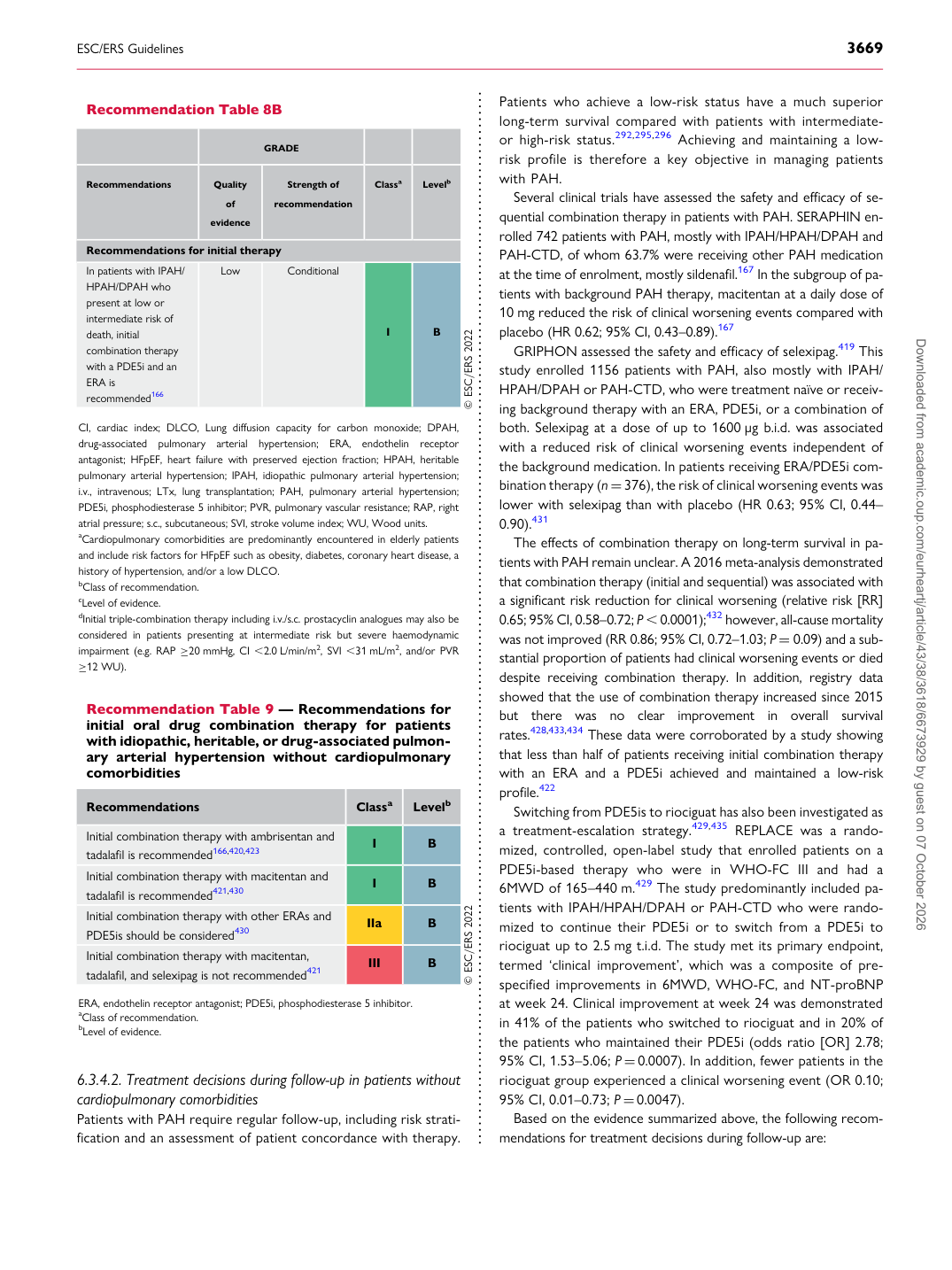
Recommendation Table 8B

GRADE

Recommendations Quality

of evidence Strength of

recommendation Classa Levelb

Recommendations for initial therapy In patients with IPAH/ HPAH/DPAH who present at low or intermediate risk of death, initial combination therapy with a PDE5i and an ERA is recommended166 Low Conditional I B © ESC/ERS 2022

CI, cardiac index; DLCO, Lung diffusion capacity for carbon monoxide; DPAH, drug-associated pulmonary arterial hypertension; ERA, endothelin receptor antagonist; HFpEF, heart failure with preserved ejection fraction; HPAH, heritable pulmonary arterial hypertension; IPAH, idiopathic pulmonary arterial hypertension; i.v., intravenous; LTx, lung transplantation; PAH, pulmonary arterial hypertension; PDE5i, phosphodiesterase 5 inhibitor; PVR, pulmonary vascular resistance; RAP, right atrial pressure; s.c., subcutaneous; SVI, stroke volume index; WU, Wood units. aCardiopulmonary comorbidities are predominantly encountered in elderly patients and include risk factors for HFpEF such as obesity, diabetes, coronary heart disease, a history of hypertension, and/or a low DLCO. bClass of recommendation. cLevel of evidence. dInitial triple-combination therapy including i.v./s.c. prostacyclin analogues may also be considered in patients presenting at intermediate risk but severe haemodynamic impairment (e.g. RAP ≥20 mmHg, CI ,2.0 L/min/m2, SVI ,31 mL/m2, and/or PVR ≥12 WU).

Recommendation Table 9 — Recommendations for initial oral drug combination therapy for patients with idiopathic, heritable, or drug-associated pulmonary arterial hypertension without cardiopulmonary comorbidities

Recommendations Classa Levelb

Initial combination therapy with ambrisentan and tadalafil is recommended166,420,423 I B Initial combination therapy with macitentan and tadalafil is recommended421,430 I B Initial combination therapy with other ERAs and PDE5is should be considered430 IIa B Initial combination therapy with macitentan, tadalafil, and selexipag is not recommended421 III B © ESC/ERS 2022 ERA, endothelin receptor antagonist; PDE5i, phosphodiesterase 5 inhibitor. aClass of recommendation. bLevel of evidence. Downloaded from academic.oup.com/eurheartj/article/43/38/3618/6673929 by guest on 07 October 2026