p.51 抽出テキスト
In addition to targeted drug treatment, the comprehensive management of patients with PAH includes general measures that may include supplementary oxygen, diuretics to optimize volume status, psychosocial support, and standardized exercise training (Section 6.3.1).315 Prior to the treatment decisions, patients and their next of kin should be provided with appropriate and timely information about the risks and benefits of the treatment options so they can make the final, informed, and joint decision about the treatment with the medical team. Treatment decisions in patients with IPAH/ HPAH/DPAH or PAH-CTD should be stratified according to the presence or absence of cardiopulmonary comorbidities (Section 6.3.4.3) and according to disease severity assessed by risk stratification (Section 6.2.7).

6.3.4.1 Initial treatment decision in patients without

cardiopulmonary comorbidities The initial treatment of patients with PAH should be based on a comprehensive, multiparameter risk assessment, considering disease type and severity, comorbidities, access to therapies, economic aspects, and patient preference. The following considerations predominantly apply to patients with IPAH/HPAH/DPAH or PAH-CTD without cardiopulmonary comorbidities, as patients with comorbidities were under-represented in the clinical studies addressing treatment strategies and combination therapy in patients with PAH. Treatment considerations for patients with PAH and cardiopulmonary comorbidities are summarized in Section 6.3.4.3. For patients presenting at low or intermediate risk, initial combination therapy with an ERA and a PDE5i is recommended. This approach was assessed in the AMBITION study, which compared initial combination therapy using ambrisentan at a target dose of 10 mg o.d. and tadalafil at a target dose of 40 mg o.d. with initial monotherapy with either drug.166 AMBITION predominantly included patients with IPAH/HPAH/DPAH or PAH-CTD. The primary endpoint was the time to first clinical failure event (a composite of death, hospitalization for worsening PAH, disease progression, or unsatisfactory long-term clinical response). The hazard ratio (HR) for the primary endpoint in the combination-therapy group vs. the pooled monotherapy group was 0.50 (95% confidence interval [CI], 0.35–0.72; P , 0.001) and there were significant improvements in 6MWD and NT-proBNP with initial combination therapy. At the end of the study, 10% of the patients assigned to initial combination therapy had died compared with 14% of the patients assigned to initial monotherapy (HR 0.67; 95% CI, 0.42–1.08).420 In the TRITON study, treatment-naïve patients with PAH were assigned to initial dual-combination therapy with macitentan and tadalafil, or initial triple-combination therapy with macitentan 10 mg o.d., tadalafil at a target dose of 40 mg o.d., and selexipag up to 1600 μg o.d.421 TRITON predominantly included patients with IPAH/HPAH/DPAH or PAH-CTD. At week 26, PVR was reduced by 52% and 54%, with double- or triple-combination therapy, respectively, and 6MWD had increased by 55 m and 56 m, respectively. The geometric means of the NT-proBNP ratio from baseline to week 26 were 0.25 and 0.26, respectively. Hence, TRITON did not show a benefit of oral triple- vs. oral double-combination therapy but confirmed that substantial improvements in haemodynamics and exercise capacity can be obtained with initial ERA/PDE5i combination therapy. Further studies are needed to determine whether oral triple-combination therapy impacts long-term outcomes.

Based on the evidence generated by these and other studies,303,422–424 initial dual-combination therapy with an ERA and a PDE5i is recommended for newly diagnosed patients who present at low or intermediate risk. Initial oral triple-combination therapy is not recommended, given the current lack of evidence supporting this strategy. In patients presenting at high risk, initial triplecombination therapy including an i.v./s.c. prostacyclin analogue should be considered.426,427 While it is acknowledged that the evidence for this approach is limited to case series, there is consensus that this strategy has the highest likelihood of success, especially in view of registry data from France showing that initial triplecombination therapy including an i.v./s.c. prostacyclin analogue was associated with better long-term survival than monotherapy or dualcombination therapy.428 Initial triple-combination therapy including an i.v./s.c. prostacyclin analogue should also be considered in patients at intermediate risk presenting with severe haemodynamic impairment (e.g. RAP ≥20 mmHg, CI ,2.0 L/min/m2, SVI ,31 mL/m2, and/or PVR ≥12 WU).238,426 The recommendations for initial oral double-combination therapy are based on PICO question I (Supplementary Data, Section 6.2). Although the quality of evidence is low, initial oral combination therapy with an ERA and a PDE5i achieves important targets in symptom improvement (functional class), exercise capacity, cardiac biomarkers, and reduction of hospitalizations.

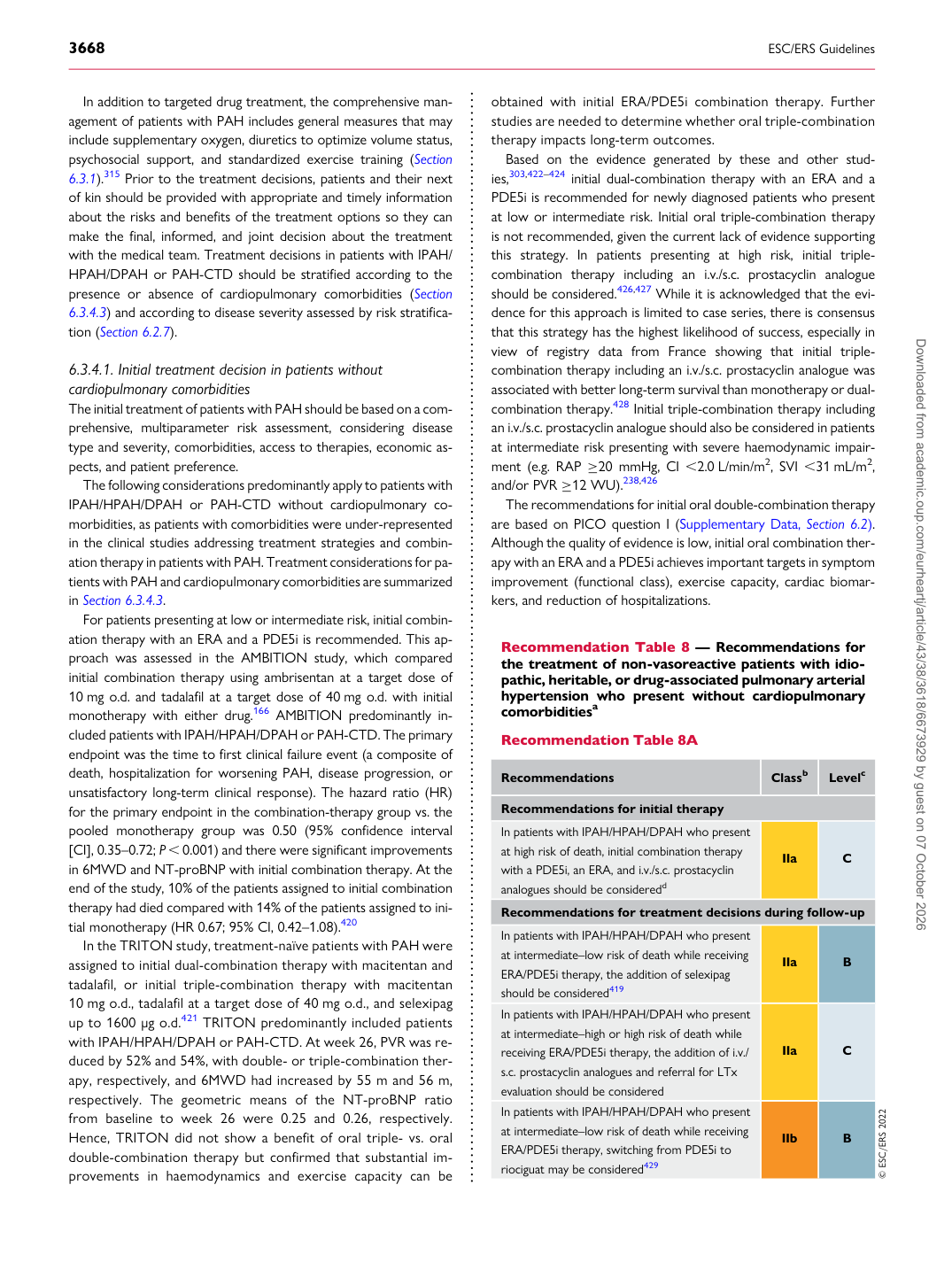
Recommendation Table 8 — Recommendations for the treatment of non-vasoreactive patients with idiopathic, heritable, or drug-associated pulmonary arterial hypertension who present without cardiopulmonary comorbiditiesa Recommendation Table 8A

Recommendations Classb Levelc

Recommendations for initial therapy In patients with IPAH/HPAH/DPAH who present at high risk of death, initial combination therapy with a PDE5i, an ERA, and i.v./s.c. prostacyclin analogues should be consideredd IIa C Recommendations for treatment decisions during follow-up In patients with IPAH/HPAH/DPAH who present at intermediate–low risk of death while receiving ERA/PDE5i therapy, the addition of selexipag should be considered419 IIa B In patients with IPAH/HPAH/DPAH who present at intermediate–high or high risk of death while receiving ERA/PDE5i therapy, the addition of i.v./ s.c. prostacyclin analogues and referral for LTx evaluation should be considered IIa C In patients with IPAH/HPAH/DPAH who present at intermediate–low risk of death while receiving ERA/PDE5i therapy, switching from PDE5i to riociguat may be considered429 IIb B © ESC/ERS 2022 Downloaded from academic.oup.com/eurheartj/article/43/38/3618/6673929 by guest on 07 October 2026