p.47 抽出テキスト
attempts. Patients who have not undergone a vasoreactivity study or those with a negative test should not be started on CCBs because of potentially severe side effects (e.g. severe hypotension, syncope, and RV failure), unless prescribed at standard doses for other indications.379

6.3.3.2 Endothelin receptor antagonists

Binding of endothelin-1 to endothelin receptors A and B on PA smooth-muscle cells promotes vasoconstriction and proliferation (Figure 7).380 Endothelin B receptors are mostly expressed on

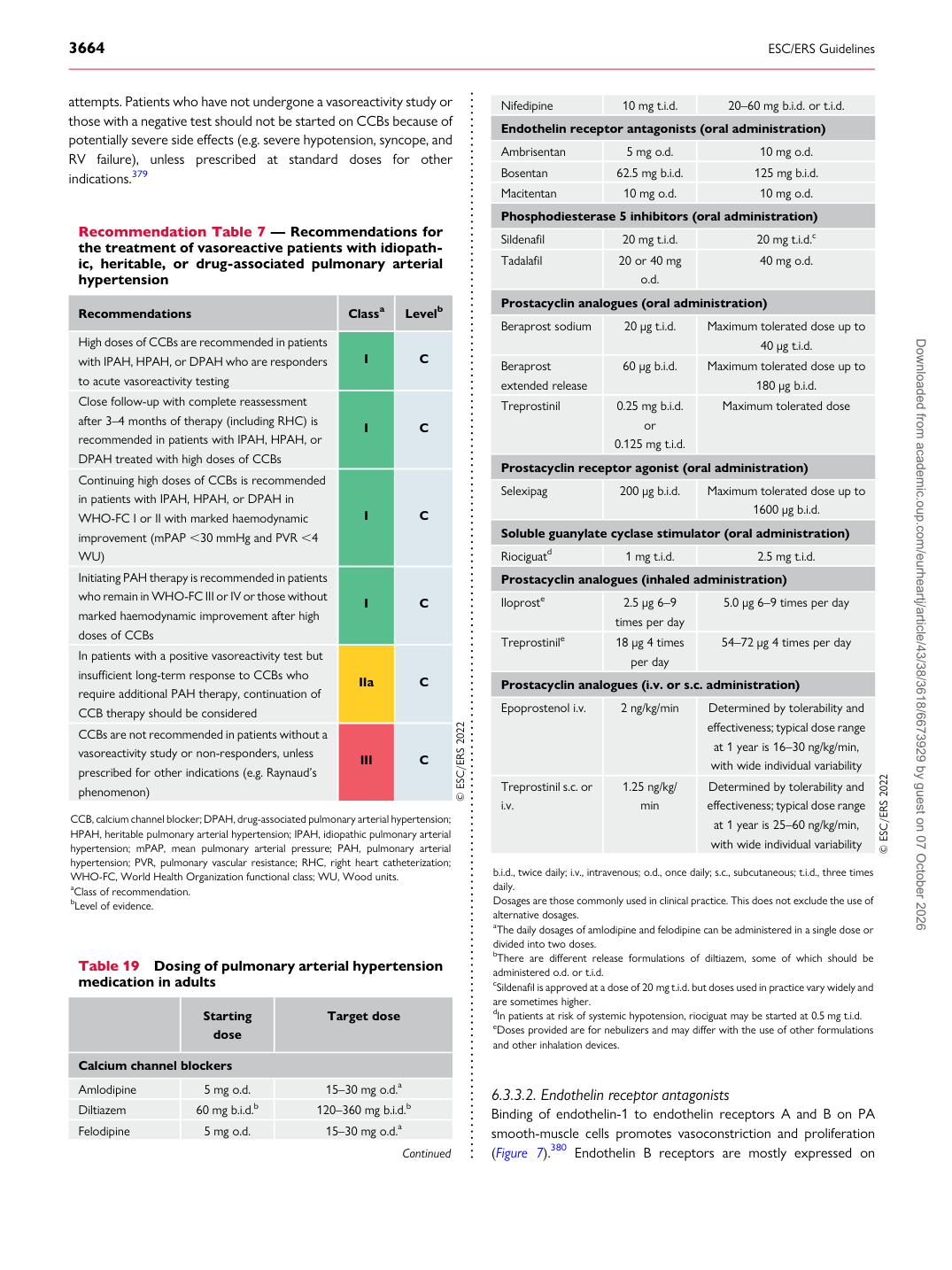
Recommendation Table 7 — Recommendations for the treatment of vasoreactive patients with idiopathic, heritable, or drug-associated pulmonary arterial hypertension

Recommendations Classa Levelb

High doses of CCBs are recommended in patients with IPAH, HPAH, or DPAH who are responders to acute vasoreactivity testing I C Close follow-up with complete reassessment after 3–4 months of therapy (including RHC) is recommended in patients with IPAH, HPAH, or DPAH treated with high doses of CCBs I C Continuing high doses of CCBs is recommended in patients with IPAH, HPAH, or DPAH in WHO-FC I or II with marked haemodynamic improvement (mPAP ,30 mmHg and PVR ,4 WU) I C Initiating PAH therapy is recommended in patients who remain in WHO-FC III or IV or those without marked haemodynamic improvement after high doses of CCBs I C In patients with a positive vasoreactivity test but insufficient long-term response to CCBs who require additional PAH therapy, continuation of CCB therapy should be considered IIa C CCBs are not recommended in patients without a vasoreactivity study or non-responders, unless prescribed for other indications (e.g. Raynaud’s phenomenon) III C © ESC/ERS 2022 CCB, calcium channel blocker; DPAH, drug-associated pulmonary arterial hypertension; HPAH, heritable pulmonary arterial hypertension; IPAH, idiopathic pulmonary arterial hypertension; mPAP, mean pulmonary arterial pressure; PAH, pulmonary arterial hypertension; PVR, pulmonary vascular resistance; RHC, right heart catheterization; WHO-FC, World Health Organization functional class; WU, Wood units. aClass of recommendation. bLevel of evidence.

Table 19 Dosing of pulmonary arterial hypertension medication in adults

Starting

dose Target dose

Calcium channel blockers Amlodipine 5 mg o.d. 15–30 mg o.d.a Diltiazem 60 mg b.i.d.b 120–360 mg b.i.d.b Felodipine 5 mg o.d. 15–30 mg o.d.a

Continued Nifedipine 10 mg t.i.d. 20–60 mg b.i.d. or t.i.d.

Endothelin receptor antagonists (oral administration) Ambrisentan 5 mg o.d. 10 mg o.d. Bosentan 62.5 mg b.i.d. 125 mg b.i.d. Macitentan 10 mg o.d. 10 mg o.d. Phosphodiesterase 5 inhibitors (oral administration) Sildenafil 20 mg t.i.d. 20 mg t.i.d.c Tadalafil 20 or 40 mg

o.d. 40 mg o.d.

Prostacyclin analogues (oral administration) Beraprost sodium 20 μg t.i.d. Maximum tolerated dose up to

40 μg t.i.d.

Beraprost extended release 60 μg b.i.d. Maximum tolerated dose up to

180 μg b.i.d.

Treprostinil 0.25 mg b.i.d.

or 0.125 mg t.i.d. Maximum tolerated dose

Prostacyclin receptor agonist (oral administration) Selexipag 200 μg b.i.d. Maximum tolerated dose up to

1600 μg b.i.d.

Soluble guanylate cyclase stimulator (oral administration) Riociguatd 1 mg t.i.d. 2.5 mg t.i.d. Prostacyclin analogues (inhaled administration) Iloproste 2.5 μg 6–9

times per day 5.0 μg 6–9 times per day

Treprostinile 18 μg 4 times

per day 54–72 μg 4 times per day

Prostacyclin analogues (i.v. or s.c. administration) Epoprostenol i.v. 2 ng/kg/min Determined by tolerability and

effectiveness; typical dose range at 1 year is 16–30 ng/kg/min, with wide individual variability

Treprostinil s.c. or i.v. 1.25 ng/kg/

min Determined by tolerability and

effectiveness; typical dose range at 1 year is 25–60 ng/kg/min, with wide individual variability © ESC/ERS 2022

b.i.d., twice daily; i.v., intravenous; o.d., once daily; s.c., subcutaneous; t.i.d., three times daily. Dosages are those commonly used in clinical practice. This does not exclude the use of alternative dosages. aThe daily dosages of amlodipine and felodipine can be administered in a single dose or divided into two doses. bThere are different release formulations of diltiazem, some of which should be administered o.d. or t.i.d. cSildenafil is approved at a dose of 20 mg t.i.d. but doses used in practice vary widely and are sometimes higher. dIn patients at risk of systemic hypotension, riociguat may be started at 0.5 mg t.i.d. eDoses provided are for nebulizers and may differ with the use of other formulations and other inhalation devices. Downloaded from academic.oup.com/eurheartj/article/43/38/3618/6673929 by guest on 07 October 2026