p.46 抽出テキスト
6.3.3 Pulmonary arterial hypertension therapies

6.3.3.1. Calcium channel blockers Patients with PAH who respond favourably to acute vasoreactivity testing (Figure 8) may respond favourably to treatment with CCBs.129,146 Less than 10% of patients with IPAH, HPAH, or DPAH are responders, while an acute vasodilator response does not predict a favourable long-term response to CCBs in patients with other forms of PAH.129,146,378 The CCBs that have predominantly been used in PAH are nifedipine, diltiazem, and amlodipine.129,146 Amlodipine and felodipine are increasingly being used in clinical practice due to their long half-life and good tolerability. The daily doses that have shown efficacy in PAH are relatively high and they must be reached progressively (Table 19). The most common adverse events are systemic hypotension and peripheral oedema. Patients who meet the criteria for a positive acute vasodilator response and treated with CCBs should be closely followed for safety and efficacy, with a complete reassessment after 3–6 months of therapy, including RHC. Additional acute vasoreactivity testing should be performed at re-evaluation to detect persistent vasodilator response, supporting possible increases in CCB dosage. Patients with a satisfactory chronic response present with WHO-FC I/II and marked haemodynamic improvement (ideally, mPAP ,30 mmHg and PVR ,4 WU) while on CCB therapy. In the absence of a satisfactory response, additional PAH therapy should be instituted. In some cases, a combination of CCBs with approved PAH drugs is required because of clinical deterioration with CCB withdrawal

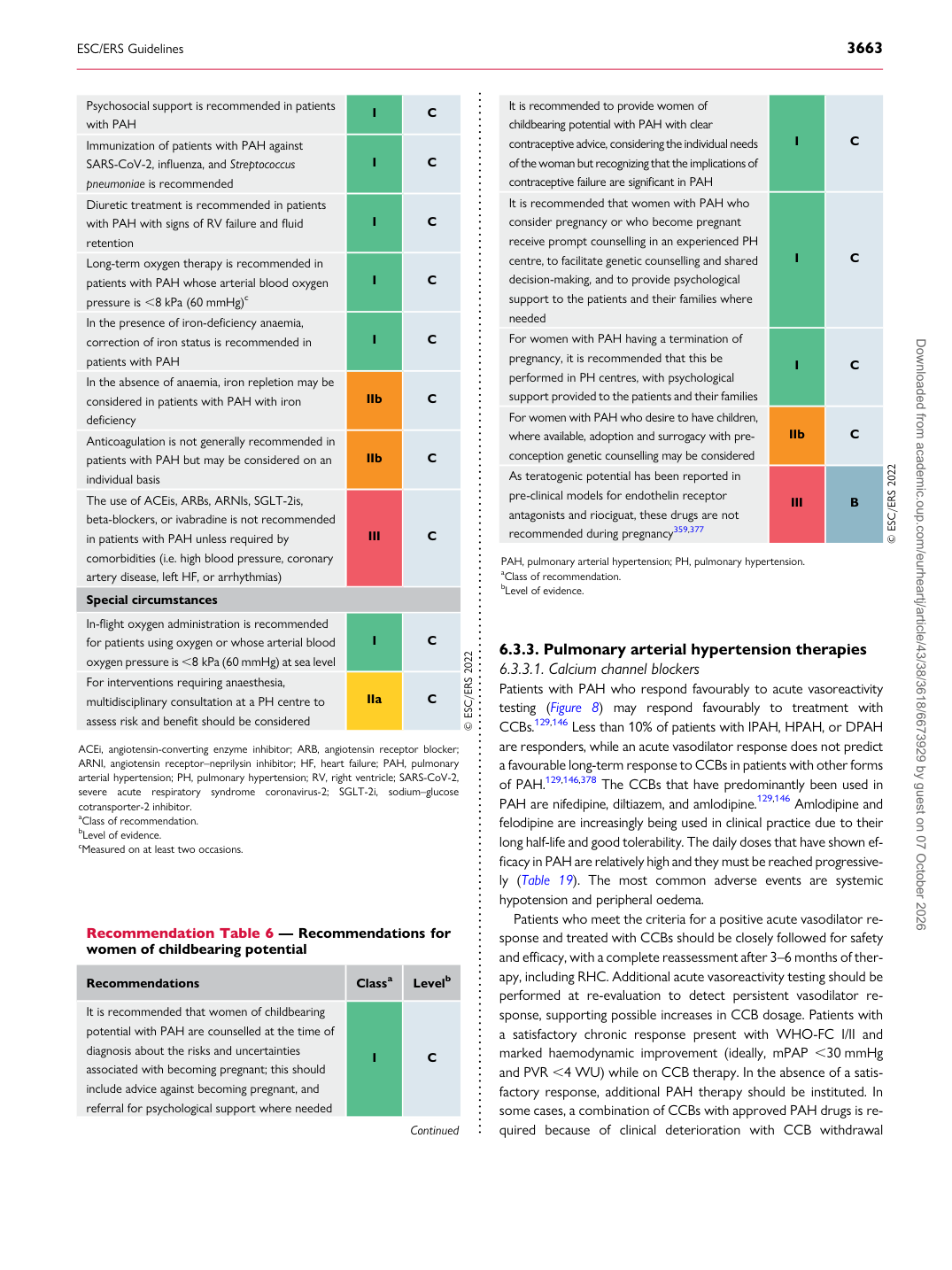
Psychosocial support is recommended in patients with PAH I C Immunization of patients with PAH against SARS-CoV-2, influenza, and Streptococcus pneumoniae is recommended I C Diuretic treatment is recommended in patients with PAH with signs of RV failure and fluid retention I C Long-term oxygen therapy is recommended in patients with PAH whose arterial blood oxygen pressure is ,8 kPa (60 mmHg)c I C In the presence of iron-deficiency anaemia, correction of iron status is recommended in patients with PAH I C In the absence of anaemia, iron repletion may be considered in patients with PAH with iron deficiency IIb C Anticoagulation is not generally recommended in patients with PAH but may be considered on an individual basis IIb C The use of ACEis, ARBs, ARNIs, SGLT-2is, beta-blockers, or ivabradine is not recommended in patients with PAH unless required by comorbidities (i.e. high blood pressure, coronary artery disease, left HF, or arrhythmias) III C Special circumstances In-flight oxygen administration is recommended for patients using oxygen or whose arterial blood oxygen pressure is ,8 kPa (60 mmHg) at sea level I C For interventions requiring anaesthesia, multidisciplinary consultation at a PH centre to assess risk and benefit should be considered IIa C © ESC/ERS 2022 ACEi, angiotensin-converting enzyme inhibitor; ARB, angiotensin receptor blocker; ARNI, angiotensin receptor–neprilysin inhibitor; HF, heart failure; PAH, pulmonary arterial hypertension; PH, pulmonary hypertension; RV, right ventricle; SARS-CoV-2, severe acute respiratory syndrome coronavirus-2; SGLT-2i, sodium–glucose cotransporter-2 inhibitor. aClass of recommendation. bLevel of evidence. cMeasured on at least two occasions.

Recommendation Table 6 — Recommendations for women of childbearing potential

Recommendations Classa Levelb

It is recommended that women of childbearing potential with PAH are counselled at the time of diagnosis about the risks and uncertainties associated with becoming pregnant; this should include advice against becoming pregnant, and referral for psychological support where needed I C

Continued It is recommended to provide women of

childbearing potential with PAH with clear contraceptive advice, considering the individual needs of the woman but recognizing that the implications of contraceptive failure are significant in PAH I C It is recommended that women with PAH who consider pregnancy or who become pregnant receive prompt counselling in an experienced PH centre, to facilitate genetic counselling and shared decision-making, and to provide psychological support to the patients and their families where needed I C For women with PAH having a termination of pregnancy, it is recommended that this be performed in PH centres, with psychological support provided to the patients and their families I C For women with PAH who desire to have children, where available, adoption and surrogacy with preconception genetic counselling may be considered IIb C As teratogenic potential has been reported in pre-clinical models for endothelin receptor antagonists and riociguat, these drugs are not recommended during pregnancy359,377 III B © ESC/ERS 2022 PAH, pulmonary arterial hypertension; PH, pulmonary hypertension. aClass of recommendation. bLevel of evidence. Downloaded from academic.oup.com/eurheartj/article/43/38/3618/6673929 by guest on 07 October 2026