p.45 抽出テキスト
monitored by a member of the multidisciplinary team, to identify non-adherence and any changes to the treatment regimen spontaneously triggered by patients or non-expert physicians. To promote adherence, it is important to ensure that patients are involved in care decisions and appropriately informed about treatment options and rationale, expectations, side effects, and potential consequences of non-adherence. Patients should be advised that any changes in treatment should be made in cooperation with the PH centre.

6.3.2 Special circumstances

6.3.2.1. Pregnancy and birth control 6.3.2.1.1. Pregnancy. Historically, pregnancy in women with PAH and other forms of severe PH has been associated with maternal mortality rates of up to 56% and neonatal mortality rates of up to 13%.350 With improved treatment of PAH and new approaches to managing women during pregnancy and the peri-partum period, maternal mortality has declined but remains high, ranging 11–25%.351–355 For these reasons, previous ESC/ERS Guidelines for the diagnosis and treatment of PH have recommended that patients with PAH should avoid pregnancy.25,26 However, there are reports of favourable pregnancy outcomes in women with PH, including, but not limited to, women with IPAH who respond to CCB therapy.353,354,356,357 Nonetheless, pregnancy remains associated with unforeseeable risks, and may accelerate PH progression.358 Women with PH can deteriorate at any time during or after pregnancy. Therefore, physicians have a responsibility to inform patients about the risks of pregnancy, so that women and their families can make informed decisions. Women with poorly controlled disease, indicated by an intermediate- or high-risk profile and signs of RV dysfunction, are at high risk of adverse outcomes; in the event of pregnancy, they should be carefully counselled and early termination should be advised. For patients with well-controlled disease, a low-risk profile, and normal or near-normal resting haemodynamics who consider becoming pregnant, individual counselling and shared decisionmaking are recommended. In such cases, alternatives such as adoption and surrogacy may also be explored. Pre-conception genetic counselling should also be considered in HPAH. Women with PH who become pregnant or present during pregnancy with newly diagnosed PAH should be treated, whenever possible, in centres with a multidisciplinary team experienced in managing PH in pregnancy. If pregnancy is continued, PAH therapy may have to be adjusted. It is recommended to stop endothelin receptor antagonists (ERAs), riociguat, and selexipag because of potential or unknown teratogenicity.359 Despite limited evidence, CCBs, PDE5is, and inhaled/i.v./subcutaneous (s.c.) prostacyclin analogues are considered safe during pregnancy.356,360 Pregnancy in PH is a very sensitive topic and requires empathic communication. Psychological support should be offered whenever needed.

6.3.2.1.2 Contraception. Women with PH of childbearing poten-

tial should be provided with clear contraceptive advice, considering the individual needs of the woman but recognizing that the implications of contraceptive failure are significant in PH. With appropriate use, many forms of contraception, including oral contraceptives, are highly effective. In patients treated with bosentan, reduced efficacy of hormonal contraceptives should be carefully considered.361 Using hormonal implants or an intrauterine device are alternative options with low failure rates. Surgical sterilization may be considered but is associated with peri-operative risks. Emergency post-coital hormonal contraception is safe in PH.

6.3.2.2 Surgical procedures

Surgical procedures in patients with PH are associated with an elevated risk of right HF and death. In a prospective, multinational registry including 114 patients with PAH who underwent non-cardiac and non-obstetric surgery, the peri-operative mortality rate was 2% in elective procedures and 15% in emergency procedures.362 The mortality risk was associated with the severity of PH. The decision to perform surgery should be made by a multidisciplinary team involving a PH physician, and must be based on an individual risk:benefit assessment considering various factors, including indication, urgency, PH severity, and patient preferences. Risk scores to predict the perioperative mortality risk have been developed but require further validation.363 General recommendations cannot be made. The same is true regarding the preferred mode of anaesthesia. Pre-operative optimization of PAH therapy should be attempted whenever possible (see also the 2022 ESC Guidelines on cardiovascular assessment and management of patients undergoing non-cardiac surgery).364

6.3.2.3 Travel and altitude

Hypobaric hypoxia may induce arterial hypoxaemia, additional hypoxic pulmonary vasoconstriction, and increased RV load in PAH.365,366 Cabin aircraft pressures are equivalent to altitudes up to 2438 m,367 at which the PaO2 decreases to that of an inspired O2 fraction of 15.1% at sea level.365 However, evidence suggests that short-term (less than 1 day) normobaric hypoxia is generally well tolerated in clinically stable patients with PAH.365,368–372 In-flight oxygen administration is advised for patients using oxygen at sea level and for those with PaO2 ,8 kPa (60 mmHg) or SaO2 ,92%.25,26,325,369,372 An oxygen flow rate of 2 L/min will raise inspired oxygen pressure to values as at sea level, and patients already using oxygen at sea level should increase their oxygen flow rate.25,26,373 As the effects of moderate to long-term (hours–days) hypoxia exposure in PAH remain largely unexplored,374,375 patients should avoid altitudes .1500 m without supplemental oxygen.25,26,369 However, patients with PAH who are not hypoxaemic at sea level have tolerated day trips to 2500 m reasonably well.376 Patients should travel with written information about their disease, including a medication list, bring extra doses of their medication, and be informed about local PH centres near their travel destination.25,26

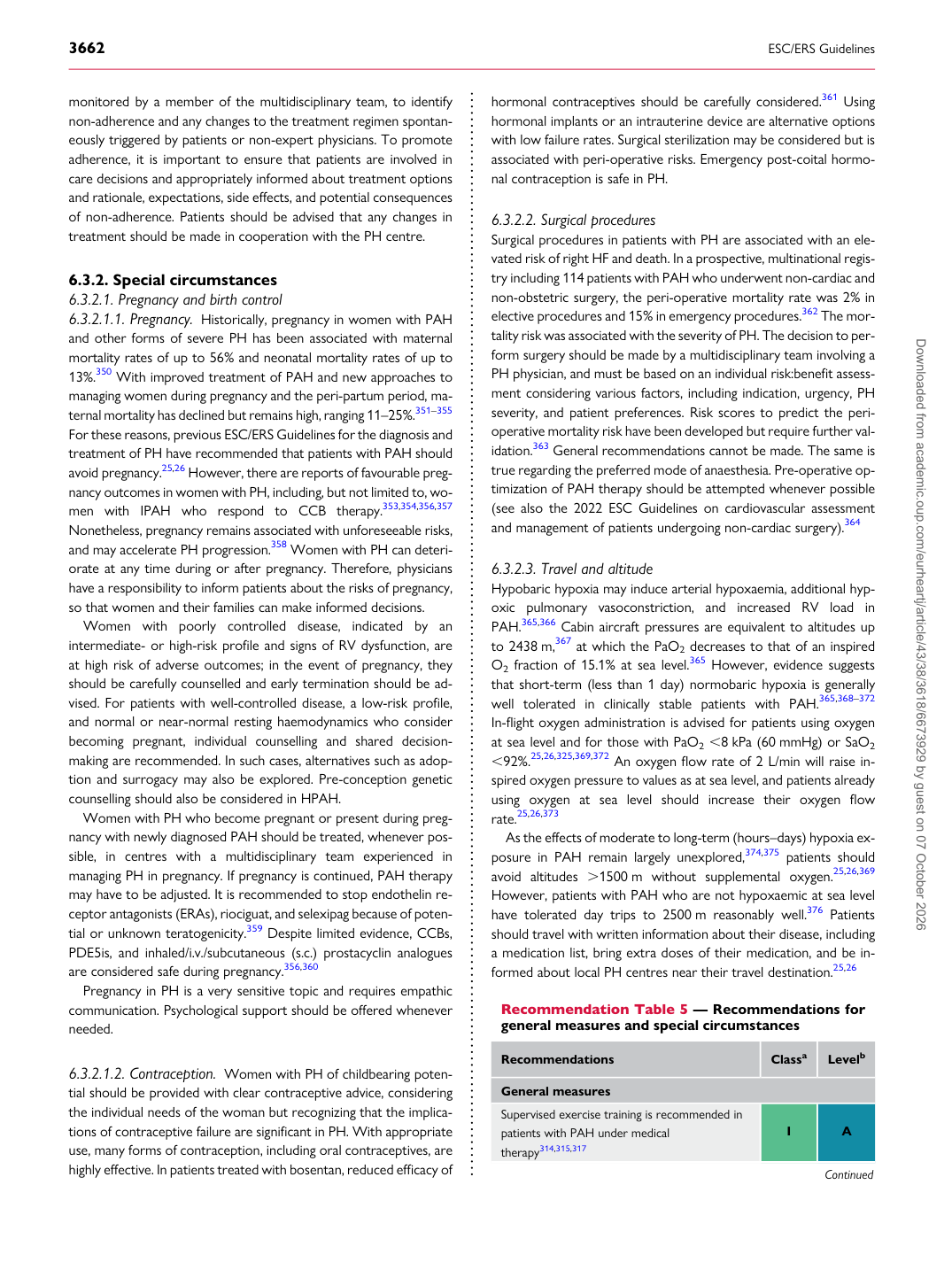
Recommendation Table 5 — Recommendations for general measures and special circumstances

Recommendations Classa Levelb

General measures Supervised exercise training is recommended in patients with PAH under medical therapy314,315,317 I A

Continued Downloaded from academic.oup.com/eurheartj/article/43/38/3618/6673929 by guest on 07 October 2026