p.43 抽出テキスト
At follow-up, the four-strata model (Table 18) is recommended as a basic risk-stratification tool, but additional variables should be considered as needed, especially right heart imaging and haemodynamics. At any stage, individual factors such as age, sex, disease type, comorbidities, and kidney function should also be considered.

6.3 Therapy

According to the revised haemodynamic definition, PAH may be diagnosed in patients with mPAP .20 mmHg and PVR .2 WU. Yet, the efficacy of drugs approved for PAH has only been demonstrated in patients with mPAP ≥25 mmHg and PVR .3 WU (see Supplementary Data, Table S1). No data are available for the efficacy of drugs approved for PAH in patients whose mPAP is ,25 mmHg and whose PVR is ,3 WU. Hence, for such patients, the efficacy of drugs approved for PAH has not been established. The same is true for patients with exercise PH, who, by definition, do not fulfil the diagnostic criteria for PAH. Patients at high risk of developing PAH, for instance patients with SSc or family members of patients with HPAH, should be referred to a PH centre for individual decision-making.

6.3.1 General measures

Managing patients with PAH requires a comprehensive treatment strategy and multidisciplinary care. In addition to applying PAH drugs, general measures and care in special situations represent integral components of optimized patient care. In this context, the systemic consequences of PH and right-sided HF, often contributing to disease burden, should be appropriately managed.119

6.3.1.1 Physical activity and supervised rehabilitation

The 2015 ESC/ERS Guidelines for the diagnosis and treatment of PH suggested that patients with PAH should be encouraged to be active within symptom limits.25,26 Since then, additional studies have shown the beneficial impact of exercise training on exercise capacity (6MWD) and quality of life.312–316 A large, randomized controlled trial (RCT) in 11 centres across 10 European countries, including 116 patients with PAH/CTEPH on PAH drugs, showed a significant improvement in 6MWD of 34.1 + 8.3 m, quality of life, WHO-FC, and peak VO2 compared with standard of care.315 Since most of the studies included patients who were stable on medical treatment, patients with PAH should be treated with the best standard of pharmacological treatment and be in a stable clinical condition before embarking on a supervised rehabilitation programme. Establishing specialized rehabilitation programmes for patients with PH would further enhance patient access to this intervention.317

6.3.1.2 Anticoagulation

There are several reasons to consider anticoagulation in patients with PAH. Histopathological specimens from PAH patients’ lungs have shown in situ thrombosis of pulmonary vessels. Patients with CHD or PA aneurysms may develop thrombosis of the central PAs. Abnormalities in the coagulation and fibrinolytic system indicating a pro-coagulant state have been reported in patients with PAH.318 Data from RCTs on anticoagulation in PAH are lacking, and registry data have yielded conflicting results. The largest registry analysis so far suggested a potential survival benefit associated with anticoagulation in patients with IPAH,319 but this finding was not confirmed by others.320 Two recent meta-analyses also concluded that using anticoagulants may improve survival in patients with IPAH;321,322 however, none of the included studies were methodologically robust. Despite the lack of evidence, registry data obtained between 2007 and 2016 showed that anticoagulation was used in 43% of patients with IPAH.293 In PAH associated with SSc, registry data and meta-analyses uniformly indicated that anticoagulation may be harmful.320–322 In CHD, there are also no RCTs on anticoagulation. There is also no consensus about the use of anticoagulants in patients who have permanent i.v. lines for therapy with prostacyclin analogues; this is left to local centre practice. As anticoagulation is associated with an increased bleeding risk, and in the absence of robust data, no general recommendation has been made for or against the use of anticoagulants in patients with PAH.; therefore, individual decision-making is required.

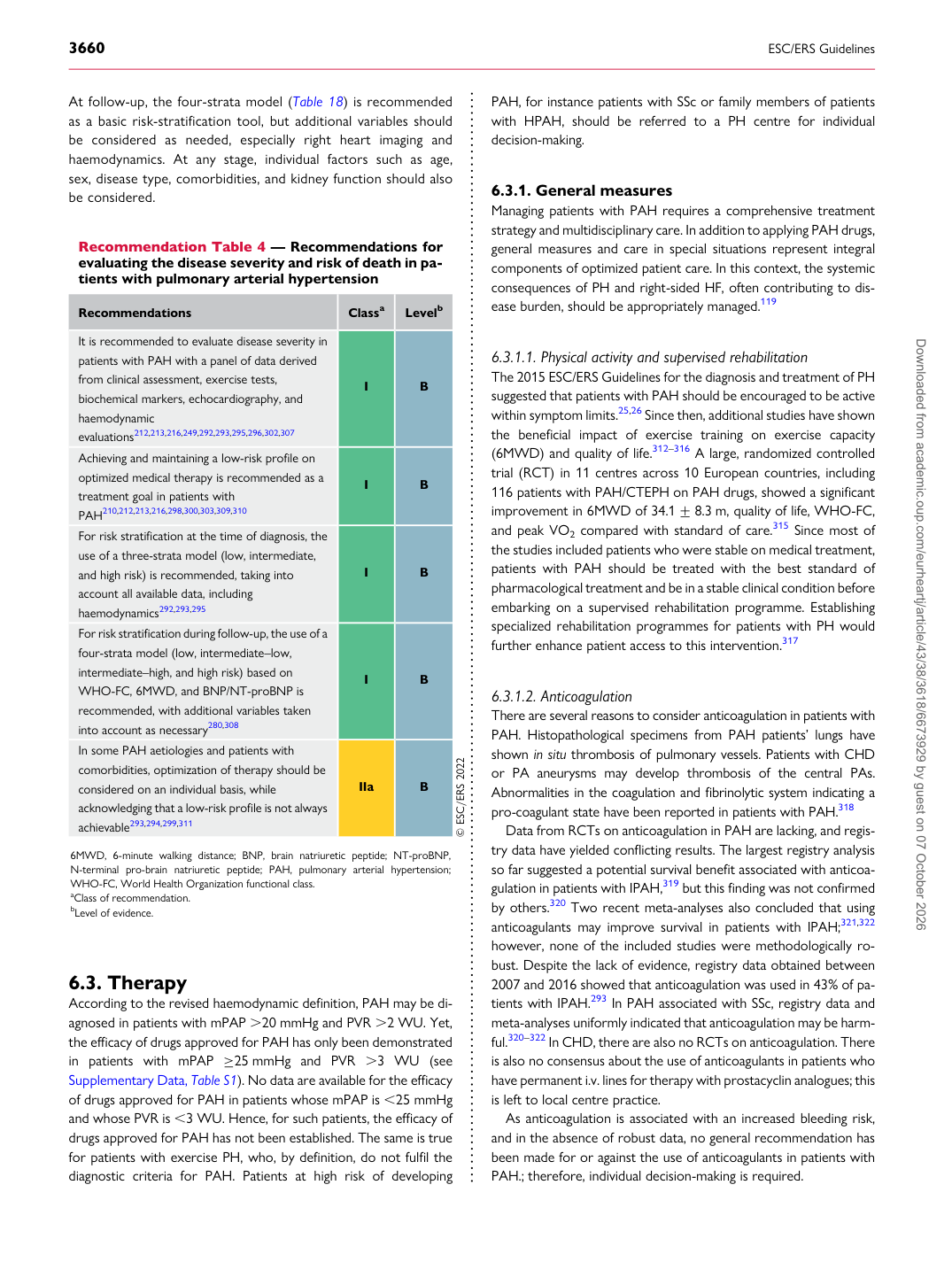
Recommendation Table 4 — Recommendations for evaluating the disease severity and risk of death in patients with pulmonary arterial hypertension

Recommendations Classa Levelb

It is recommended to evaluate disease severity in patients with PAH with a panel of data derived from clinical assessment, exercise tests, biochemical markers, echocardiography, and haemodynamic evaluations212,213,216,249,292,293,295,296,302,307 I B Achieving and maintaining a low-risk profile on optimized medical therapy is recommended as a treatment goal in patients with PAH210,212,213,216,298,300,303,309,310 I B For risk stratification at the time of diagnosis, the use of a three-strata model (low, intermediate, and high risk) is recommended, taking into account all available data, including haemodynamics292,293,295 I B For risk stratification during follow-up, the use of a four-strata model (low, intermediate–low, intermediate–high, and high risk) based on WHO-FC, 6MWD, and BNP/NT-proBNP is recommended, with additional variables taken into account as necessary280,308 I B In some PAH aetiologies and patients with comorbidities, optimization of therapy should be considered on an individual basis, while acknowledging that a low-risk profile is not always achievable293,294,299,311 IIa B © ESC/ERS 2022 6MWD, 6-minute walking distance; BNP, brain natriuretic peptide; NT-proBNP, N-terminal pro-brain natriuretic peptide; PAH, pulmonary arterial hypertension; WHO-FC, World Health Organization functional class. aClass of recommendation. bLevel of evidence. Downloaded from academic.oup.com/eurheartj/article/43/38/3618/6673929 by guest on 07 October 2026