p.42 抽出テキスト
functional status, clinical deterioration, and prognosis in PAH, and are more sensitive to the differences in the risk status than generic PROMs.290,291 In addition, HR-QoL scores provide independent prognostic information.287

6.2.7 Comprehensive prognostic evaluation, risk

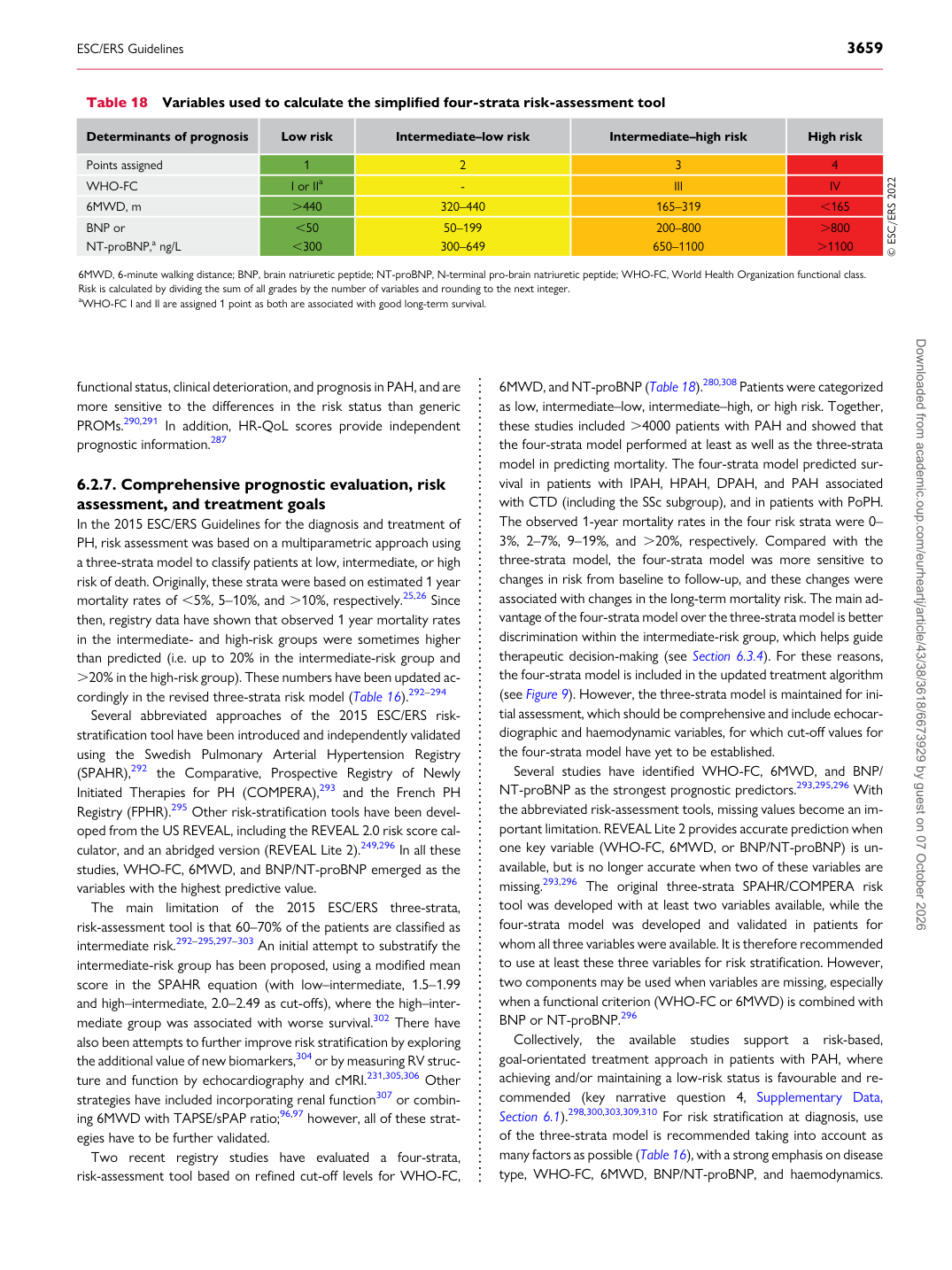
assessment, and treatment goals In the 2015 ESC/ERS Guidelines for the diagnosis and treatment of PH, risk assessment was based on a multiparametric approach using a three-strata model to classify patients at low, intermediate, or high risk of death. Originally, these strata were based on estimated 1 year mortality rates of ,5%, 5–10%, and .10%, respectively.25,26 Since then, registry data have shown that observed 1 year mortality rates in the intermediate- and high-risk groups were sometimes higher than predicted (i.e. up to 20% in the intermediate-risk group and .20% in the high-risk group). These numbers have been updated accordingly in the revised three-strata risk model (Table 16).292–294 Several abbreviated approaches of the 2015 ESC/ERS riskstratification tool have been introduced and independently validated using the Swedish Pulmonary Arterial Hypertension Registry (SPAHR),292 the Comparative, Prospective Registry of Newly Initiated Therapies for PH (COMPERA),293 and the French PH Registry (FPHR).295 Other risk-stratification tools have been developed from the US REVEAL, including the REVEAL 2.0 risk score calculator, and an abridged version (REVEAL Lite 2).249,296 In all these studies, WHO-FC, 6MWD, and BNP/NT-proBNP emerged as the variables with the highest predictive value. The main limitation of the 2015 ESC/ERS three-strata, risk-assessment tool is that 60–70% of the patients are classified as intermediate risk.292–295,297–303 An initial attempt to substratify the intermediate-risk group has been proposed, using a modified mean score in the SPAHR equation (with low–intermediate, 1.5–1.99 and high–intermediate, 2.0–2.49 as cut-offs), where the high–intermediate group was associated with worse survival.302 There have also been attempts to further improve risk stratification by exploring the additional value of new biomarkers,304 or by measuring RV structure and function by echocardiography and cMRI.231,305,306 Other strategies have included incorporating renal function307 or combining 6MWD with TAPSE/sPAP ratio;96,97 however, all of these strategies have to be further validated. Two recent registry studies have evaluated a four-strata, risk-assessment tool based on refined cut-off levels for WHO-FC, 6MWD, and NT-proBNP (Table 18).280,308 Patients were categorized as low, intermediate–low, intermediate–high, or high risk. Together, these studies included .4000 patients with PAH and showed that the four-strata model performed at least as well as the three-strata model in predicting mortality. The four-strata model predicted survival in patients with IPAH, HPAH, DPAH, and PAH associated with CTD (including the SSc subgroup), and in patients with PoPH. The observed 1-year mortality rates in the four risk strata were 0– 3%, 2–7%, 9–19%, and .20%, respectively. Compared with the three-strata model, the four-strata model was more sensitive to changes in risk from baseline to follow-up, and these changes were associated with changes in the long-term mortality risk. The main advantage of the four-strata model over the three-strata model is better discrimination within the intermediate-risk group, which helps guide therapeutic decision-making (see Section 6.3.4). For these reasons, the four-strata model is included in the updated treatment algorithm (see Figure 9). However, the three-strata model is maintained for initial assessment, which should be comprehensive and include echocardiographic and haemodynamic variables, for which cut-off values for the four-strata model have yet to be established.

Several studies have identified WHO-FC, 6MWD, and BNP/ NT-proBNP as the strongest prognostic predictors.293,295,296 With the abbreviated risk-assessment tools, missing values become an important limitation. REVEAL Lite 2 provides accurate prediction when one key variable (WHO-FC, 6MWD, or BNP/NT-proBNP) is unavailable, but is no longer accurate when two of these variables are missing.293,296 The original three-strata SPAHR/COMPERA risk tool was developed with at least two variables available, while the four-strata model was developed and validated in patients for whom all three variables were available. It is therefore recommended to use at least these three variables for risk stratification. However, two components may be used when variables are missing, especially when a functional criterion (WHO-FC or 6MWD) is combined with BNP or NT-proBNP.296 Collectively, the available studies support a risk-based, goal-orientated treatment approach in patients with PAH, where achieving and/or maintaining a low-risk status is favourable and recommended (key narrative question 4, Supplementary Data, Section 6.1).298,300,303,309,310 For risk stratification at diagnosis, use of the three-strata model is recommended taking into account as many factors as possible (Table 16), with a strong emphasis on disease type, WHO-FC, 6MWD, BNP/NT-proBNP, and haemodynamics.

Table 18 Variables used to calculate the simplified four-strata risk-assessment tool

Determinants of prognosis Low risk Intermediate–low risk Intermediate–high risk High risk

Points assigned 1 2 3 4 WHO-FC I or IIa - III IV 6MWD, m .440 320–440 165–319 ,165 BNP or NT-proBNP,a ng/L ,50 ,300 50–199 300–649 200–800 650–1100 .800 .1100 © ESC/ERS 2022 6MWD, 6-minute walking distance; BNP, brain natriuretic peptide; NT-proBNP, N-terminal pro-brain natriuretic peptide; WHO-FC, World Health Organization functional class. Risk is calculated by dividing the sum of all grades by the number of variables and rounding to the next integer. aWHO-FC I and II are assigned 1 point as both are associated with good long-term survival.

Downloaded from academic.oup.com/eurheartj/article/43/38/3618/6673929 by guest on 07 October 2026