p.31 抽出テキスト
Most available data are derived from studies aiming to uncover HFpEF (increase in PAWP) rather than identify group 2 PH (increase in PAP; see Section 8.1). It is generally accepted that rapid infusion (over 5–10 min) of ≏500 mL (7–10 mL/kg) of saline would be sufficient to detect an abnormal increase in PAWP to ≥18 mmHg (suggestive of HFpEF),142 although validation and long-term evaluation of these data are needed.143 There are insufficient data on the haemodynamic response to fluid challenge in patients with PAH. Recent data suggest that passive leg raise during RHC may also help to uncover occult HFpEF.144

5.1.13 Genetic counselling and testing

Mutations in PAH genes have been identified in familial PAH, IPAH, PVOD/PCH, and anorexigen-associated PAH (Table 13).148 The screening recommendations herein specifically relate to patients with an a priori diagnosis of PAH and not ‘at-risk’ populations being screened for PAH (see Section 5.3). All patients with these conditions should be informed about the possibility of a genetic condition and that family members could carry a mutation that increases the risk of PAH, allowing for screening and early diagnosis.33,148 Even if genetic testing is not performed, family members should be made aware of early signs and symptoms, to ensure that a timely and appropriate diagnosis is made.148

Genetic counselling by appropriately trained PAH providers or geneticists should be performed prior to genetic testing, to address the complex questions related to penetrance, genetically at-risk family members, reproduction, genetic discrimination, and psychosocial issues. Careful genetic counselling with genetic counsellors or medical geneticists is critical prior to genetic testing for asymptomatic family members.148 If the familial mutation is known and an unaffected family member tests negative for that mutation, the risk of PAH for that person is the same as for the general population.148 Many of the less common mutations outlined have a potential additional set of syndromic features. These are summarized in Table 13 where specific clinical history, examination, and investigations are suggested. In particular, clinicians should undertake a thorough history and examination, as syndromic PAH diagnoses may be missed if not interrogated. For example, in one of the largest studies to date, TBX4, ALK1, and ENG mutations were represented in the top six most common genetic findings in adults with previously diagnosed IPAH.149 These findings have been confirmed and extended in international genetics consortia in 4241 patients with PAH.150 It is therefore apparent that there is either phenotypic heterogeneity of these syndromes or missed diagnostic features. As more genes associated with PAH are discovered, it will become increasingly difficult to individually test for each. Next-generation sequencing has enabled the development of gene panels to simultaneously interrogate several genes.151 It is, however, important to check the genes included in the panel at the time of testing, since the composition changes as genetic discoveries advance.

5.2 Diagnostic algorithm

A multistep, pragmatic approach to diagnosis should be considered in patients with unexplained dyspnoea or symptoms/signs raising suspicion of PH. This strategy is depicted in detail in Figure 6 and Table 14. The diagnostic algorithm does not address screening for specific groups at risk of PH.

5.2.1 Step 1 (suspicion)

Patients with PH are likely to be seen by first-line physicians, mainly general practitioners, for non-specific symptoms. Initial evaluation should include a comprehensive medical (including familial) history, thorough physical examination (including measurement of blood pressure, heart rate, and pulse oximetry), blood test to determine BNP/NT-proBNP, and resting ECG. This first step may raise a suspicion of a cardiac or respiratory disorder causing the symptoms.

5.2.2 Step 2 (detection)

The second step includes classical, non-invasive lung and cardiac testing. Among those tests, echocardiography is an important step in the

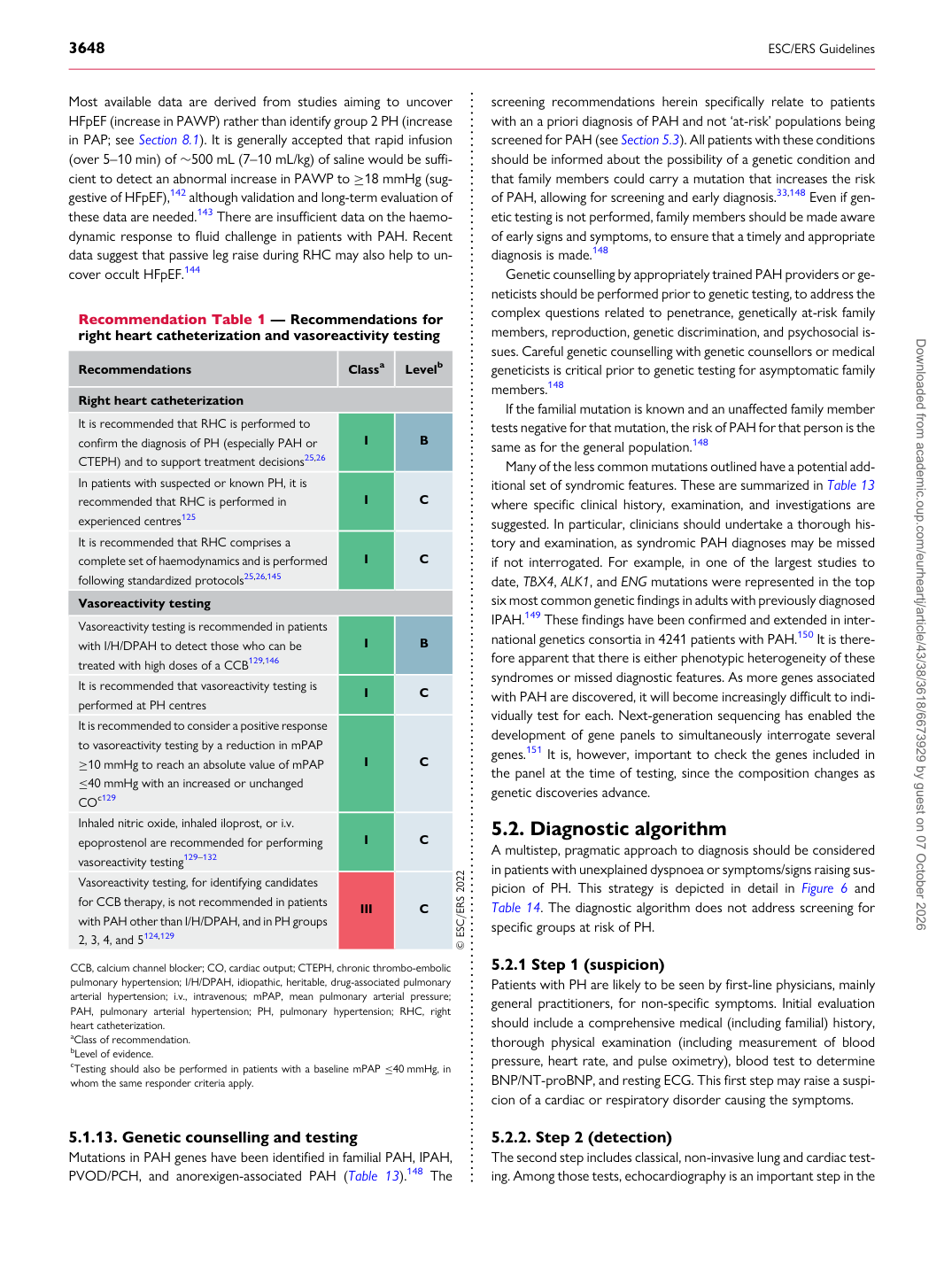
Recommendation Table 1 — Recommendations for right heart catheterization and vasoreactivity testing

Recommendations Classa Levelb

Right heart catheterization It is recommended that RHC is performed to confirm the diagnosis of PH (especially PAH or CTEPH) and to support treatment decisions25,26 I B In patients with suspected or known PH, it is recommended that RHC is performed in experienced centres125 I C It is recommended that RHC comprises a complete set of haemodynamics and is performed following standardized protocols25,26,145 I C Vasoreactivity testing Vasoreactivity testing is recommended in patients with I/H/DPAH to detect those who can be treated with high doses of a CCB129,146 I B It is recommended that vasoreactivity testing is performed at PH centres I C It is recommended to consider a positive response to vasoreactivity testing by a reduction in mPAP ≥10 mmHg to reach an absolute value of mPAP ≤40 mmHg with an increased or unchanged COc129 I C Inhaled nitric oxide, inhaled iloprost, or i.v. epoprostenol are recommended for performing vasoreactivity testing129–132 I C Vasoreactivity testing, for identifying candidates for CCB therapy, is not recommended in patients with PAH other than I/H/DPAH, and in PH groups 2, 3, 4, and 5124,129 III C © ESC/ERS 2022 CCB, calcium channel blocker; CO, cardiac output; CTEPH, chronic thrombo-embolic pulmonary hypertension; I/H/DPAH, idiopathic, heritable, drug-associated pulmonary arterial hypertension; i.v., intravenous; mPAP, mean pulmonary arterial pressure; PAH, pulmonary arterial hypertension; PH, pulmonary hypertension; RHC, right heart catheterization. aClass of recommendation. bLevel of evidence. cTesting should also be performed in patients with a baseline mPAP ≤40 mmHg, in whom the same responder criteria apply. Downloaded from academic.oup.com/eurheartj/article/43/38/3618/6673929 by guest on 07 October 2026