p.21 抽出テキスト
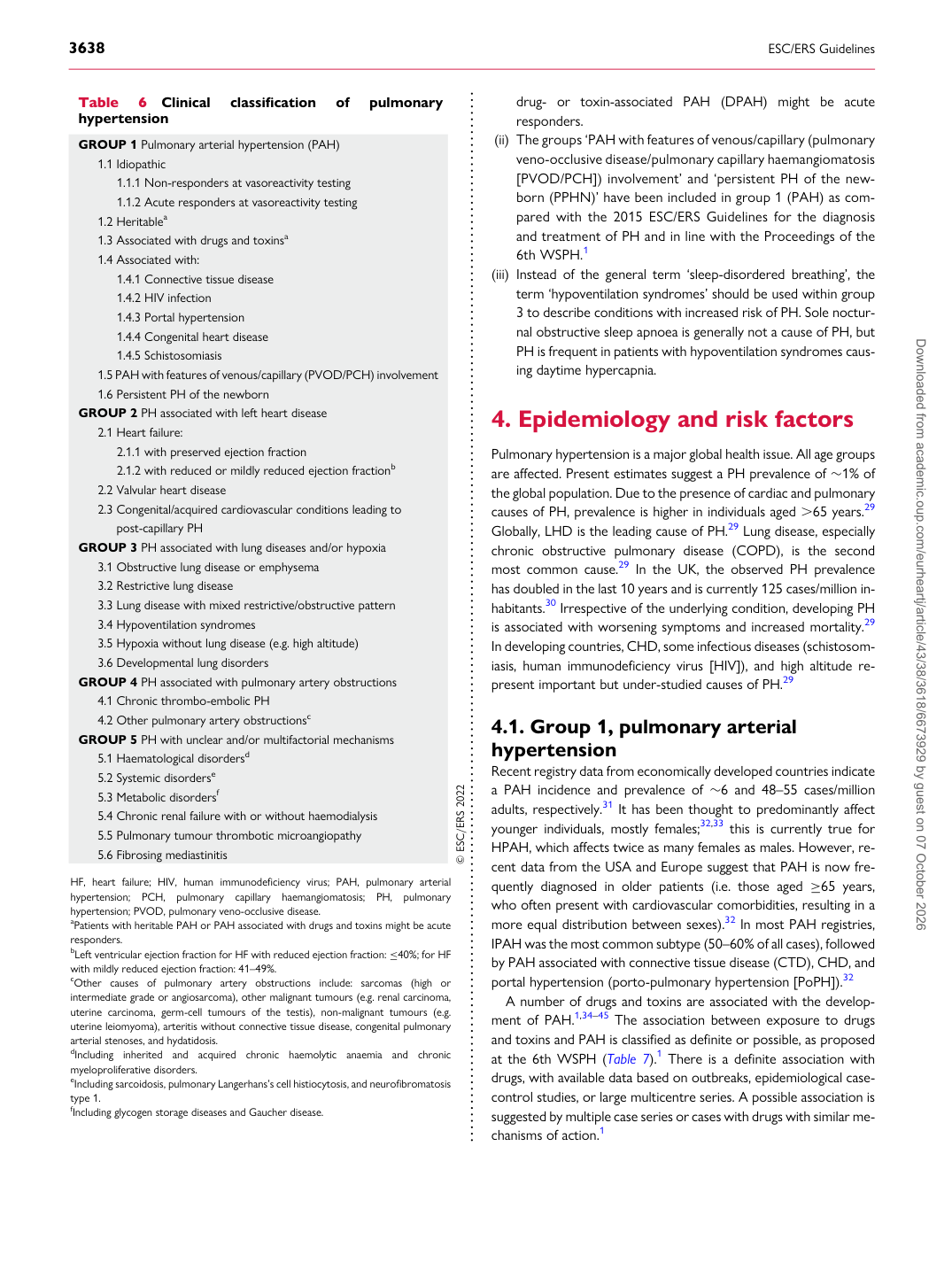
drug- or toxin-associated PAH (DPAH) might be acute responders. (ii) The groups ‘PAH with features of venous/capillary (pulmonary

veno-occlusive disease/pulmonary capillary haemangiomatosis [PVOD/PCH]) involvement’ and ‘persistent PH of the newborn (PPHN)’ have been included in group 1 (PAH) as compared with the 2015 ESC/ERS Guidelines for the diagnosis and treatment of PH and in line with the Proceedings of the 6th WSPH.1 (iii) Instead of the general term ‘sleep-disordered breathing’, the

term ‘hypoventilation syndromes’ should be used within group 3 to describe conditions with increased risk of PH. Sole nocturnal obstructive sleep apnoea is generally not a cause of PH, but PH is frequent in patients with hypoventilation syndromes causing daytime hypercapnia.

4 Epidemiology and risk factors

Pulmonary hypertension is a major global health issue. All age groups are affected. Present estimates suggest a PH prevalence of ≏1% of the global population. Due to the presence of cardiac and pulmonary causes of PH, prevalence is higher in individuals aged .65 years.29 Globally, LHD is the leading cause of PH.29 Lung disease, especially chronic obstructive pulmonary disease (COPD), is the second most common cause.29 In the UK, the observed PH prevalence has doubled in the last 10 years and is currently 125 cases/million inhabitants.30 Irrespective of the underlying condition, developing PH is associated with worsening symptoms and increased mortality.29 In developing countries, CHD, some infectious diseases (schistosomiasis, human immunodeficiency virus [HIV]), and high altitude represent important but under-studied causes of PH.29

4.1 Group 1, pulmonary arterial

hypertension Recent registry data from economically developed countries indicate a PAH incidence and prevalence of ≏6 and 48–55 cases/million adults, respectively.31 It has been thought to predominantly affect younger individuals, mostly females;32,33 this is currently true for HPAH, which affects twice as many females as males. However, recent data from the USA and Europe suggest that PAH is now frequently diagnosed in older patients (i.e. those aged ≥65 years, who often present with cardiovascular comorbidities, resulting in a more equal distribution between sexes).32 In most PAH registries, IPAH was the most common subtype (50–60% of all cases), followed by PAH associated with connective tissue disease (CTD), CHD, and portal hypertension (porto-pulmonary hypertension [PoPH]).32 A number of drugs and toxins are associated with the development of PAH.1,34–45 The association between exposure to drugs and toxins and PAH is classified as definite or possible, as proposed at the 6th WSPH (Table 7).1 There is a definite association with drugs, with available data based on outbreaks, epidemiological casecontrol studies, or large multicentre series. A possible association is suggested by multiple case series or cases with drugs with similar mechanisms of action.1

Table 6 Clinical classification of pulmonary hypertension GROUP 1 Pulmonary arterial hypertension (PAH)

1.1 Idiopathic

1.1.1 Non-responders at vasoreactivity testing 1.1.2 Acute responders at vasoreactivity testing

1.2 Heritablea

1.3 Associated with drugs and toxinsa

1.4 Associated with:

1.4.1 Connective tissue disease

1.4.2 HIV infection 1.4.3 Portal hypertension

1.4.4 Congenital heart disease

1.4.5 Schistosomiasis 1.5 PAH with features of venous/capillary (PVOD/PCH) involvement

1.6 Persistent PH of the newborn

GROUP 2 PH associated with left heart disease

2.1 Heart failure:

2.1.1 with preserved ejection fraction

2.1.2 with reduced or mildly reduced ejection fractionb

2.2 Valvular heart disease

2.3 Congenital/acquired cardiovascular conditions leading to

post-capillary PH GROUP 3 PH associated with lung diseases and/or hypoxia

3.1 Obstructive lung disease or emphysema

3.2 Restrictive lung disease 3.3 Lung disease with mixed restrictive/obstructive pattern

3.4 Hypoventilation syndromes

3.5 Hypoxia without lung disease (e.g. high altitude) 3.6 Developmental lung disorders

GROUP 4 PH associated with pulmonary artery obstructions

4.1 Chronic thrombo-embolic PH 4.2 Other pulmonary artery obstructionsc

GROUP 5 PH with unclear and/or multifactorial mechanisms

5.1 Haematological disordersd

5.2 Systemic disorderse

5.3 Metabolic disordersf

5.4 Chronic renal failure with or without haemodialysis 5.5 Pulmonary tumour thrombotic microangiopathy

5.6 Fibrosing mediastinitis © ESC/ERS 2022

HF, heart failure; HIV, human immunodeficiency virus; PAH, pulmonary arterial hypertension; PCH, pulmonary capillary haemangiomatosis; PH, pulmonary hypertension; PVOD, pulmonary veno-occlusive disease. aPatients with heritable PAH or PAH associated with drugs and toxins might be acute responders. bLeft ventricular ejection fraction for HF with reduced ejection fraction: ≤40%; for HF with mildly reduced ejection fraction: 41–49%. cOther causes of pulmonary artery obstructions include: sarcomas (high or intermediate grade or angiosarcoma), other malignant tumours (e.g. renal carcinoma, uterine carcinoma, germ-cell tumours of the testis), non-malignant tumours (e.g. uterine leiomyoma), arteritis without connective tissue disease, congenital pulmonary arterial stenoses, and hydatidosis. dIncluding inherited and acquired chronic haemolytic anaemia and chronic myeloproliferative disorders. eIncluding sarcoidosis, pulmonary Langerhans’s cell histiocytosis, and neurofibromatosis type 1. fIncluding glycogen storage diseases and Gaucher disease. Downloaded from academic.oup.com/eurheartj/article/43/38/3618/6673929 by guest on 07 October 2026