p.20 抽出テキスト
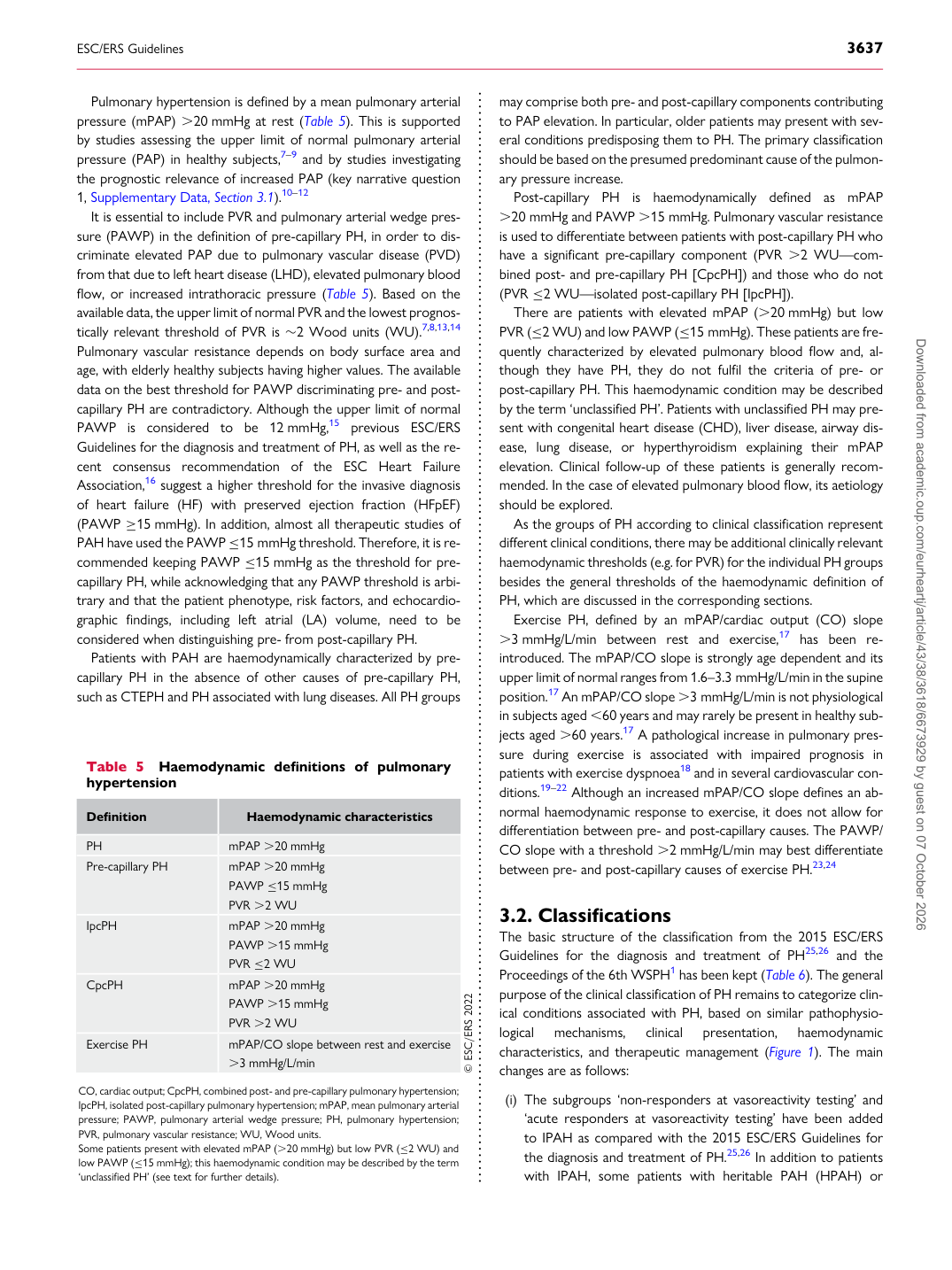
Pulmonary hypertension is defined by a mean pulmonary arterial pressure (mPAP) .20 mmHg at rest (Table 5). This is supported by studies assessing the upper limit of normal pulmonary arterial pressure (PAP) in healthy subjects,7–9 and by studies investigating the prognostic relevance of increased PAP (key narrative question 1, Supplementary Data, Section 3.1).10–12 It is essential to include PVR and pulmonary arterial wedge pressure (PAWP) in the definition of pre-capillary PH, in order to discriminate elevated PAP due to pulmonary vascular disease (PVD) from that due to left heart disease (LHD), elevated pulmonary blood flow, or increased intrathoracic pressure (Table 5). Based on the available data, the upper limit of normal PVR and the lowest prognostically relevant threshold of PVR is ≏2 Wood units (WU).7,8,13,14 Pulmonary vascular resistance depends on body surface area and age, with elderly healthy subjects having higher values. The available data on the best threshold for PAWP discriminating pre- and postcapillary PH are contradictory. Although the upper limit of normal PAWP is considered to be 12 mmHg,15 previous ESC/ERS Guidelines for the diagnosis and treatment of PH, as well as the recent consensus recommendation of the ESC Heart Failure Association,16 suggest a higher threshold for the invasive diagnosis of heart failure (HF) with preserved ejection fraction (HFpEF) (PAWP ≥15 mmHg). In addition, almost all therapeutic studies of PAH have used the PAWP ≤15 mmHg threshold. Therefore, it is recommended keeping PAWP ≤15 mmHg as the threshold for precapillary PH, while acknowledging that any PAWP threshold is arbitrary and that the patient phenotype, risk factors, and echocardiographic findings, including left atrial (LA) volume, need to be considered when distinguishing pre- from post-capillary PH. Patients with PAH are haemodynamically characterized by precapillary PH in the absence of other causes of pre-capillary PH, such as CTEPH and PH associated with lung diseases. All PH groups may comprise both pre- and post-capillary components contributing to PAP elevation. In particular, older patients may present with several conditions predisposing them to PH. The primary classification should be based on the presumed predominant cause of the pulmonary pressure increase.

Post-capillary PH is haemodynamically defined as mPAP .20 mmHg and PAWP .15 mmHg. Pulmonary vascular resistance is used to differentiate between patients with post-capillary PH who have a significant pre-capillary component (PVR .2 WU—combined post- and pre-capillary PH [CpcPH]) and those who do not (PVR ≤2 WU—isolated post-capillary PH [IpcPH]). There are patients with elevated mPAP (.20 mmHg) but low PVR (≤2 WU) and low PAWP (≤15 mmHg). These patients are frequently characterized by elevated pulmonary blood flow and, although they have PH, they do not fulfil the criteria of pre- or post-capillary PH. This haemodynamic condition may be described by the term ‘unclassified PH’. Patients with unclassified PH may present with congenital heart disease (CHD), liver disease, airway disease, lung disease, or hyperthyroidism explaining their mPAP elevation. Clinical follow-up of these patients is generally recommended. In the case of elevated pulmonary blood flow, its aetiology should be explored. As the groups of PH according to clinical classification represent different clinical conditions, there may be additional clinically relevant haemodynamic thresholds (e.g. for PVR) for the individual PH groups besides the general thresholds of the haemodynamic definition of PH, which are discussed in the corresponding sections. Exercise PH, defined by an mPAP/cardiac output (CO) slope .3 mmHg/L/min between rest and exercise,17 has been reintroduced. The mPAP/CO slope is strongly age dependent and its upper limit of normal ranges from 1.6–3.3 mmHg/L/min in the supine position.17 An mPAP/CO slope .3 mmHg/L/min is not physiological in subjects aged ,60 years and may rarely be present in healthy subjects aged .60 years.17 A pathological increase in pulmonary pressure during exercise is associated with impaired prognosis in patients with exercise dyspnoea18 and in several cardiovascular conditions.19–22 Although an increased mPAP/CO slope defines an abnormal haemodynamic response to exercise, it does not allow for differentiation between pre- and post-capillary causes. The PAWP/ CO slope with a threshold .2 mmHg/L/min may best differentiate between pre- and post-capillary causes of exercise PH.23,24

3.2 Classifications

The basic structure of the classification from the 2015 ESC/ERS Guidelines for the diagnosis and treatment of PH25,26 and the Proceedings of the 6th WSPH1 has been kept (Table 6). The general purpose of the clinical classification of PH remains to categorize clinical conditions associated with PH, based on similar pathophysiological mechanisms, clinical presentation, haemodynamic characteristics, and therapeutic management (Figure 1). The main changes are as follows: (i) The subgroups ‘non-responders at vasoreactivity testing’ and

‘acute responders at vasoreactivity testing’ have been added to IPAH as compared with the 2015 ESC/ERS Guidelines for the diagnosis and treatment of PH.25,26 In addition to patients with IPAH, some patients with heritable PAH (HPAH) or

Table 5 Haemodynamic definitions of pulmonary hypertension

Definition Haemodynamic characteristics

PH mPAP .20 mmHg Pre-capillary PH mPAP .20 mmHg

PAWP ≤15 mmHg PVR .2 WU

IpcPH mPAP .20 mmHg

PAWP .15 mmHg PVR ≤2 WU

CpcPH mPAP .20 mmHg PAWP .15 mmHg

PVR .2 WU

Exercise PH mPAP/CO slope between rest and exercise

.3 mmHg/L/min © ESC/ERS 2022

CO, cardiac output; CpcPH, combined post- and pre-capillary pulmonary hypertension; IpcPH, isolated post-capillary pulmonary hypertension; mPAP, mean pulmonary arterial pressure; PAWP, pulmonary arterial wedge pressure; PH, pulmonary hypertension; PVR, pulmonary vascular resistance; WU, Wood units. Some patients present with elevated mPAP (.20 mmHg) but low PVR (≤2 WU) and low PAWP (≤15 mmHg); this haemodynamic condition may be described by the term ‘unclassified PH’ (see text for further details). Downloaded from academic.oup.com/eurheartj/article/43/38/3618/6673929 by guest on 07 October 2026