p.18 抽出テキスト
2.2 Methods

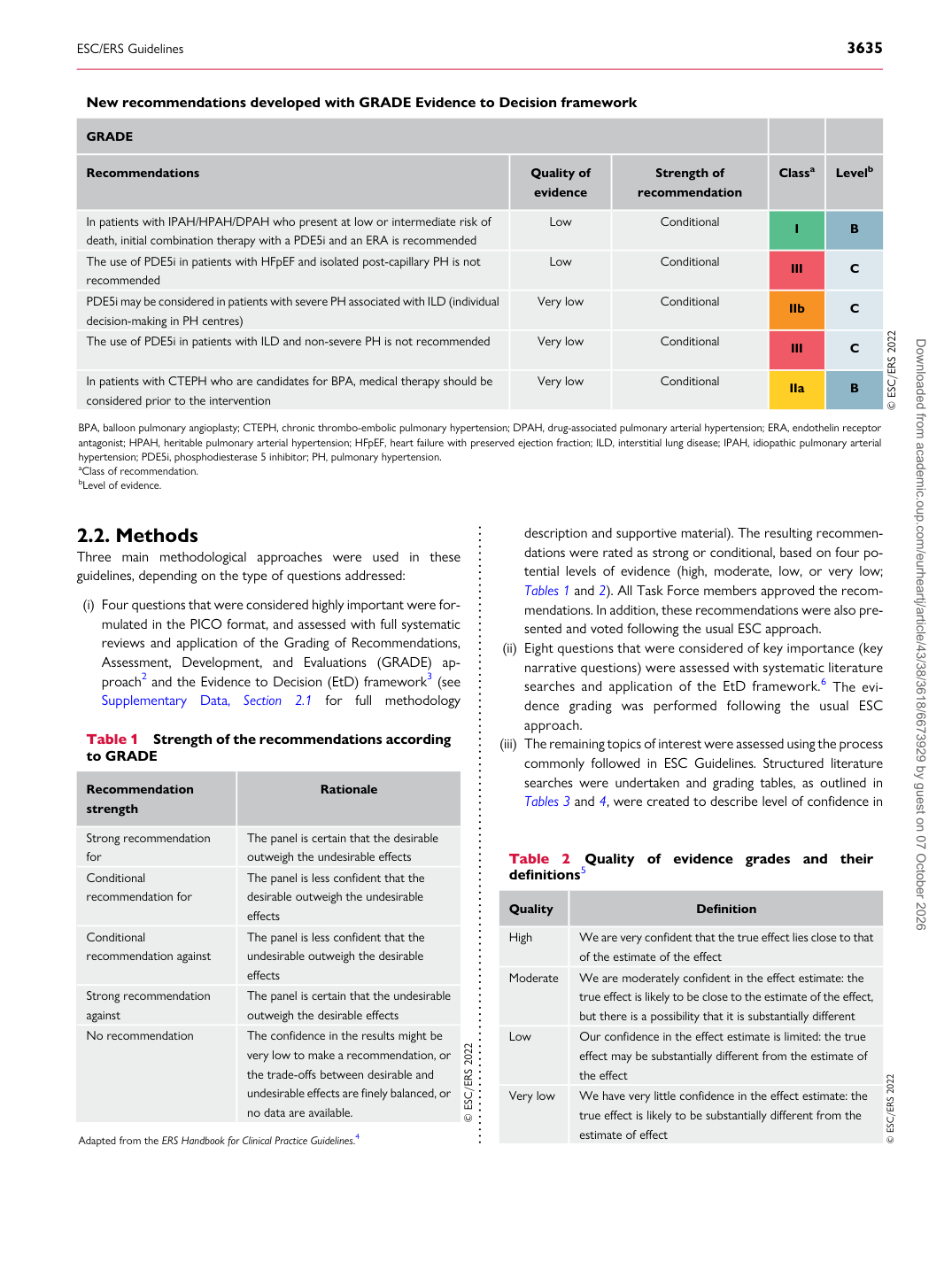
Three main methodological approaches were used in these guidelines, depending on the type of questions addressed: (i) Four questions that were considered highly important were for-

mulated in the PICO format, and assessed with full systematic reviews and application of the Grading of Recommendations, Assessment, Development, and Evaluations (GRADE) approach2 and the Evidence to Decision (EtD) framework3 (see Supplementary Data, Section 2.1 for full methodology description and supportive material). The resulting recommendations were rated as strong or conditional, based on four potential levels of evidence (high, moderate, low, or very low; Tables 1 and 2). All Task Force members approved the recommendations. In addition, these recommendations were also presented and voted following the usual ESC approach. (ii) Eight questions that were considered of key importance (key

narrative questions) were assessed with systematic literature searches and application of the EtD framework.6 The evidence grading was performed following the usual ESC approach. (iii) The remaining topics of interest were assessed using the process

commonly followed in ESC Guidelines. Structured literature searches were undertaken and grading tables, as outlined in Tables 3 and 4, were created to describe level of confidence in

New recommendations developed with GRADE Evidence to Decision framework

GRADE

Recommendations Quality of

evidence Strength of

recommendation Classa Levelb

In patients with IPAH/HPAH/DPAH who present at low or intermediate risk of death, initial combination therapy with a PDE5i and an ERA is recommended Low Conditional I B The use of PDE5i in patients with HFpEF and isolated post-capillary PH is not recommended Low Conditional III C PDE5i may be considered in patients with severe PH associated with ILD (individual decision-making in PH centres) Very low Conditional IIb C The use of PDE5i in patients with ILD and non-severe PH is not recommended Very low Conditional III C

In patients with CTEPH who are candidates for BPA, medical therapy should be considered prior to the intervention Very low Conditional IIa B © ESC/ERS 2022 BPA, balloon pulmonary angioplasty; CTEPH, chronic thrombo-embolic pulmonary hypertension; DPAH, drug-associated pulmonary arterial hypertension; ERA, endothelin receptor antagonist; HPAH, heritable pulmonary arterial hypertension; HFpEF, heart failure with preserved ejection fraction; ILD, interstitial lung disease; IPAH, idiopathic pulmonary arterial hypertension; PDE5i, phosphodiesterase 5 inhibitor; PH, pulmonary hypertension. aClass of recommendation. bLevel of evidence.

Table 1 Strength of the recommendations according to GRADE

Recommendation strength Rationale

Strong recommendation for The panel is certain that the desirable

outweigh the undesirable effects

Conditional recommendation for The panel is less confident that the

desirable outweigh the undesirable effects

Conditional recommendation against The panel is less confident that the

undesirable outweigh the desirable effects

Strong recommendation against The panel is certain that the undesirable

outweigh the desirable effects

No recommendation The confidence in the results might be

very low to make a recommendation, or the trade-offs between desirable and undesirable effects are finely balanced, or no data are available. © ESC/ERS 2022

Adapted from the ERS Handbook for Clinical Practice Guidelines.4 Table 2 Quality of evidence grades and their definitions5

Quality Definition

High We are very confident that the true effect lies close to that

of the estimate of the effect

Moderate We are moderately confident in the effect estimate: the

true effect is likely to be close to the estimate of the effect, but there is a possibility that it is substantially different

Low Our confidence in the effect estimate is limited: the true

effect may be substantially different from the estimate of the effect

Very low We have very little confidence in the effect estimate: the true effect is likely to be substantially different from the

estimate of effect © ESC/ERS 2022 Downloaded from academic.oup.com/eurheartj/article/43/38/3618/6673929 by guest on 07 October 2026