p.17 抽出テキスト
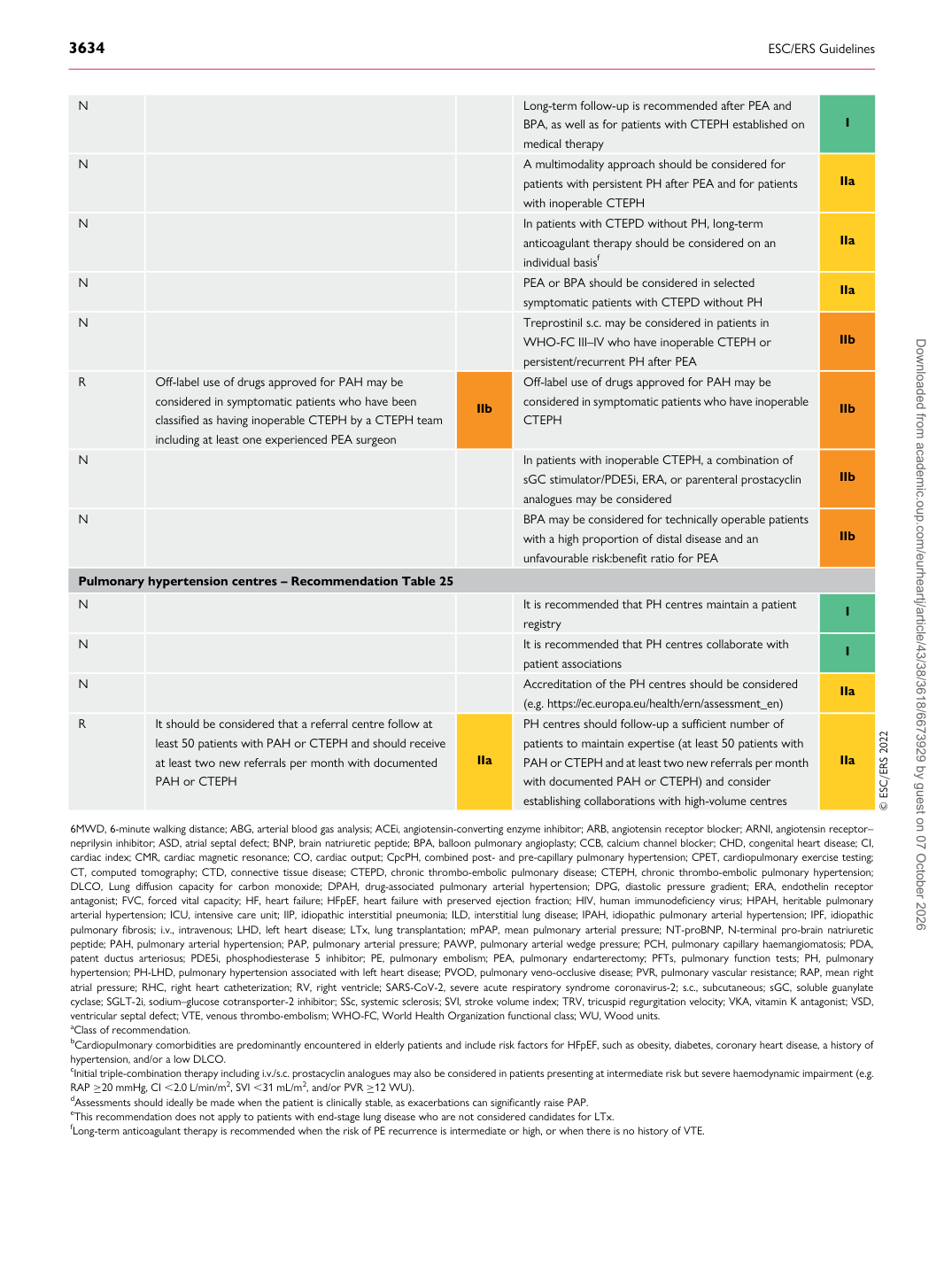
N Long-term follow-up is recommended after PEA and

BPA, as well as for patients with CTEPH established on medical therapy I

N A multimodality approach should be considered for

patients with persistent PH after PEA and for patients with inoperable CTEPH IIa

N In patients with CTEPD without PH, long-term anticoagulant therapy should be considered on an

individual basisf IIa

N PEA or BPA should be considered in selected

symptomatic patients with CTEPD without PH IIa

N Treprostinil s.c. may be considered in patients in

WHO-FC III–IV who have inoperable CTEPH or persistent/recurrent PH after PEA IIb

R Off-label use of drugs approved for PAH may be considered in symptomatic patients who have been

classified as having inoperable CTEPH by a CTEPH team including at least one experienced PEA surgeon IIb Off-label use of drugs approved for PAH may be considered in symptomatic patients who have inoperable

CTEPH IIb

N In patients with inoperable CTEPH, a combination of

sGC stimulator/PDE5i, ERA, or parenteral prostacyclin analogues may be considered IIb

N BPA may be considered for technically operable patients with a high proportion of distal disease and an

unfavourable risk:benefit ratio for PEA IIb

Pulmonary hypertension centres – Recommendation Table 25 N It is recommended that PH centres maintain a patient registry I N It is recommended that PH centres collaborate with patient associations I N Accreditation of the PH centres should be considered (e.g. https://ec.europa.eu/health/ern/assessment_en) IIa R It should be considered that a referral centre follow at

least 50 patients with PAH or CTEPH and should receive at least two new referrals per month with documented PAH or CTEPH IIa PH centres should follow-up a sufficient number of

patients to maintain expertise (at least 50 patients with PAH or CTEPH and at least two new referrals per month with documented PAH or CTEPH) and consider establishing collaborations with high-volume centres IIa © ESC/ERS 2022

6MWD, 6-minute walking distance; ABG, arterial blood gas analysis; ACEi, angiotensin-converting enzyme inhibitor; ARB, angiotensin receptor blocker; ARNI, angiotensin receptor– neprilysin inhibitor; ASD, atrial septal defect; BNP, brain natriuretic peptide; BPA, balloon pulmonary angioplasty; CCB, calcium channel blocker; CHD, congenital heart disease; CI, cardiac index; CMR, cardiac magnetic resonance; CO, cardiac output; CpcPH, combined post- and pre-capillary pulmonary hypertension; CPET, cardiopulmonary exercise testing; CT, computed tomography; CTD, connective tissue disease; CTEPD, chronic thrombo-embolic pulmonary disease; CTEPH, chronic thrombo-embolic pulmonary hypertension; DLCO, Lung diffusion capacity for carbon monoxide; DPAH, drug-associated pulmonary arterial hypertension; DPG, diastolic pressure gradient; ERA, endothelin receptor antagonist; FVC, forced vital capacity; HF, heart failure; HFpEF, heart failure with preserved ejection fraction; HIV, human immunodeficiency virus; HPAH, heritable pulmonary arterial hypertension; ICU, intensive care unit; IIP, idiopathic interstitial pneumonia; ILD, interstitial lung disease; IPAH, idiopathic pulmonary arterial hypertension; IPF, idiopathic pulmonary fibrosis; i.v., intravenous; LHD, left heart disease; LTx, lung transplantation; mPAP, mean pulmonary arterial pressure; NT-proBNP, N-terminal pro-brain natriuretic peptide; PAH, pulmonary arterial hypertension; PAP, pulmonary arterial pressure; PAWP, pulmonary arterial wedge pressure; PCH, pulmonary capillary haemangiomatosis; PDA, patent ductus arteriosus; PDE5i, phosphodiesterase 5 inhibitor; PE, pulmonary embolism; PEA, pulmonary endarterectomy; PFTs, pulmonary function tests; PH, pulmonary hypertension; PH-LHD, pulmonary hypertension associated with left heart disease; PVOD, pulmonary veno-occlusive disease; PVR, pulmonary vascular resistance; RAP, mean right atrial pressure; RHC, right heart catheterization; RV, right ventricle; SARS-CoV-2, severe acute respiratory syndrome coronavirus-2; s.c., subcutaneous; sGC, soluble guanylate cyclase; SGLT-2i, sodium–glucose cotransporter-2 inhibitor; SSc, systemic sclerosis; SVI, stroke volume index; TRV, tricuspid regurgitation velocity; VKA, vitamin K antagonist; VSD, ventricular septal defect; VTE, venous thrombo-embolism; WHO-FC, World Health Organization functional class; WU, Wood units. aClass of recommendation. bCardiopulmonary comorbidities are predominantly encountered in elderly patients and include risk factors for HFpEF, such as obesity, diabetes, coronary heart disease, a history of hypertension, and/or a low DLCO. cInitial triple-combination therapy including i.v./s.c. prostacyclin analogues may also be considered in patients presenting at intermediate risk but severe haemodynamic impairment (e.g. RAP ≥20 mmHg, CI ,2.0 L/min/m2, SVI ,31 mL/m2, and/or PVR ≥12 WU). dAssessments should ideally be made when the patient is clinically stable, as exacerbations can significantly raise PAP. eThis recommendation does not apply to patients with end-stage lung disease who are not considered candidates for LTx. fLong-term anticoagulant therapy is recommended when the risk of PE recurrence is intermediate or high, or when there is no history of VTE. Downloaded from academic.oup.com/eurheartj/article/43/38/3618/6673929 by guest on 07 October 2026