p.16 抽出テキスト
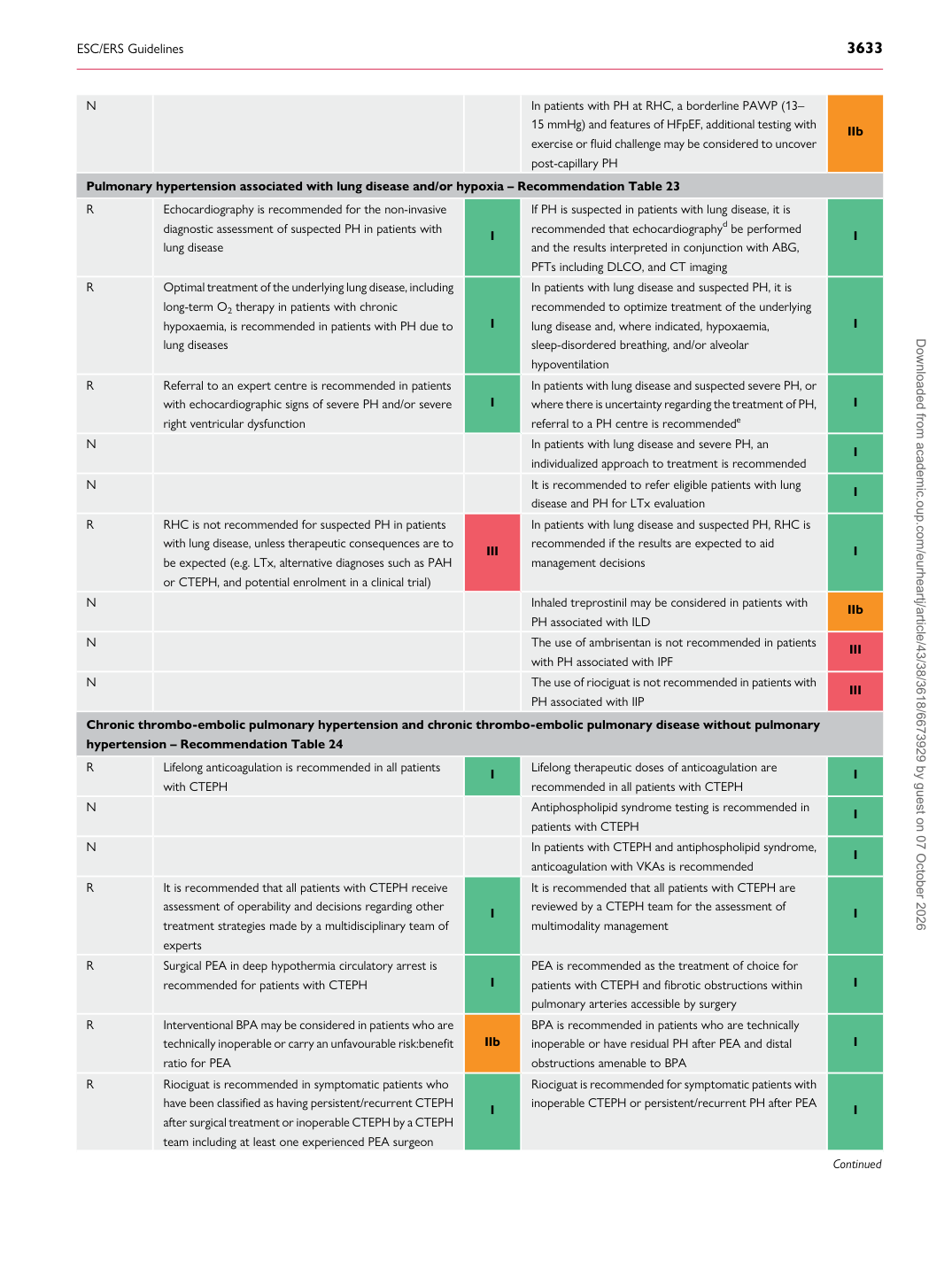
N In patients with PH at RHC, a borderline PAWP (13–

15 mmHg) and features of HFpEF, additional testing with exercise or fluid challenge may be considered to uncover post-capillary PH IIb

Pulmonary hypertension associated with lung disease and/or hypoxia – Recommendation Table 23 R Echocardiography is recommended for the non-invasive diagnostic assessment of suspected PH in patients with

lung disease I If PH is suspected in patients with lung disease, it is recommended that echocardiographyd be performed

and the results interpreted in conjunction with ABG, PFTs including DLCO, and CT imaging I

R Optimal treatment of the underlying lung disease, including

long-term O2 therapy in patients with chronic hypoxaemia, is recommended in patients with PH due to lung diseases I In patients with lung disease and suspected PH, it is

recommended to optimize treatment of the underlying lung disease and, where indicated, hypoxaemia, sleep-disordered breathing, and/or alveolar hypoventilation I

R Referral to an expert centre is recommended in patients

with echocardiographic signs of severe PH and/or severe right ventricular dysfunction I In patients with lung disease and suspected severe PH, or

where there is uncertainty regarding the treatment of PH, referral to a PH centre is recommendede I

N In patients with lung disease and severe PH, an individualized approach to treatment is recommended I N It is recommended to refer eligible patients with lung disease and PH for LTx evaluation I R RHC is not recommended for suspected PH in patients with lung disease, unless therapeutic consequences are to

be expected (e.g. LTx, alternative diagnoses such as PAH or CTEPH, and potential enrolment in a clinical trial) III In patients with lung disease and suspected PH, RHC is recommended if the results are expected to aid

management decisions I

N Inhaled treprostinil may be considered in patients with

PH associated with ILD IIb

N The use of ambrisentan is not recommended in patients

with PH associated with IPF III

N The use of riociguat is not recommended in patients with

PH associated with IIP III

Chronic thrombo-embolic pulmonary hypertension and chronic thrombo-embolic pulmonary disease without pulmonary hypertension – Recommendation Table 24 R Lifelong anticoagulation is recommended in all patients with CTEPH I Lifelong therapeutic doses of anticoagulation are recommended in all patients with CTEPH I N Antiphospholipid syndrome testing is recommended in patients with CTEPH I N In patients with CTEPH and antiphospholipid syndrome, anticoagulation with VKAs is recommended I R It is recommended that all patients with CTEPH receive assessment of operability and decisions regarding other

treatment strategies made by a multidisciplinary team of experts I It is recommended that all patients with CTEPH are reviewed by a CTEPH team for the assessment of

multimodality management I

R Surgical PEA in deep hypothermia circulatory arrest is

recommended for patients with CTEPH I PEA is recommended as the treatment of choice for

patients with CTEPH and fibrotic obstructions within pulmonary arteries accessible by surgery I

R Interventional BPA may be considered in patients who are technically inoperable or carry an unfavourable risk:benefit

ratio for PEA IIb BPA is recommended in patients who are technically inoperable or have residual PH after PEA and distal

obstructions amenable to BPA I

R Riociguat is recommended in symptomatic patients who

have been classified as having persistent/recurrent CTEPH after surgical treatment or inoperable CTEPH by a CTEPH team including at least one experienced PEA surgeon I Riociguat is recommended for symptomatic patients with

inoperable CTEPH or persistent/recurrent PH after PEA I

Continued Downloaded from academic.oup.com/eurheartj/article/43/38/3618/6673929 by guest on 07 October 2026