p.14 抽出テキスト
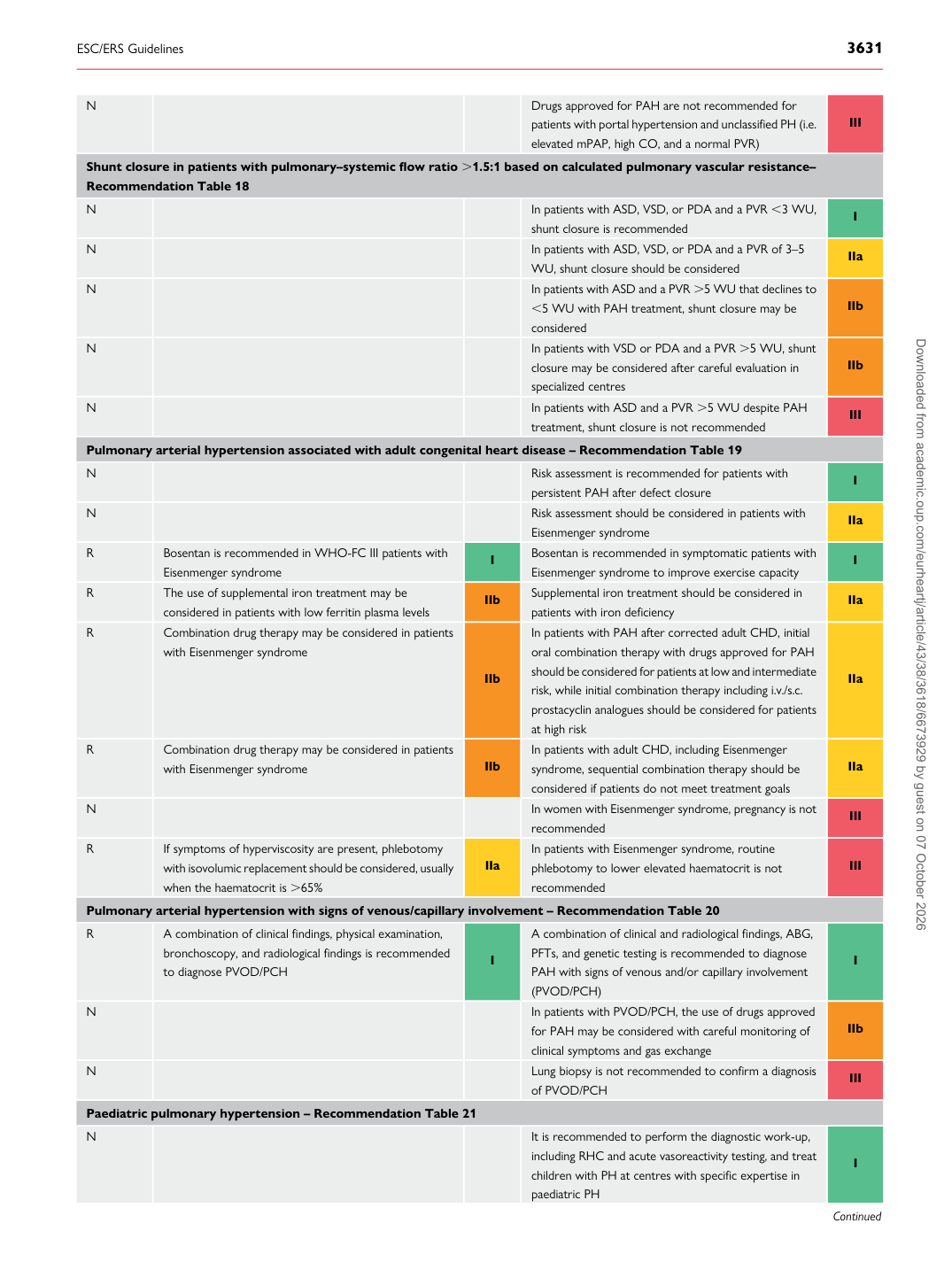
N Drugs approved for PAH are not recommended for

patients with portal hypertension and unclassified PH (i.e. elevated mPAP, high CO, and a normal PVR) III

Shunt closure in patients with pulmonary–systemic flow ratio .1.5:1 based on calculated pulmonary vascular resistance– Recommendation Table 18 N In patients with ASD, VSD, or PDA and a PVR ,3 WU, shunt closure is recommended I N In patients with ASD, VSD, or PDA and a PVR of 3–5 WU, shunt closure should be considered IIa N In patients with ASD and a PVR .5 WU that declines to ,5 WU with PAH treatment, shunt closure may be

considered IIb

N In patients with VSD or PDA and a PVR .5 WU, shunt

closure may be considered after careful evaluation in specialized centres IIb

N In patients with ASD and a PVR .5 WU despite PAH

treatment, shunt closure is not recommended III

Pulmonary arterial hypertension associated with adult congenital heart disease – Recommendation Table 19 N Risk assessment is recommended for patients with

persistent PAH after defect closure I

N Risk assessment should be considered in patients with

Eisenmenger syndrome IIa

R Bosentan is recommended in WHO-FC III patients with

Eisenmenger syndrome I Bosentan is recommended in symptomatic patients with

Eisenmenger syndrome to improve exercise capacity I

R The use of supplemental iron treatment may be

considered in patients with low ferritin plasma levels IIb Supplemental iron treatment should be considered in

patients with iron deficiency IIa

R Combination drug therapy may be considered in patients

with Eisenmenger syndrome

IIb In patients with PAH after corrected adult CHD, initial

oral combination therapy with drugs approved for PAH should be considered for patients at low and intermediate risk, while initial combination therapy including i.v./s.c. prostacyclin analogues should be considered for patients at high risk IIa

R Combination drug therapy may be considered in patients with Eisenmenger syndrome IIb In patients with adult CHD, including Eisenmenger syndrome, sequential combination therapy should be

considered if patients do not meet treatment goals IIa

N In women with Eisenmenger syndrome, pregnancy is not

recommended III

R If symptoms of hyperviscosity are present, phlebotomy

with isovolumic replacement should be considered, usually when the haematocrit is .65% IIa In patients with Eisenmenger syndrome, routine

phlebotomy to lower elevated haematocrit is not recommended III

Pulmonary arterial hypertension with signs of venous/capillary involvement – Recommendation Table 20 R A combination of clinical findings, physical examination,

bronchoscopy, and radiological findings is recommended to diagnose PVOD/PCH I A combination of clinical and radiological findings, ABG,

PFTs, and genetic testing is recommended to diagnose PAH with signs of venous and/or capillary involvement (PVOD/PCH) I

N In patients with PVOD/PCH, the use of drugs approved

for PAH may be considered with careful monitoring of clinical symptoms and gas exchange IIb

N Lung biopsy is not recommended to confirm a diagnosis

of PVOD/PCH III

Paediatric pulmonary hypertension – Recommendation Table 21 N It is recommended to perform the diagnostic work-up,

including RHC and acute vasoreactivity testing, and treat children with PH at centres with specific expertise in paediatric PH I

Continued Downloaded from academic.oup.com/eurheartj/article/43/38/3618/6673929 by guest on 07 October 2026