p.9 抽出テキスト
interest that arose during the writing period were notified to the ESC and updated. The Task Force received its entire financial support from the ESC without any involvement from the healthcare industry. The ESC CPG Committee supervises and coordinates the preparation of new guidelines. The Committee is also responsible for the approval process of these guidelines. The ESC Guidelines undergo extensive review by the CPG Committee and external experts, including a mix of members from across the whole of the ESC region and from relevant ESC Subspecialty Communities and National Cardiac Societies. After appropriate revisions, the guidelines are signed-off by all the experts involved in the Task Force. The finalized document is signed-off by the CPG Committee for publication in the European Heart Journal. The guidelines are developed after careful consideration of the scientific and medical knowledge and the evidence available at the time of their writing. The task of developing the ESC Guidelines also includes creating educational tools and implementating programmes for the recommendations, including condensed pocket guidelines versions, summary slides, summary cards for non-specialists, and an electronic version for digital applications (smartphones, etc.). These versions are abridged and thus, for more detailed information, the user should always access the full text version of the guidelines, which is freely available via the ESC website and the European Heart Journal. The National Cardiac Societies of the ESC are encouraged to endorse, adopt, translate, and implement all ESC Guidelines. Implementation programmes are needed because it has been shown that the outcome of disease may be favourably influenced by the thorough application of clinical recommendations. Health professionals are encouraged to take the ESC Guidelines fully into account when exercising their clinical judgment, and in determining and implementing preventive, diagnostic, or therapeutic medical strategies. However, the ESC Guidelines do not override, in any way whatsoever, the individual responsibility of health professionals to make appropriate and accurate decisions in considering each patient’s health condition and in consulting with that patient or the patient’s caregiver where appropriate and/or necessary. It is also the health professional’s responsibility to verify the rules and regulations applicable in each country to drugs and devices at the time of prescription and, where appropriate, to respect the ethical rules of their profession. Off-label use of medication may be presented in these guidelines if a sufficient level of evidence shows that it can be considered medically appropriate to a given condition and if patients could benefit from the recommended therapy. However, the final decisions concerning an individual patient must be made by the responsible health professional, giving special consideration to:

(a) the specific situation of the patient. In this respect, it is specified that, unless otherwise provided for by national regulations, offlabel use of medication should be limited to situations where it is in the patient’s interest to do so, with regard to the quality, safety, and efficacy of care, and only after the patient has been informed and provided consent; (b) and country-specific health regulations, indications by govern-

mental drug regulatory agencies, and the ethical rules to which health professionals are subject, where applicable. 2 Introduction

2.1 What is new

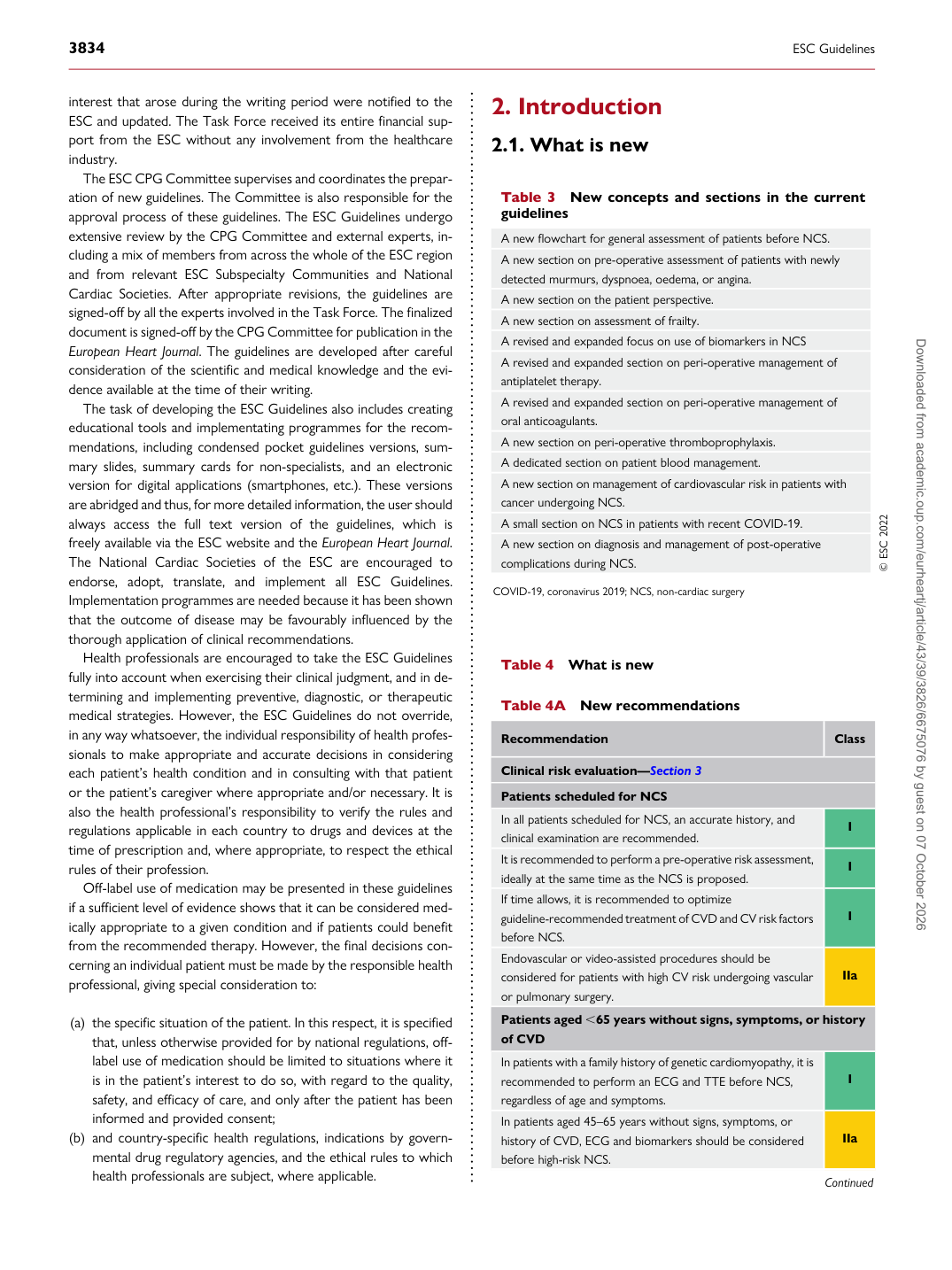
Table 3 New concepts and sections in the current guidelines A new flowchart for general assessment of patients before NCS. A new section on pre-operative assessment of patients with newly detected murmurs, dyspnoea, oedema, or angina. A new section on the patient perspective. A new section on assessment of frailty. A revised and expanded focus on use of biomarkers in NCS A revised and expanded section on peri-operative management of antiplatelet therapy. A revised and expanded section on peri-operative management of oral anticoagulants. A new section on peri-operative thromboprophylaxis. A dedicated section on patient blood management. A new section on management of cardiovascular risk in patients with cancer undergoing NCS. A small section on NCS in patients with recent COVID-19. A new section on diagnosis and management of post-operative complications during NCS. © ESC 2022

COVID-19, coronavirus 2019; NCS, non-cardiac surgery

Table 4 What is new © ESC 2022

Table 4A New recommendations

Recommendation Class

Clinical risk evaluation—Section 3 Patients scheduled for NCS In all patients scheduled for NCS, an accurate history, and clinical examination are recommended. I It is recommended to perform a pre-operative risk assessment, ideally at the same time as the NCS is proposed. I If time allows, it is recommended to optimize guideline-recommended treatment of CVD and CV risk factors before NCS. I Endovascular or video-assisted procedures should be considered for patients with high CV risk undergoing vascular or pulmonary surgery. IIa Patients aged ,65 years without signs, symptoms, or history of CVD In patients with a family history of genetic cardiomyopathy, it is recommended to perform an ECG and TTE before NCS, regardless of age and symptoms. I In patients aged 45–65 years without signs, symptoms, or history of CVD, ECG and biomarkers should be considered before high-risk NCS. IIa

Continued Downloaded from academic.oup.com/eurheartj/article/43/39/3826/6675076 by guest on 07 October 2026