p.81 抽出テキスト
13 Quality indicators

Quality indicators (QIs) are tools that may be used to evaluate care quality, including structural, process, and outcomes of care.698 They may also serve as a mechanism for enhancing adherence to guideline recommendations, through associated quality improvement initiatives and the benchmarking of care providers.699,700 As such, the role of QIs in improving care and outcomes for CV disease is increasingly being recognized by healthcare authorities, professional organizations, payers, and the public.698 The ESC understands the need for measuring and reporting quality and outcomes of CV care and has established methods for the development of the ESC QIs for the quantification of care and outcomes for CV diseases.698 To date, the ESC has developed QI suites for a number of CV diseases701–703 and embedded these in respective ESC Clinical Practice Guidelines (2020 ESC Guidelines for the diagnosis and management of atrial fibrillation; 2021 ESC Guidelines for the diagnosis and treatment of acute and chronic heart failure; and 2021 ESC Guidelines on cardiac pacing and cardiac resynchronization therapy).99,412,481,704 Furthermore, the ESC aims to integrate its QIs with clinical registries such as the EURObservational Research Programme (EORP) and the European Unified Registries On Heart Care Evaluation and Randomized Trials (EuroHeart) project705 to provide ‘real-world’ data about the patterns and outcomes of care for CV disease across Europe.

In parallel with the writing of this Clinical Practice Guideline document, a process has been initiated to develop QIs for patients undergoing NCS using the ESC methodology and through collaboration with patient representatives and domain experts. Such QIs may be used for evaluation of the quality of care for this group of patients and enable capture of important aspects of care delivery. The QIs, alongside their measurement specifications and development process, will be published in a separate paper.

14 Central illustration

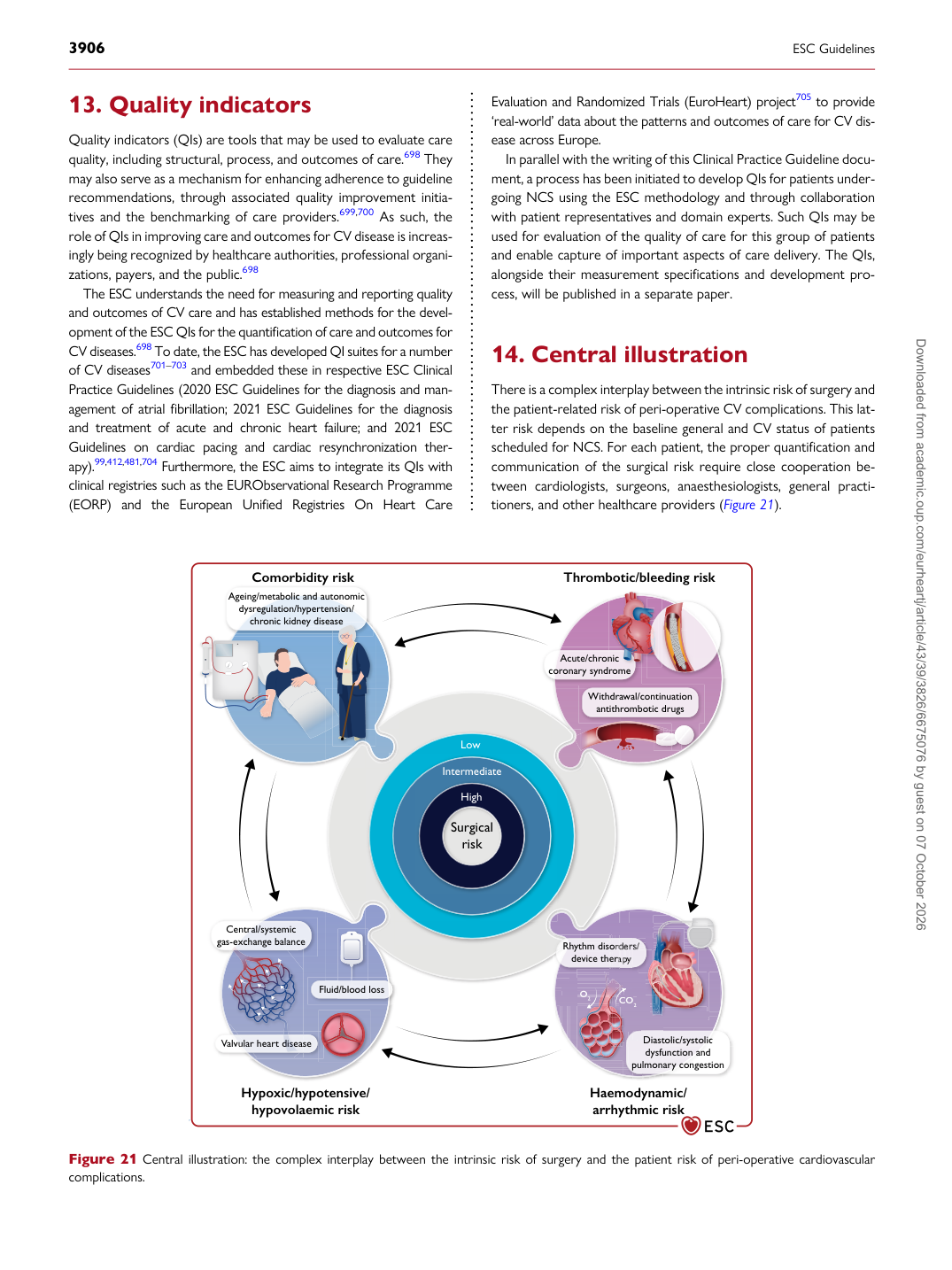
There is a complex interplay between the intrinsic risk of surgery and the patient-related risk of peri-operative CV complications. This latter risk depends on the baseline general and CV status of patients scheduled for NCS. For each patient, the proper quantification and communication of the surgical risk require close cooperation between cardiologists, surgeons, anaesthesiologists, general practitioners, and other healthcare providers (Figure 21).

Comorbidity risk

Hypoxic/hypotensive/

hypovolaemic risk Thrombotic/bleeding risk

Haemodynamic/ arrhythmic risk

Surgical

risk

High

Intermediate

Low

y

Ageing/metabolic and autonomic

dysregulation/hypertension/

chronic kidney disease

Central/systemic gas-exchange balance

Diastolic/systolic dysfunction and pulmonary congestion

Rhythm diso

device ther

Valvular heart disease Withdrawal/continuation

antithrombotic drugs

Acute/chronic coronary syndrome

nic

Fluid/blood loss

xchange balance

s

alvu vula vu vu xchange balance

e exchange bal e ex

ular hea r t d seas

dise

y Haemodyn Haemody fu

on

sf on

y o

dy mo

d m l ul p p p p u p p

O2 CO2

ase

y lic tolic/systol l l t ast a Di D ic

tolic/systol i li t ast a Di D ic

tolic/systoli i i t ast a Di D c

tolic/systolic

ic ic t ast a Di D

o e o e o e o er r

C C C C C O O O

2

O O

2 2 2

Figure 21 Central illustration: the complex interplay between the intrinsic risk of surgery and the patient risk of peri-operative cardiovascular complications. Downloaded from academic.oup.com/eurheartj/article/43/39/3826/6675076 by guest on 07 October 2026