p.8 抽出テキスト
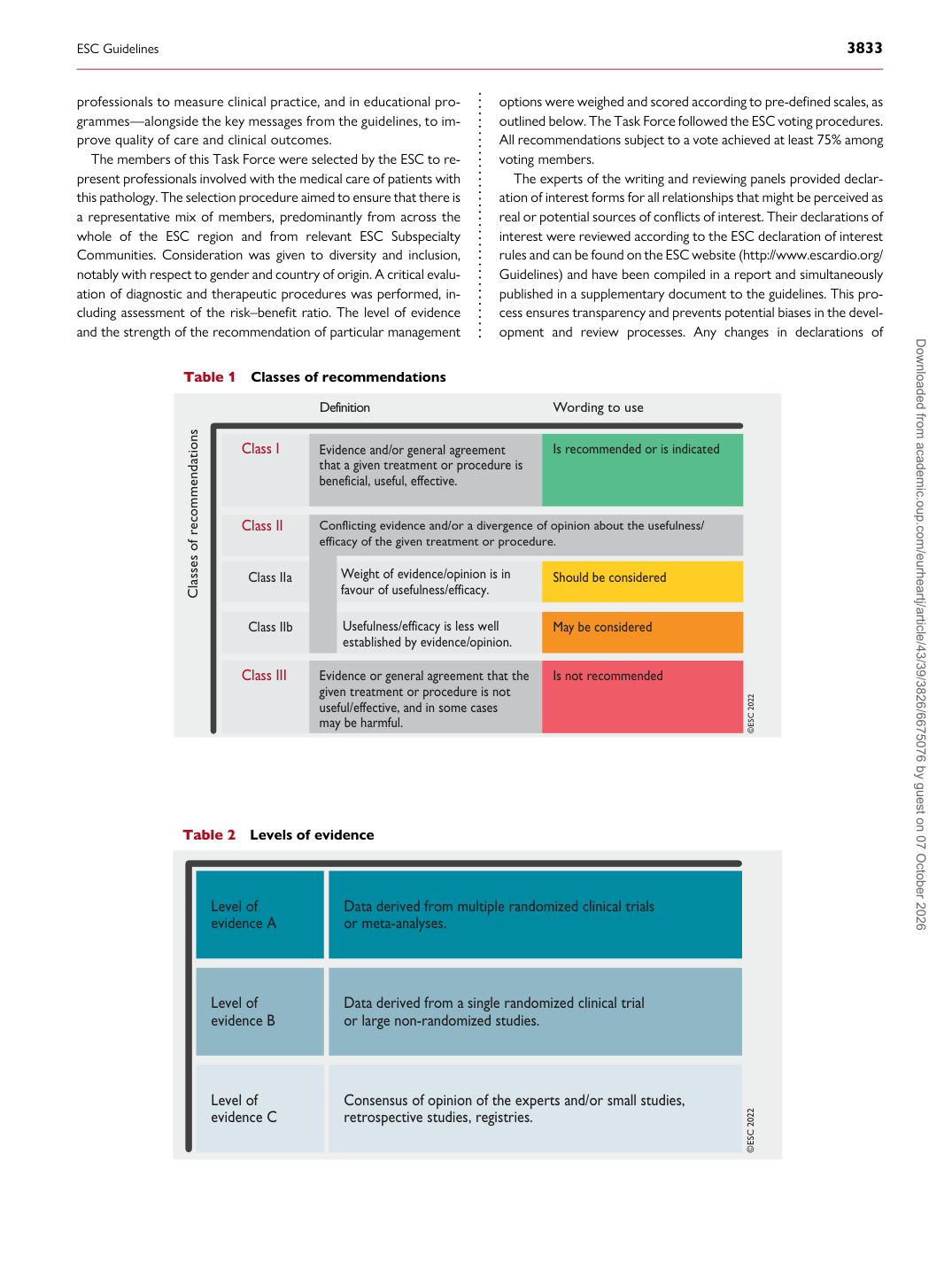
professionals to measure clinical practice, and in educational programmes—alongside the key messages from the guidelines, to improve quality of care and clinical outcomes. The members of this Task Force were selected by the ESC to represent professionals involved with the medical care of patients with this pathology. The selection procedure aimed to ensure that there is a representative mix of members, predominantly from across the whole of the ESC region and from relevant ESC Subspecialty Communities. Consideration was given to diversity and inclusion, notably with respect to gender and country of origin. A critical evaluation of diagnostic and therapeutic procedures was performed, including assessment of the risk–benefit ratio. The level of evidence and the strength of the recommendation of particular management options were weighed and scored according to pre-defined scales, as outlined below. The Task Force followed the ESC voting procedures. All recommendations subject to a vote achieved at least 75% among voting members.

The experts of the writing and reviewing panels provided declaration of interest forms for all relationships that might be perceived as real or potential sources of conflicts of interest. Their declarations of interest were reviewed according to the ESC declaration of interest rules and can be found on the ESC website (http://www.escardio.org/ Guidelines) and have been compiled in a report and simultaneously published in a supplementary document to the guidelines. This process ensures transparency and prevents potential biases in the development and review processes. Any changes in declarations of

Table 1 Classes of recommendations

©ESC 2022

Classes of recommendations Class I Evidence and/or general agreement that a given treatment or procedure is

Conflicting evidence and/or a divergence of opinion about the usefulness/ efficacy of the given treatment or procedure.

Is recommended or is indicated

Wording to use Definition

Class III Evidence or general agreement that the given treatment or procedure is not

may be harmful. useful/effective, and in some cases Is not recommended

Class IIb

established by evidence/opinion. May be considered

Class IIa W favour of usefulness/efficacy.

Usefulness/efficacy is less well

eight of evidence/opinion is in Should be considered

Class II beneficial, useful, effective.

© ESC 2022

Table 2 Levels of evidence

Level of evidence A

Level of evidence B

Level of evidence C Data derived from multiple randomized clinical trials or meta-analyses.

Data derived from a single randomized clinical trial or large non-randomized studies.

Consensus of opinion of the experts and/or small studies, retrospective studies, registries. ©ESC 2022 © ESC 2022

ESC Guidelines                                                                                                                                                                                     3833

Downloaded from academic.oup.com/eurheartj/article/43/39/3826/6675076 by guest on 07 October 2026