p.78 抽出テキスト
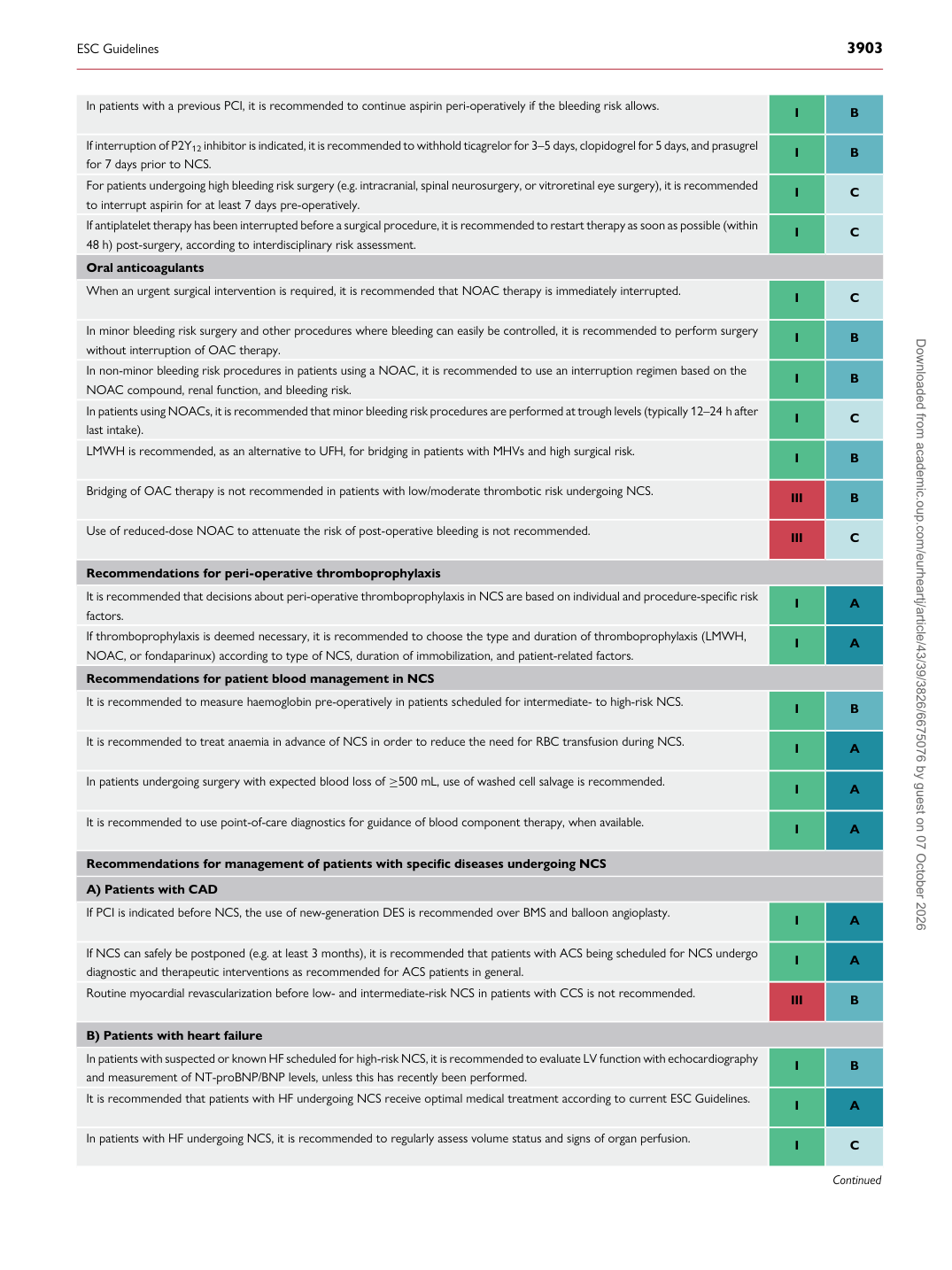
In patients with a previous PCI, it is recommended to continue aspirin peri-operatively if the bleeding risk allows. I B

If interruption of P2Y12 inhibitor is indicated, it is recommended to withhold ticagrelor for 3–5 days, clopidogrel for 5 days, and prasugrel for 7 days prior to NCS. I B For patients undergoing high bleeding risk surgery (e.g. intracranial, spinal neurosurgery, or vitroretinal eye surgery), it is recommended to interrupt aspirin for at least 7 days pre-operatively. I C If antiplatelet therapy has been interrupted before a surgical procedure, it is recommended to restart therapy as soon as possible (within 48 h) post-surgery, according to interdisciplinary risk assessment. I C Oral anticoagulants When an urgent surgical intervention is required, it is recommended that NOAC therapy is immediately interrupted. I C

In minor bleeding risk surgery and other procedures where bleeding can easily be controlled, it is recommended to perform surgery without interruption of OAC therapy. I B In non-minor bleeding risk procedures in patients using a NOAC, it is recommended to use an interruption regimen based on the NOAC compound, renal function, and bleeding risk. I B In patients using NOACs, it is recommended that minor bleeding risk procedures are performed at trough levels (typically 12–24 h after last intake). I C LMWH is recommended, as an alternative to UFH, for bridging in patients with MHVs and high surgical risk. I B

Bridging of OAC therapy is not recommended in patients with low/moderate thrombotic risk undergoing NCS. III B

Use of reduced-dose NOAC to attenuate the risk of post-operative bleeding is not recommended. III C

Recommendations for peri-operative thromboprophylaxis It is recommended that decisions about peri-operative thromboprophylaxis in NCS are based on individual and procedure-specific risk factors. I A If thromboprophylaxis is deemed necessary, it is recommended to choose the type and duration of thromboprophylaxis (LMWH, NOAC, or fondaparinux) according to type of NCS, duration of immobilization, and patient-related factors. I A Recommendations for patient blood management in NCS It is recommended to measure haemoglobin pre-operatively in patients scheduled for intermediate- to high-risk NCS. I B

It is recommended to treat anaemia in advance of NCS in order to reduce the need for RBC transfusion during NCS. I A

In patients undergoing surgery with expected blood loss of ≥500 mL, use of washed cell salvage is recommended. I A

It is recommended to use point-of-care diagnostics for guidance of blood component therapy, when available. I A

Recommendations for management of patients with specific diseases undergoing NCS A) Patients with CAD If PCI is indicated before NCS, the use of new-generation DES is recommended over BMS and balloon angioplasty. I A

If NCS can safely be postponed (e.g. at least 3 months), it is recommended that patients with ACS being scheduled for NCS undergo diagnostic and therapeutic interventions as recommended for ACS patients in general. I A Routine myocardial revascularization before low- and intermediate-risk NCS in patients with CCS is not recommended. III B

B) Patients with heart failure In patients with suspected or known HF scheduled for high-risk NCS, it is recommended to evaluate LV function with echocardiography and measurement of NT-proBNP/BNP levels, unless this has recently been performed. I B It is recommended that patients with HF undergoing NCS receive optimal medical treatment according to current ESC Guidelines. I A

In patients with HF undergoing NCS, it is recommended to regularly assess volume status and signs of organ perfusion. I C

Continued

ESC Guidelines                                                                                                                                                                                     3903

Downloaded from academic.oup.com/eurheartj/article/43/39/3826/6675076 by guest on 07 October 2026