p.77 抽出テキスト
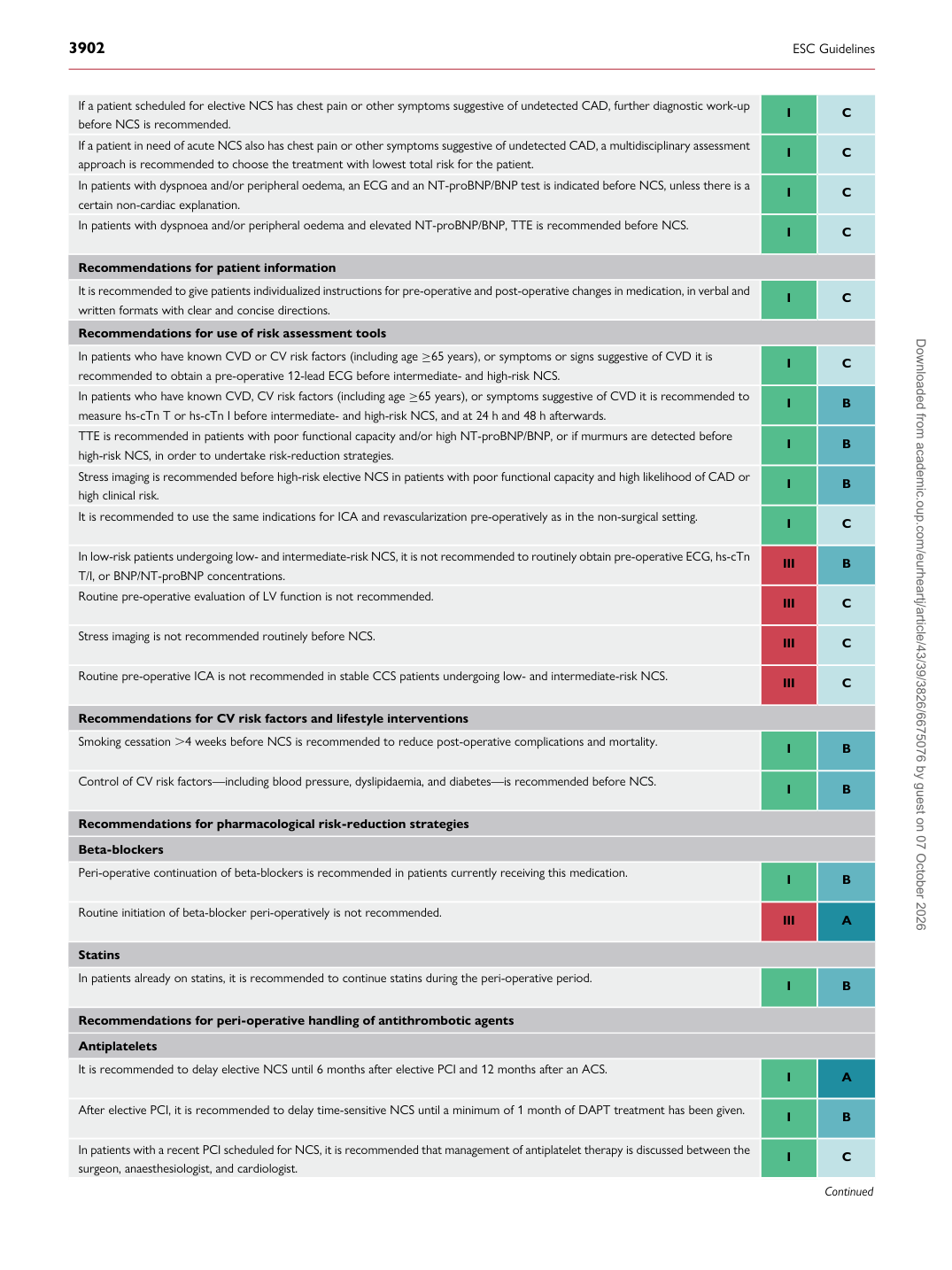
If a patient scheduled for elective NCS has chest pain or other symptoms suggestive of undetected CAD, further diagnostic work-up before NCS is recommended. I C If a patient in need of acute NCS also has chest pain or other symptoms suggestive of undetected CAD, a multidisciplinary assessment approach is recommended to choose the treatment with lowest total risk for the patient. I C In patients with dyspnoea and/or peripheral oedema, an ECG and an NT-proBNP/BNP test is indicated before NCS, unless there is a certain non-cardiac explanation. I C In patients with dyspnoea and/or peripheral oedema and elevated NT-proBNP/BNP, TTE is recommended before NCS. I C

Recommendations for patient information It is recommended to give patients individualized instructions for pre-operative and post-operative changes in medication, in verbal and written formats with clear and concise directions. I C Recommendations for use of risk assessment tools In patients who have known CVD or CV risk factors (including age ≥65 years), or symptoms or signs suggestive of CVD it is recommended to obtain a pre-operative 12-lead ECG before intermediate- and high-risk NCS. I C In patients who have known CVD, CV risk factors (including age ≥65 years), or symptoms suggestive of CVD it is recommended to measure hs-cTn T or hs-cTn I before intermediate- and high-risk NCS, and at 24 h and 48 h afterwards. I B TTE is recommended in patients with poor functional capacity and/or high NT-proBNP/BNP, or if murmurs are detected before high-risk NCS, in order to undertake risk-reduction strategies. I B Stress imaging is recommended before high-risk elective NCS in patients with poor functional capacity and high likelihood of CAD or high clinical risk. I B It is recommended to use the same indications for ICA and revascularization pre-operatively as in the non-surgical setting. I C

In low-risk patients undergoing low- and intermediate-risk NCS, it is not recommended to routinely obtain pre-operative ECG, hs-cTn T/I, or BNP/NT-proBNP concentrations. III B Routine pre-operative evaluation of LV function is not recommended. III C

Stress imaging is not recommended routinely before NCS. III C

Routine pre-operative ICA is not recommended in stable CCS patients undergoing low- and intermediate-risk NCS. III C

Recommendations for CV risk factors and lifestyle interventions Smoking cessation .4 weeks before NCS is recommended to reduce post-operative complications and mortality. I B

Control of CV risk factors—including blood pressure, dyslipidaemia, and diabetes—is recommended before NCS. I B

Recommendations for pharmacological risk-reduction strategies Beta-blockers Peri-operative continuation of beta-blockers is recommended in patients currently receiving this medication. I B

Routine initiation of beta-blocker peri-operatively is not recommended. III A

Statins In patients already on statins, it is recommended to continue statins during the peri-operative period. I B

Recommendations for peri-operative handling of antithrombotic agents Antiplatelets It is recommended to delay elective NCS until 6 months after elective PCI and 12 months after an ACS. I A

After elective PCI, it is recommended to delay time-sensitive NCS until a minimum of 1 month of DAPT treatment has been given. I B

In patients with a recent PCI scheduled for NCS, it is recommended that management of antiplatelet therapy is discussed between the surgeon, anaesthesiologist, and cardiologist. I C

Continued Downloaded from academic.oup.com/eurheartj/article/43/39/3826/6675076 by guest on 07 October 2026