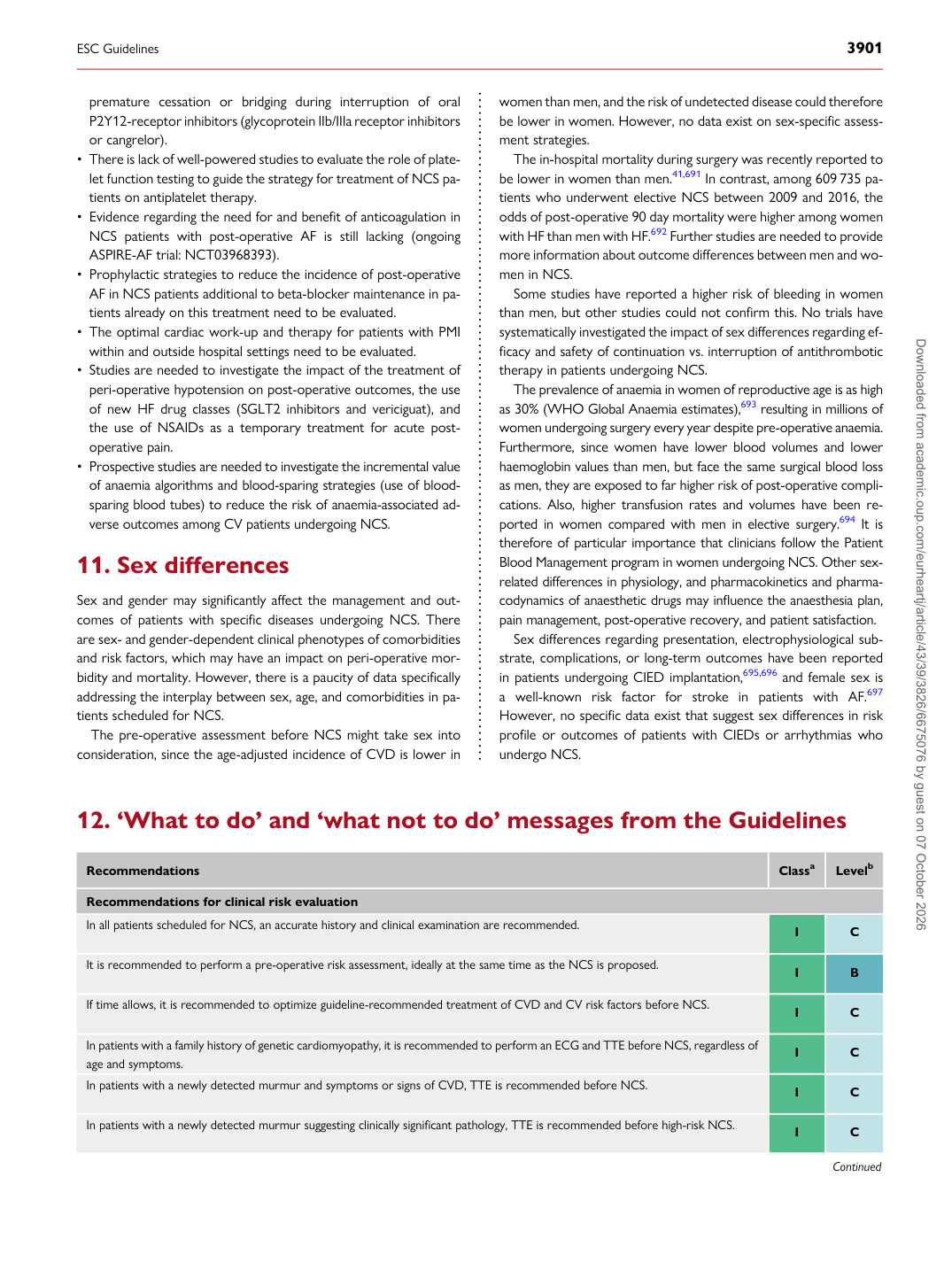
p.76 抽出テキスト
premature cessation or bridging during interruption of oral P2Y12-receptor inhibitors (glycoprotein IIb/IIIa receptor inhibitors or cangrelor). • There is lack of well-powered studies to evaluate the role of platelet function testing to guide the strategy for treatment of NCS patients on antiplatelet therapy. • Evidence regarding the need for and benefit of anticoagulation in NCS patients with post-operative AF is still lacking (ongoing ASPIRE-AF trial: NCT03968393). • Prophylactic strategies to reduce the incidence of post-operative AF in NCS patients additional to beta-blocker maintenance in patients already on this treatment need to be evaluated. • The optimal cardiac work-up and therapy for patients with PMI within and outside hospital settings need to be evaluated. • Studies are needed to investigate the impact of the treatment of peri-operative hypotension on post-operative outcomes, the use of new HF drug classes (SGLT2 inhibitors and vericiguat), and the use of NSAIDs as a temporary treatment for acute postoperative pain. • Prospective studies are needed to investigate the incremental value of anaemia algorithms and blood-sparing strategies (use of bloodsparing blood tubes) to reduce the risk of anaemia-associated adverse outcomes among CV patients undergoing NCS.

11 Sex differences

Sex and gender may significantly affect the management and outcomes of patients with specific diseases undergoing NCS. There are sex- and gender-dependent clinical phenotypes of comorbidities and risk factors, which may have an impact on peri-operative morbidity and mortality. However, there is a paucity of data specifically addressing the interplay between sex, age, and comorbidities in patients scheduled for NCS. The pre-operative assessment before NCS might take sex into consideration, since the age-adjusted incidence of CVD is lower in women than men, and the risk of undetected disease could therefore be lower in women. However, no data exist on sex-specific assessment strategies.

The in-hospital mortality during surgery was recently reported to be lower in women than men.41,691 In contrast, among 609 735 patients who underwent elective NCS between 2009 and 2016, the odds of post-operative 90 day mortality were higher among women with HF than men with HF.692 Further studies are needed to provide more information about outcome differences between men and women in NCS. Some studies have reported a higher risk of bleeding in women than men, but other studies could not confirm this. No trials have systematically investigated the impact of sex differences regarding efficacy and safety of continuation vs. interruption of antithrombotic therapy in patients undergoing NCS. The prevalence of anaemia in women of reproductive age is as high as 30% (WHO Global Anaemia estimates),693 resulting in millions of women undergoing surgery every year despite pre-operative anaemia. Furthermore, since women have lower blood volumes and lower haemoglobin values than men, but face the same surgical blood loss as men, they are exposed to far higher risk of post-operative complications. Also, higher transfusion rates and volumes have been reported in women compared with men in elective surgery.694 It is therefore of particular importance that clinicians follow the Patient Blood Management program in women undergoing NCS. Other sexrelated differences in physiology, and pharmacokinetics and pharmacodynamics of anaesthetic drugs may influence the anaesthesia plan, pain management, post-operative recovery, and patient satisfaction. Sex differences regarding presentation, electrophysiological substrate, complications, or long-term outcomes have been reported in patients undergoing CIED implantation,695,696 and female sex is a well-known risk factor for stroke in patients with AF.697 However, no specific data exist that suggest sex differences in risk profile or outcomes of patients with CIEDs or arrhythmias who undergo NCS.

12 ‘What to do’ and ‘what not to do’ messages from the Guidelines

Recommendations Classa Levelb

Recommendations for clinical risk evaluation In all patients scheduled for NCS, an accurate history and clinical examination are recommended. I C

It is recommended to perform a pre-operative risk assessment, ideally at the same time as the NCS is proposed. I B

If time allows, it is recommended to optimize guideline-recommended treatment of CVD and CV risk factors before NCS. I C

In patients with a family history of genetic cardiomyopathy, it is recommended to perform an ECG and TTE before NCS, regardless of age and symptoms. I C In patients with a newly detected murmur and symptoms or signs of CVD, TTE is recommended before NCS. I C

In patients with a newly detected murmur suggesting clinically significant pathology, TTE is recommended before high-risk NCS. I C

Continued

ESC Guidelines                                                                                                                                                                                     3901

Downloaded from academic.oup.com/eurheartj/article/43/39/3826/6675076 by guest on 07 October 2026