p.75 抽出テキスト
9 Key messages

• The occurrence of CV complications in the peri-operative phase of NCS has a dramatic impact on prognosis. • The risk of CV complications in patients undergoing NCS is determined by patient-related factors, type of surgery or procedure, and the circumstances under which surgery takes place (elective vs. emergency procedure; local or tertiary hospital). • Specific patient-related risk factors may be reduced by adequate pre-operative risk assessment and initiation of effective risk-reduction strategies. • The quantification of surgical risk as low, intermediate, and high is helpful in identifying the group of patients who should most benefit from preventive, diagnostic, and therapeutic approaches to concomitant CV conditions. • Proper selection of type and timing of the surgical procedure may reduce the risk of complications. • It is important that patients’ values, quality of life, and preferences regarding the benefits and risks of surgery are taken into consideration, and that well-informed patients are involved in the decisions. Risk should be communicated to the patient in absolute terms (e.g. 1 out of 100). • Clinical examination, patient-reported functional capacity, and non-invasive tests represent the cornerstone of pre-operative cardiac assessment. • Instrumental and functional cardiac examination tools should be selected in view of the surgical risk, relative diagnostic proficiency, and healthcare resource utilization and costs. • The peri-operative evaluation of elderly patients who require elective major NCS should include frailty screening, which has proven to be an excellent predictor of unfavourable health outcomes in the older surgical population. • Treatment of pre-existing or newly diagnosed CV conditions (e.g. coronary and peripheral vascular disease, rhythm disorders, and HF) should be individualized according to the pre-operative risk of NCS, and considering the recommendations of speciality guidelines. • A multidisciplinary approach to evaluate whether the treatment of concomitant cardiac conditions before scheduled NCS improves peri-operative safety without unnecessary delay is encouraged. • Efficient peri-operative management of antithrombotic therapies in patients scheduled for NCS aims to offer the potential benefit of preventing thrombotic events without excessive bleeding complications. • It is important to clearly and concisely communicate with patients, with simple verbal and written instructions, about changes in medication in the pre- and post-operative phases. • Management in the peri-operative phase of NCS aims to avoid haemodynamic imbalance, while ensuring sufficient cardioprotective action. • Healthcare providers are recommended to have high awareness of peri-operative CV complications combined with surveillance for PMI in high-risk patients undergoing intermediate- or high-risk NCS. • Routine assessment of treatment quality through specific indicators is important to document and measure the success of preventive and therapeutic strategies in patients undergoing NCS.

10 Gaps in evidence

• The age cut-off for individuals (considered to be cardiovascularly healthy) benefiting from risk stratification work-out before NCS needs to be evaluated. • Further studies are needed to characterize outcome differences in NCS between men and women, and between different countries, in order to individualize peri-operative management and improve patient safety. • Evidence on the additive value of cardiac biomarkers, hand-held ultrasound, problem FOCUS, and stress echocardiography for cardiac risk stratification of patients scheduled for NCS presenting with previously unknown cardiac murmur, dyspnoea, oedema, and chest pain is still lacking. The impact of FOCUS on outcomes of urgent or time-sensitive surgery needs further investigation. • The impact of stress imaging (echocardiography or MRI) before NCS on reduction of peri-operative CV complications in nonischaemic heart diseases needs further research. • The role of right heart catheterization in patients with advanced HF or patients with severe pulmonary hypertension undergoing NCS is unknown. • It is unknown whether artificial intelligence-based systems facilitate prompt detection and response to imminent adverse events in high-risk cardiac patients undergoing high-risk NCS. • Systematic and structured research to investigate pathophysiology, causes, and time distribution of serious peri-operative arrhythmic events among patients undergoing NCS is still needed. • Strategies for timing of pre-operative CIED control dependent on device type, urgency, and type of NCS, and risk of EMI during NCS need to be developed to ensure maximal patient safety. • Benefit of routine myocardial revascularization of high-risk CCS patients (except left main or three-vessel CAD, reduced LV function) before elective intermediate- and high-risk NCS is not well-established. • More evidence regarding the need for bridging of anticoagulation in patients with MHVs is needed. • There is a lack of evidence regarding the optimal strategies before emergent or time-sensitive NCS for patients on antithrombotic treatment at high risk of thromboembolic events, including the: (i) use of extracorporeal haemoperfusion or NOAC antidotes (ongoing trial NCT04233073); (ii) use of albumin, extracorporeal haemoperfusion, or PB2452-specific antidote to antagonized ticagrelor (ongoing trial NCT04286438 for PB2452); and (iii)

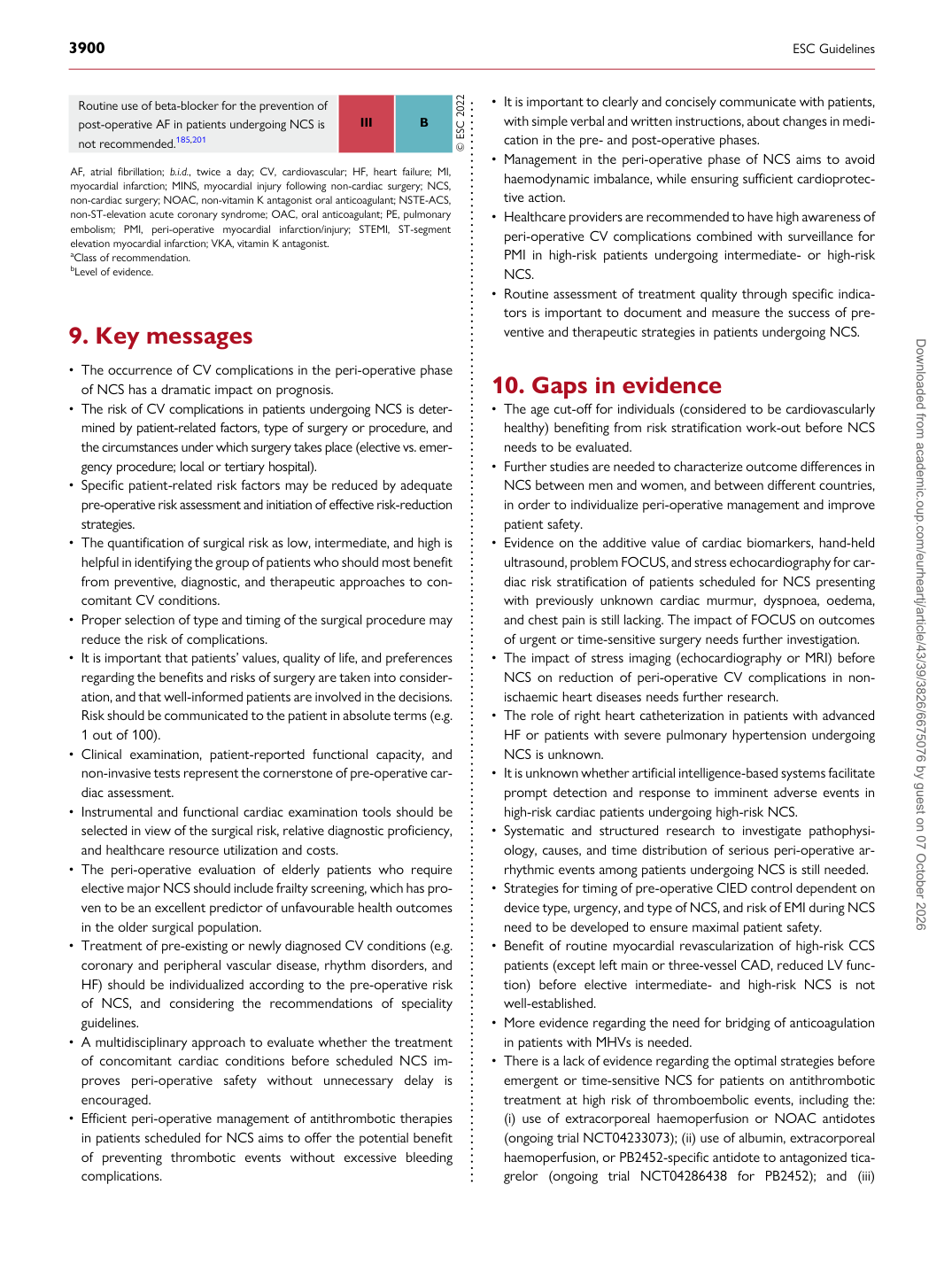
Routine use of beta-blocker for the prevention of post-operative AF in patients undergoing NCS is not recommended.185,201 III B © ESC 2022

AF, atrial fibrillation; b.i.d., twice a day; CV, cardiovascular; HF, heart failure; MI, myocardial infarction; MINS, myocardial injury following non-cardiac surgery; NCS, non-cardiac surgery; NOAC, non-vitamin K antagonist oral anticoagulant; NSTE-ACS, non-ST-elevation acute coronary syndrome; OAC, oral anticoagulant; PE, pulmonary embolism; PMI, peri-operative myocardial infarction/injury; STEMI, ST-segment elevation myocardial infarction; VKA, vitamin K antagonist. aClass of recommendation. bLevel of evidence.

Downloaded from academic.oup.com/eurheartj/article/43/39/3826/6675076 by guest on 07 October 2026