p.71 抽出テキスト
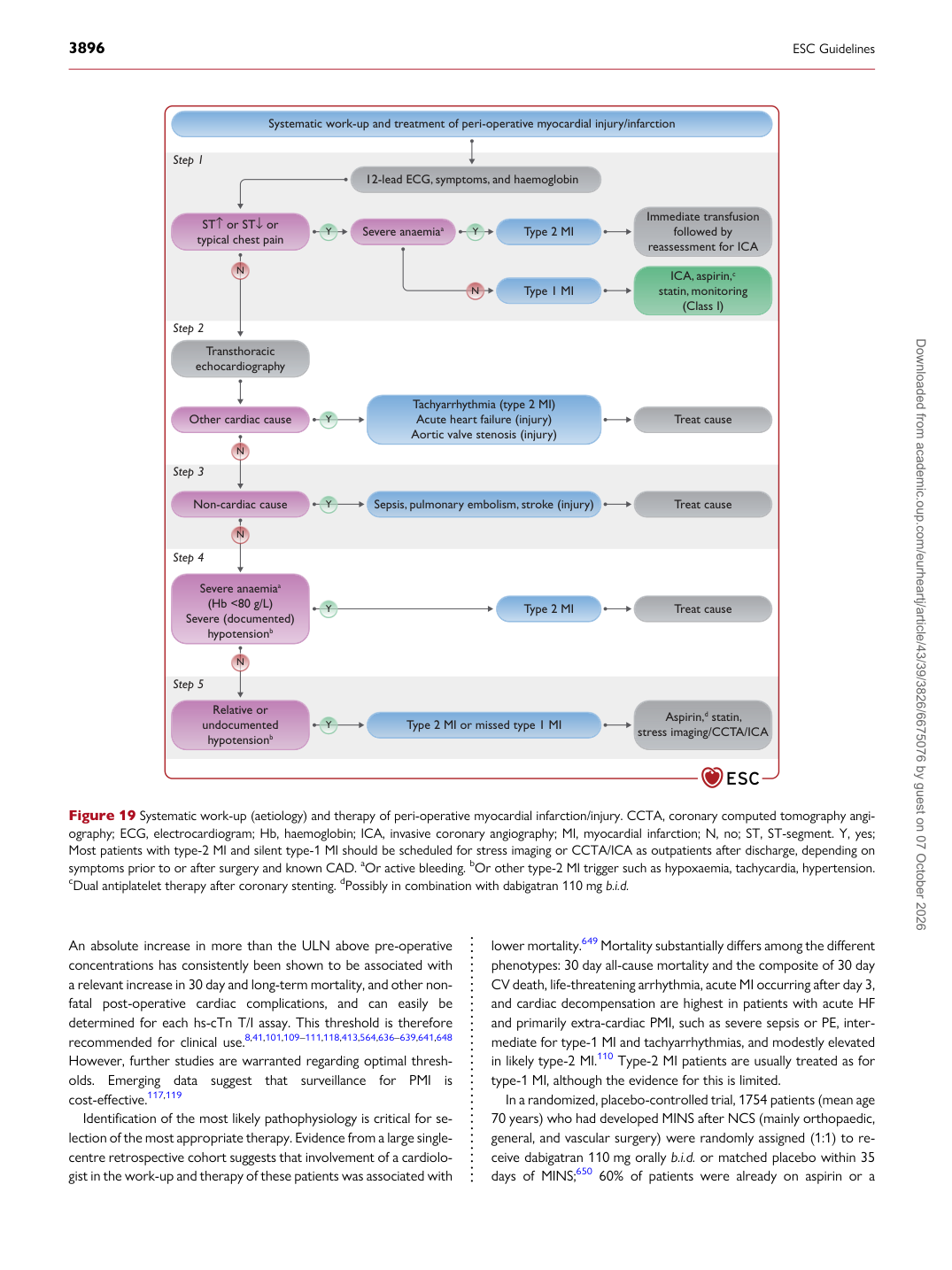
An absolute increase in more than the ULN above pre-operative concentrations has consistently been shown to be associated with a relevant increase in 30 day and long-term mortality, and other nonfatal post-operative cardiac complications, and can easily be determined for each hs-cTn T/I assay. This threshold is therefore recommended for clinical use.8,41,101,109–111,118,413,564,636–639,641,648 However, further studies are warranted regarding optimal thresholds. Emerging data suggest that surveillance for PMI is cost-effective.117,119 Identification of the most likely pathophysiology is critical for selection of the most appropriate therapy. Evidence from a large singlecentre retrospective cohort suggests that involvement of a cardiologist in the work-up and therapy of these patients was associated with lower mortality.649 Mortality substantially differs among the different phenotypes: 30 day all-cause mortality and the composite of 30 day CV death, life-threatening arrhythmia, acute MI occurring after day 3, and cardiac decompensation are highest in patients with acute HF and primarily extra-cardiac PMI, such as severe sepsis or PE, intermediate for type-1 MI and tachyarrhythmias, and modestly elevated in likely type-2 MI.110 Type-2 MI patients are usually treated as for type-1 MI, although the evidence for this is limited. In a randomized, placebo-controlled trial, 1754 patients (mean age 70 years) who had developed MINS after NCS (mainly orthopaedic, general, and vascular surgery) were randomly assigned (1:1) to receive dabigatran 110 mg orally b.i.d. or matched placebo within 35 days of MINS;650 60% of patients were already on aspirin or a N N Y Y Y ST or ST or typical chest pain Other cardiac cause Transthoracic echocardiography N N N Relative or undocumented hypotensionb Severe anaemiaa Type 2 MI Systematic work-up and treatment of peri-operative myocardial injury/infarction 12-lead ECG, symptoms, and haemoglobin Immediate transfusion followed by reassessment for ICA Aspirin,d statin, stress imaging/CCTA/ICA Y Y Severe anaemiaa (Hb <80 g/L) Severe (documented) hypotensionb Type 2 MI Step 5 Step 4 Step 3 Step 2 Step 1 Type 1 MI Tachyarrhythmia (type 2 MI) Acute heart failure (injury) Aortic valve stenosis (injury) Y Sepsis, pulmonary embolism, stroke (injury) ICA, aspirin,c statin, monitoring (Class I) Treat cause Treat cause Treat cause Non-cardiac cause Type 2 MI or missed type 1 MI Figure 19 Systematic work-up (aetiology) and therapy of peri-operative myocardial infarction/injury. CCTA, coronary computed tomography angiography; ECG, electrocardiogram; Hb, haemoglobin; ICA, invasive coronary angiography; MI, myocardial infarction; N, no; ST, ST-segment. Y, yes; Most patients with type-2 MI and silent type-1 MI should be scheduled for stress imaging or CCTA/ICA as outpatients after discharge, depending on symptoms prior to or after surgery and known CAD. aOr active bleeding. bOr other type-2 MI trigger such as hypoxaemia, tachycardia, hypertension. cDual antiplatelet therapy after coronary stenting. dPossibly in combination with dabigatran 110 mg b.i.d. Downloaded from academic.oup.com/eurheartj/article/43/39/3826/6675076 by guest on 07 October 2026