p.70 抽出テキスト
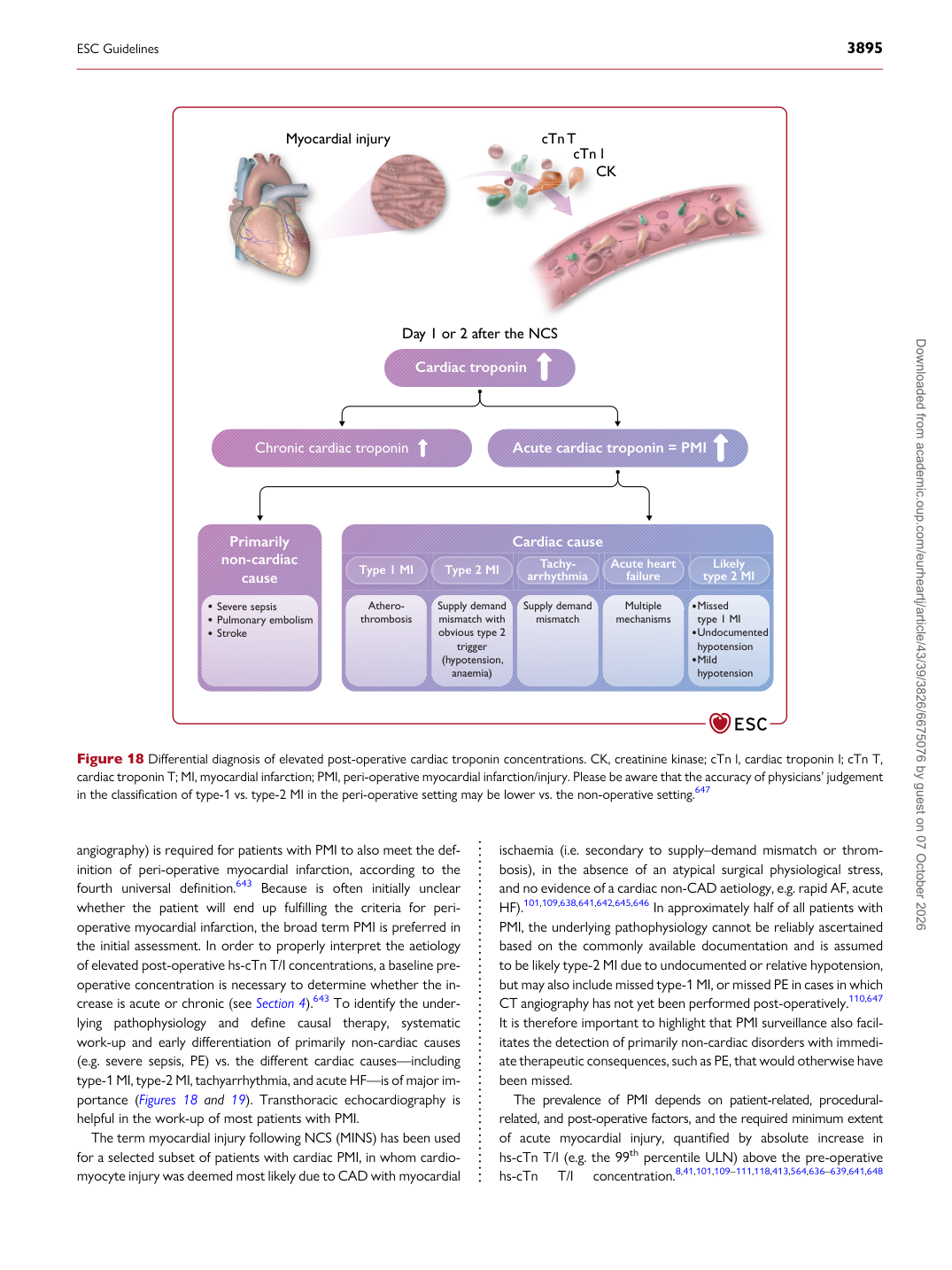
angiography) is required for patients with PMI to also meet the definition of peri-operative myocardial infarction, according to the fourth universal definition.643 Because is often initially unclear whether the patient will end up fulfilling the criteria for perioperative myocardial infarction, the broad term PMI is preferred in the initial assessment. In order to properly interpret the aetiology of elevated post-operative hs-cTn T/I concentrations, a baseline preoperative concentration is necessary to determine whether the increase is acute or chronic (see Section 4).643 To identify the underlying pathophysiology and define causal therapy, systematic work-up and early differentiation of primarily non-cardiac causes (e.g. severe sepsis, PE) vs. the different cardiac causes—including type-1 MI, type-2 MI, tachyarrhythmia, and acute HF—is of major importance (Figures 18 and 19). Transthoracic echocardiography is helpful in the work-up of most patients with PMI. The term myocardial injury following NCS (MINS) has been used for a selected subset of patients with cardiac PMI, in whom cardiomyocyte injury was deemed most likely due to CAD with myocardial ischaemia (i.e. secondary to supply–demand mismatch or thrombosis), in the absence of an atypical surgical physiological stress, and no evidence of a cardiac non-CAD aetiology, e.g. rapid AF, acute HF).101,109,638,641,642,645,646 In approximately half of all patients with PMI, the underlying pathophysiology cannot be reliably ascertained based on the commonly available documentation and is assumed to be likely type-2 MI due to undocumented or relative hypotension, but may also include missed type-1 MI, or missed PE in cases in which CT angiography has not yet been performed post-operatively.110,647

It is therefore important to highlight that PMI surveillance also facilitates the detection of primarily non-cardiac disorders with immediate therapeutic consequences, such as PE, that would otherwise have been missed. The prevalence of PMI depends on patient-related, proceduralrelated, and post-operative factors, and the required minimum extent of acute myocardial injury, quantified by absolute increase in hs-cTn T/I (e.g. the 99th percentile ULN) above the pre-operative hs-cTn T/I concentration.8,41,101,109–111,118,413,564,636–639,641,648

Cardiac troponin

Chronic cardiac troponin Acute cardiac troponin = PMI

Primarily non-cardiac

cause Cardiac cause Severe sepsis Pulmonary embolism Stroke Atherothrombosis

Type 1 MI Type 2 MI

Supply demand mismatch with obvious type 2 trigger (hypotension,

anaemia) Tachyarrhythmia

Supply demand

mismatch Acute heart

failure

Multiple mechanisms Likely type 2 MI

Missed type 1 MI Undocumented hypotension Mild hypotension

Day 1 or 2 after the NCS CK

cTn T

cTn l Myocardial injury

Figure 18 Differential diagnosis of elevated post-operative cardiac troponin concentrations. CK, creatinine kinase; cTn l, cardiac troponin I; cTn T, cardiac troponin T; MI, myocardial infarction; PMI, peri-operative myocardial infarction/injury. Please be aware that the accuracy of physicians’ judgement in the classification of type-1 vs. type-2 MI in the peri-operative setting may be lower vs. the non-operative setting.647

ESC Guidelines                                                                                                                                                                                     3895

Downloaded from academic.oup.com/eurheartj/article/43/39/3826/6675076 by guest on 07 October 2026