p.68 抽出テキスト
Current research is focusing on alternatives for neuraxial analgesia with similar effects on peri-operative pain control in patients with cardiac comorbidities undergoing NCS; these include alternative analgesic techniques such as i.v. analgesia, continuous wound infiltration, paravertebral bloc, and selective nerve blocks.

7.4 Peri-operative goal-directed

haemodynamic therapy Goal-directed therapy aims to optimize CV performance, in order to achieve normal or even supranormal oxygen delivery to tissues, by optimizing pre-load and inotropic function using pre-defined haemodynamic targets. In contrast to clinical signs or arterial pressure-orientated standard therapy, goal-directed therapy is based on flow or fluid responsiveness of haemodynamic variables, such as stroke volume, response to fluid challenges, stroke volume or pulse pressure variation, or similar optimization of cardiac output. Goal-directed therapy was initially based on the use of a pulmonary artery catheter. Less-invasive techniques have recently been developed, including: transoesophageal Doppler, transpulmonary dilution techniques, and advanced pressure waveform analysis. Early goaldirected fluid therapy—in the right patient cohort and with a clearly defined protocol—has been shown to decrease post-operative mortality and morbidity.614–618

7.5 Post-operative management

Several studies have demonstrated that it is possible to stratify the risk of post-operative complications and mortality with a simple surgical Apgar score. This post-event stratification might enable patients to be redirected to higher-intensity care units. The importance of such risk stratification is underscored by the results of the EuSOS group. In this 7 day cohort study, 46 539 consecutive adult NCS patients in 498 hospitals across 28 European nations were included: 1855 patients (4%) died before hospital discharge and 1358 (73%) of those patients were not admitted to critical care at any stage after surgery.7 This concept of failure-to-rescue has gained a lot of attention in peri-operative medicine in the last few years and strategies have been proposed to address this issue.619–622 Severe post-operative pain occurs in 5–10% of patients, increases sympathetic drive, and delays recovery.623,624 A recent study demonstrated that time-weighted average pain scores within 72 h after surgery were significantly associated with myocardial injury in patients undergoing NCS;625 this finding underscores the importance of effective post-operative analgesia to reduce post-operative CV risk. The place of non-steroidal anti-inflammatory drugs (NSAIDs) in the treatment of post-operative pain in cardiac patients undergoing NCS is a point of debate. Diclofenac has been shown to carry the highest CV risk of any of the non-selective NSAIDs.626,627 The CV risk of ibuprofen seems to be comparable with that of celecoxib.628 Naproxen has a better CV safety profile than diclofenac and ibuprofen.629,630 One randomized trial found that parecoxib and valdecoxib did not increase thromboembolic events in patients undergoing NCS. A meta-analysis of 32 randomized trials did not find an increased CV risk when comparing parecoxib/valdecoxib with placebo,631 and a single-centre observational study with .10 000 patients undergoing arthroplasty found no association between NSAID use and post-operative MI.632 In contrast, another meta-analysis of three randomized trials including 2604 major surgery patients detected a 2.3-fold increase in MACEs in the group with COX-2 inhibitors. In a position paper, The ESC Working Group on Cardiovascular Pharmacotherapy advises that non-aspirin NSAIDs should generally not be used in patients with established or at high risk of CVD.633

8 Peri-operative cardiovascular

complications

Specific challenges apply to detecting CV complications that occur peri-operatively. First, due to anaesthesia and analgesia, PMI, which is the most common CV complication, is largely asymptomatic in ≏90% of patients and is therefore missed in routine clinical practice in the absence of surveillance for PMI.41,101,111,413,636–641 Second, post-operative pain, nausea, surgical wounds, and drains may interfere with the early identification of acute cardiac disorders, such as PMI, Takotsubo syndrome, tachyarrhythmias, and acute HF. Third, cardiologists are usually not directly involved in post-operative care; therefore, the early detection and early treatment of cardiac complications is performed by non-cardiologists, sometimes with little training in the early detection of acute cardiac disorders. Given the relatively high prevalence of cardiac complications, their high morbidity and mortality, and the availability of effective therapy, high awareness combined with surveillance for PMI in high-risk patients (known CAD, PAD, insulin-dependent DM, or symptoms suggestive of cardiac disorders) undergoing intermediate- or high-risk NCS is recommended to overcome

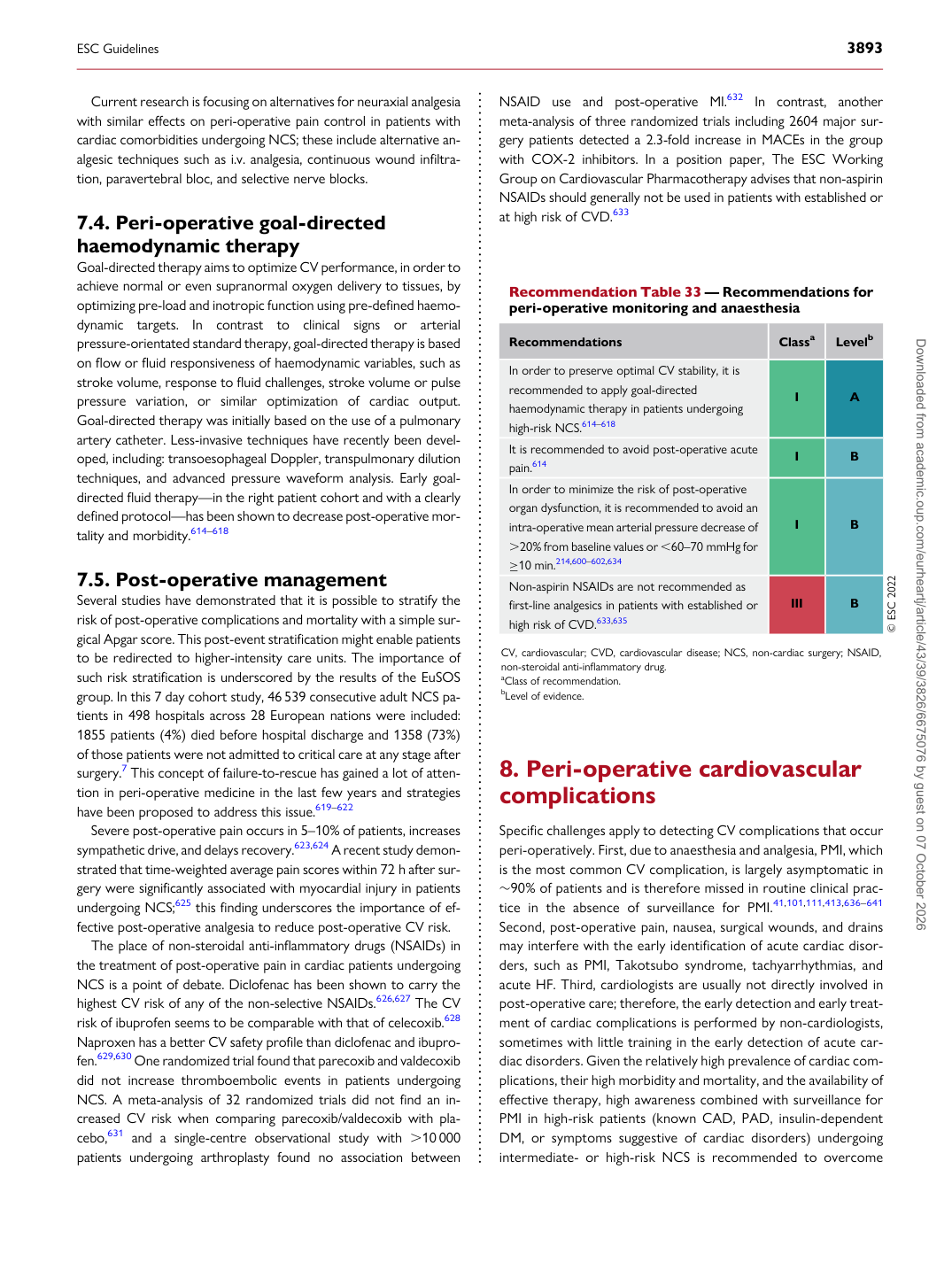
Recommendation Table 33 — Recommendations for peri-operative monitoring and anaesthesia

Recommendations Classa Levelb

In order to preserve optimal CV stability, it is recommended to apply goal-directed haemodynamic therapy in patients undergoing high-risk NCS.614–618 I A It is recommended to avoid post-operative acute pain.614 I B In order to minimize the risk of post-operative organ dysfunction, it is recommended to avoid an intra-operative mean arterial pressure decrease of .20% from baseline values or ,60–70 mmHg for ≥10 min.214,600–602,634 I B Non-aspirin NSAIDs are not recommended as first-line analgesics in patients with established or high risk of CVD.633,635 III B © ESC 2022

CV, cardiovascular; CVD, cardiovascular disease; NCS, non-cardiac surgery; NSAID, non-steroidal anti-inflammatory drug. aClass of recommendation. bLevel of evidence.

ESC Guidelines                                                                                                                                                                                     3893

Downloaded from academic.oup.com/eurheartj/article/43/39/3826/6675076 by guest on 07 October 2026