p.67 抽出テキスト
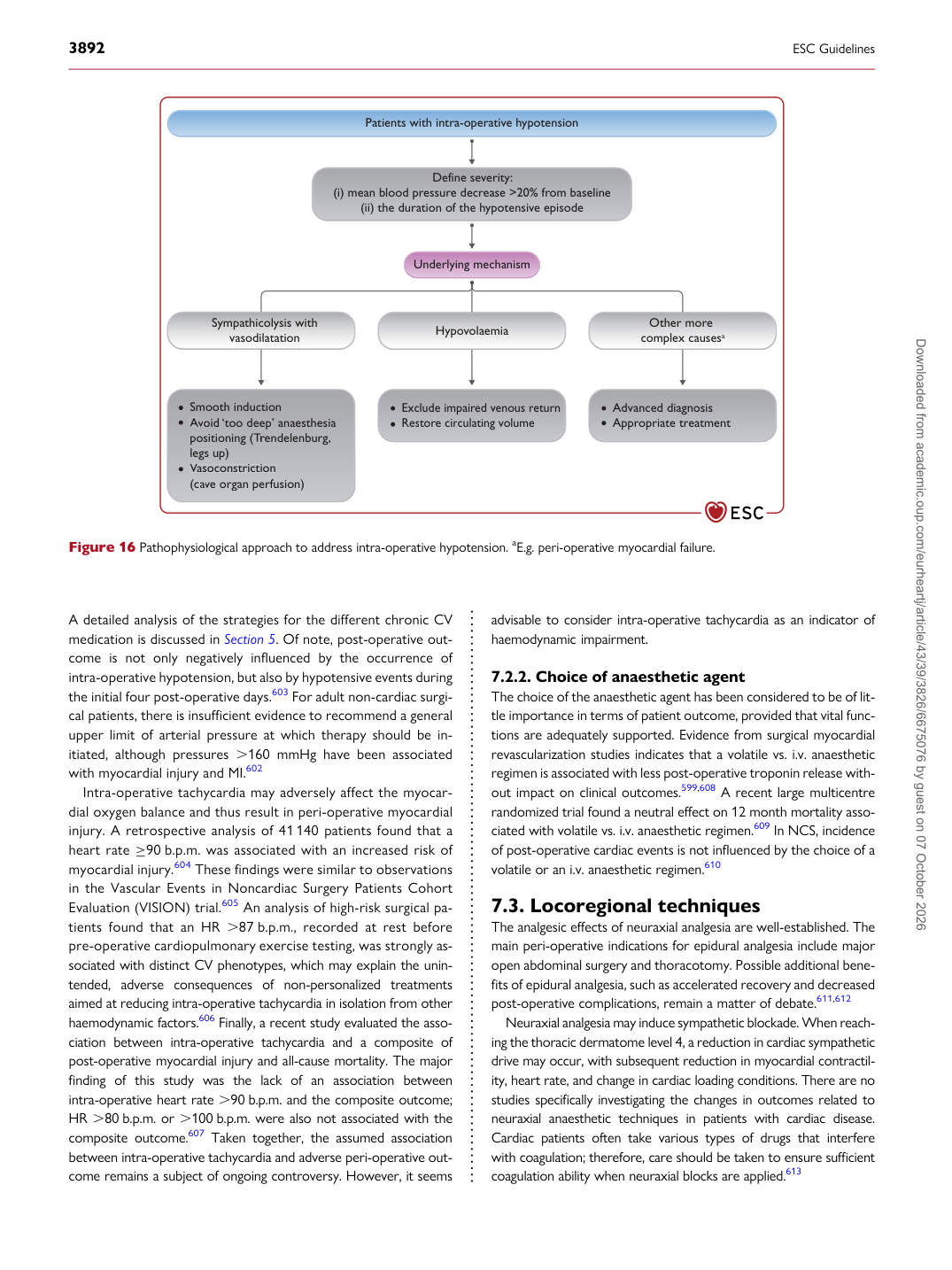
A detailed analysis of the strategies for the different chronic CV medication is discussed in Section 5. Of note, post-operative outcome is not only negatively influenced by the occurrence of intra-operative hypotension, but also by hypotensive events during the initial four post-operative days.603 For adult non-cardiac surgical patients, there is insufficient evidence to recommend a general upper limit of arterial pressure at which therapy should be initiated, although pressures .160 mmHg have been associated with myocardial injury and MI.602 Intra-operative tachycardia may adversely affect the myocardial oxygen balance and thus result in peri-operative myocardial injury. A retrospective analysis of 41 140 patients found that a heart rate ≥90 b.p.m. was associated with an increased risk of myocardial injury.604 These findings were similar to observations in the Vascular Events in Noncardiac Surgery Patients Cohort Evaluation (VISION) trial.605 An analysis of high-risk surgical patients found that an HR .87 b.p.m., recorded at rest before pre-operative cardiopulmonary exercise testing, was strongly associated with distinct CV phenotypes, which may explain the unintended, adverse consequences of non-personalized treatments aimed at reducing intra-operative tachycardia in isolation from other haemodynamic factors.606 Finally, a recent study evaluated the association between intra-operative tachycardia and a composite of post-operative myocardial injury and all-cause mortality. The major finding of this study was the lack of an association between intra-operative heart rate .90 b.p.m. and the composite outcome; HR .80 b.p.m. or .100 b.p.m. were also not associated with the composite outcome.607 Taken together, the assumed association between intra-operative tachycardia and adverse peri-operative outcome remains a subject of ongoing controversy. However, it seems advisable to consider intra-operative tachycardia as an indicator of haemodynamic impairment.

7.2.2 Choice of anaesthetic agent

The choice of the anaesthetic agent has been considered to be of little importance in terms of patient outcome, provided that vital functions are adequately supported. Evidence from surgical myocardial revascularization studies indicates that a volatile vs. i.v. anaesthetic regimen is associated with less post-operative troponin release without impact on clinical outcomes.599,608 A recent large multicentre randomized trial found a neutral effect on 12 month mortality associated with volatile vs. i.v. anaesthetic regimen.609 In NCS, incidence of post-operative cardiac events is not influenced by the choice of a volatile or an i.v. anaesthetic regimen.610

7.3 Locoregional techniques

The analgesic effects of neuraxial analgesia are well-established. The main peri-operative indications for epidural analgesia include major open abdominal surgery and thoracotomy. Possible additional benefits of epidural analgesia, such as accelerated recovery and decreased post-operative complications, remain a matter of debate.611,612 Neuraxial analgesia may induce sympathetic blockade. When reaching the thoracic dermatome level 4, a reduction in cardiac sympathetic drive may occur, with subsequent reduction in myocardial contractility, heart rate, and change in cardiac loading conditions. There are no studies specifically investigating the changes in outcomes related to neuraxial anaesthetic techniques in patients with cardiac disease. Cardiac patients often take various types of drugs that interfere with coagulation; therefore, care should be taken to ensure sufficient coagulation ability when neuraxial blocks are applied.613

Define s e v erity:

(i ) mean blood p r essu r e dec r ease >20% f r om baseline

(ii ) the duration of the h ypotensi v e episode

Patients with intra-operati v e h ypotension

Under l ying mechanism

Sympathico l ysis with

vasodilatation Hyp o v olaemia Other mo r e

complex causes a

Smooth induction A v

A

A oid ‘too deep’ anaesthesia positioning ( T r

T

T endelenburg, legs up) V asoconstriction

V

V (c a v

a a e organ perfusion) Advanced diagnosis

App r opriate t r eatment

Ex c lu de imp a i r e d v en ous r et u r n R es t o r e c i r c ul a tin g v o l u m e

Figure 16 Pathophysiological approach to address intra-operative hypotension. aE.g. peri-operative myocardial failure. Downloaded from academic.oup.com/eurheartj/article/43/39/3826/6675076 by guest on 07 October 2026