p.64 抽出テキスト
6.13 Diabetes

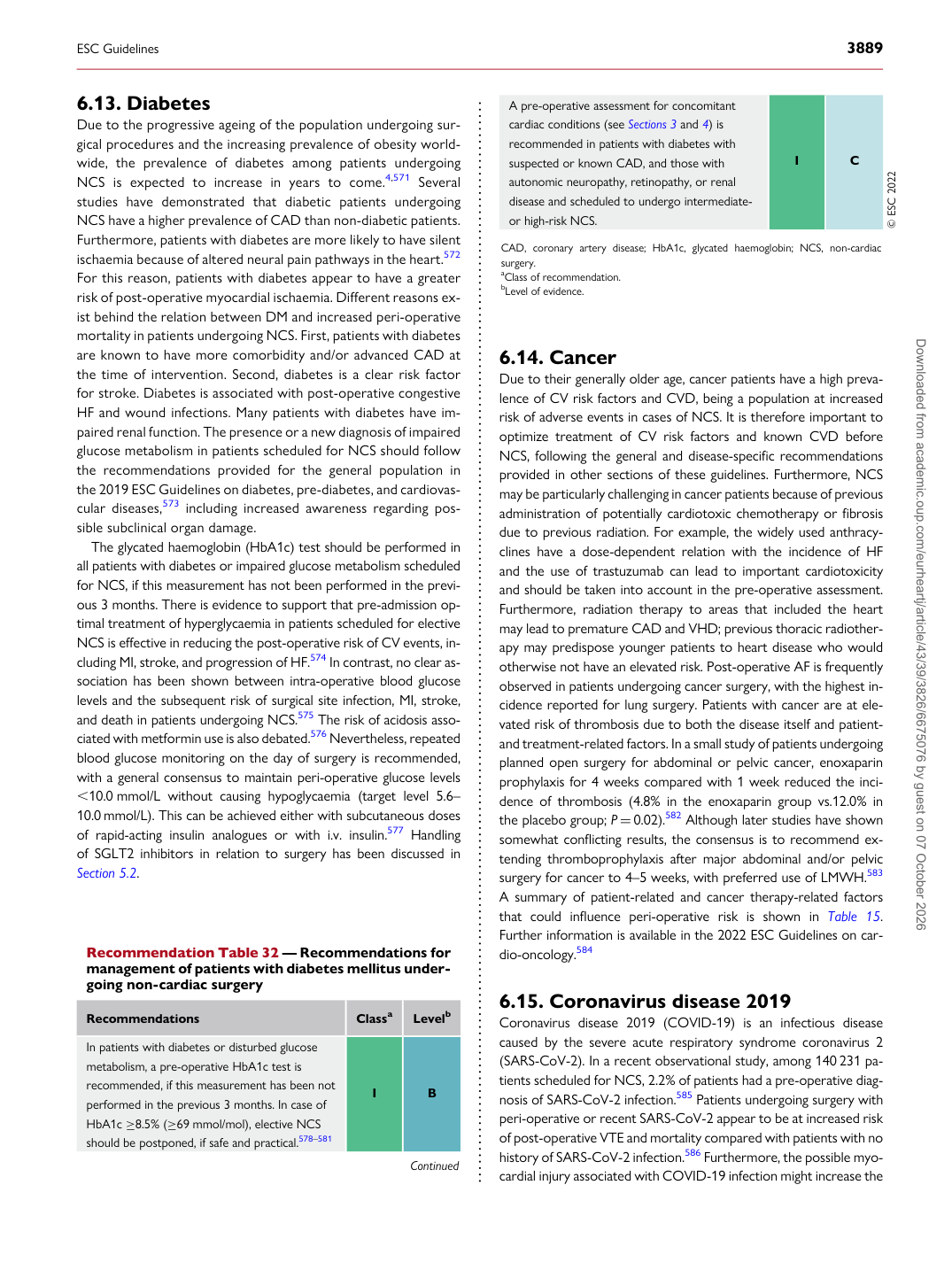
Due to the progressive ageing of the population undergoing surgical procedures and the increasing prevalence of obesity worldwide, the prevalence of diabetes among patients undergoing NCS is expected to increase in years to come.4,571 Several studies have demonstrated that diabetic patients undergoing NCS have a higher prevalence of CAD than non-diabetic patients. Furthermore, patients with diabetes are more likely to have silent ischaemia because of altered neural pain pathways in the heart.572 For this reason, patients with diabetes appear to have a greater risk of post-operative myocardial ischaemia. Different reasons exist behind the relation between DM and increased peri-operative mortality in patients undergoing NCS. First, patients with diabetes are known to have more comorbidity and/or advanced CAD at the time of intervention. Second, diabetes is a clear risk factor for stroke. Diabetes is associated with post-operative congestive HF and wound infections. Many patients with diabetes have impaired renal function. The presence or a new diagnosis of impaired glucose metabolism in patients scheduled for NCS should follow the recommendations provided for the general population in the 2019 ESC Guidelines on diabetes, pre-diabetes, and cardiovascular diseases,573 including increased awareness regarding possible subclinical organ damage. The glycated haemoglobin (HbA1c) test should be performed in all patients with diabetes or impaired glucose metabolism scheduled for NCS, if this measurement has not been performed in the previous 3 months. There is evidence to support that pre-admission optimal treatment of hyperglycaemia in patients scheduled for elective NCS is effective in reducing the post-operative risk of CV events, including MI, stroke, and progression of HF.574 In contrast, no clear association has been shown between intra-operative blood glucose levels and the subsequent risk of surgical site infection, MI, stroke, and death in patients undergoing NCS.575 The risk of acidosis associated with metformin use is also debated.576 Nevertheless, repeated blood glucose monitoring on the day of surgery is recommended, with a general consensus to maintain peri-operative glucose levels ,10.0 mmol/L without causing hypoglycaemia (target level 5.6– 10.0 mmol/L). This can be achieved either with subcutaneous doses of rapid-acting insulin analogues or with i.v. insulin.577 Handling of SGLT2 inhibitors in relation to surgery has been discussed in Section 5.2. 6.14 Cancer

Due to their generally older age, cancer patients have a high prevalence of CV risk factors and CVD, being a population at increased risk of adverse events in cases of NCS. It is therefore important to optimize treatment of CV risk factors and known CVD before NCS, following the general and disease-specific recommendations provided in other sections of these guidelines. Furthermore, NCS may be particularly challenging in cancer patients because of previous administration of potentially cardiotoxic chemotherapy or fibrosis due to previous radiation. For example, the widely used anthracyclines have a dose-dependent relation with the incidence of HF and the use of trastuzumab can lead to important cardiotoxicity and should be taken into account in the pre-operative assessment. Furthermore, radiation therapy to areas that included the heart may lead to premature CAD and VHD; previous thoracic radiotherapy may predispose younger patients to heart disease who would otherwise not have an elevated risk. Post-operative AF is frequently observed in patients undergoing cancer surgery, with the highest incidence reported for lung surgery. Patients with cancer are at elevated risk of thrombosis due to both the disease itself and patientand treatment-related factors. In a small study of patients undergoing planned open surgery for abdominal or pelvic cancer, enoxaparin prophylaxis for 4 weeks compared with 1 week reduced the incidence of thrombosis (4.8% in the enoxaparin group vs.12.0% in the placebo group; P = 0.02).582 Although later studies have shown somewhat conflicting results, the consensus is to recommend extending thromboprophylaxis after major abdominal and/or pelvic surgery for cancer to 4–5 weeks, with preferred use of LMWH.583 A summary of patient-related and cancer therapy-related factors that could influence peri-operative risk is shown in Table 15. Further information is available in the 2022 ESC Guidelines on cardio-oncology.584

6.15 Coronavirus disease 2019

Coronavirus disease 2019 (COVID-19) is an infectious disease caused by the severe acute respiratory syndrome coronavirus 2 (SARS-CoV-2). In a recent observational study, among 140 231 patients scheduled for NCS, 2.2% of patients had a pre-operative diagnosis of SARS-CoV-2 infection.585 Patients undergoing surgery with peri-operative or recent SARS-CoV-2 appear to be at increased risk of post-operative VTE and mortality compared with patients with no history of SARS-CoV-2 infection.586 Furthermore, the possible myocardial injury associated with COVID-19 infection might increase the

Recommendation Table 32 — Recommendations for management of patients with diabetes mellitus undergoing non-cardiac surgery

Recommendations Classa Levelb

In patients with diabetes or disturbed glucose metabolism, a pre-operative HbA1c test is recommended, if this measurement has been not performed in the previous 3 months. In case of HbA1c ≥8.5% (≥69 mmol/mol), elective NCS should be postponed, if safe and practical.578–581 I B

Continued A pre-operative assessment for concomitant

cardiac conditions (see Sections 3 and 4) is recommended in patients with diabetes with suspected or known CAD, and those with autonomic neuropathy, retinopathy, or renal disease and scheduled to undergo intermediateor high-risk NCS. I C © ESC 2022

CAD, coronary artery disease; HbA1c, glycated haemoglobin; NCS, non-cardiac surgery. aClass of recommendation. bLevel of evidence.

ESC Guidelines                                                                                                                                                                                     3889

Downloaded from academic.oup.com/eurheartj/article/43/39/3826/6675076 by guest on 07 October 2026