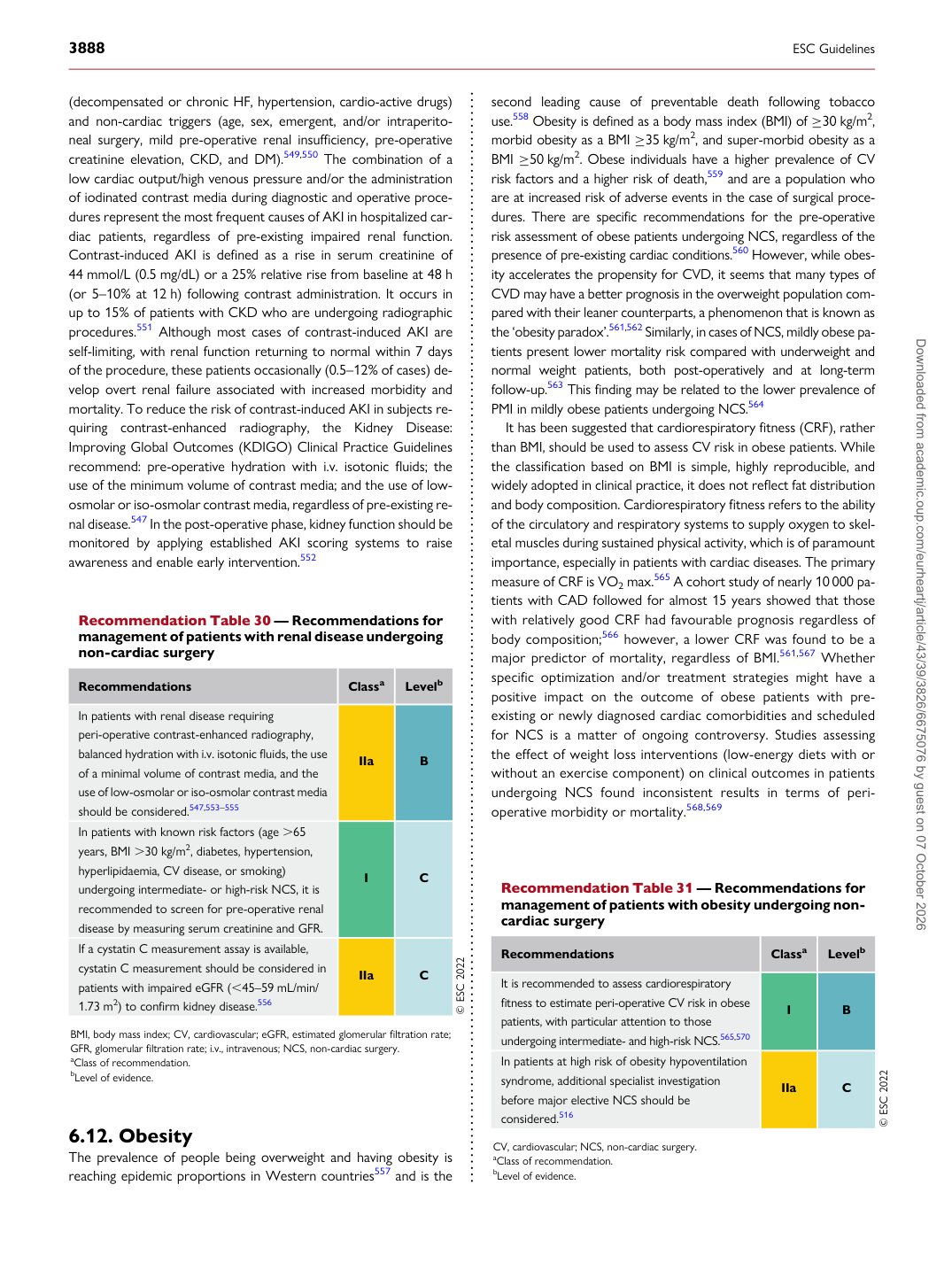
p.63 抽出テキスト
(decompensated or chronic HF, hypertension, cardio-active drugs) and non-cardiac triggers (age, sex, emergent, and/or intraperitoneal surgery, mild pre-operative renal insufficiency, pre-operative creatinine elevation, CKD, and DM).549,550 The combination of a low cardiac output/high venous pressure and/or the administration of iodinated contrast media during diagnostic and operative procedures represent the most frequent causes of AKI in hospitalized cardiac patients, regardless of pre-existing impaired renal function. Contrast-induced AKI is defined as a rise in serum creatinine of 44 mmol/L (0.5 mg/dL) or a 25% relative rise from baseline at 48 h (or 5–10% at 12 h) following contrast administration. It occurs in up to 15% of patients with CKD who are undergoing radiographic procedures.551 Although most cases of contrast-induced AKI are self-limiting, with renal function returning to normal within 7 days of the procedure, these patients occasionally (0.5–12% of cases) develop overt renal failure associated with increased morbidity and mortality. To reduce the risk of contrast-induced AKI in subjects requiring contrast-enhanced radiography, the Kidney Disease: Improving Global Outcomes (KDIGO) Clinical Practice Guidelines recommend: pre-operative hydration with i.v. isotonic fluids; the use of the minimum volume of contrast media; and the use of lowosmolar or iso-osmolar contrast media, regardless of pre-existing renal disease.547 In the post-operative phase, kidney function should be monitored by applying established AKI scoring systems to raise awareness and enable early intervention.552

6.12 Obesity

The prevalence of people being overweight and having obesity is reaching epidemic proportions in Western countries557 and is the second leading cause of preventable death following tobacco use.558 Obesity is defined as a body mass index (BMI) of ≥30 kg/m2, morbid obesity as a BMI ≥35 kg/m2, and super-morbid obesity as a BMI ≥50 kg/m2. Obese individuals have a higher prevalence of CV risk factors and a higher risk of death,559 and are a population who are at increased risk of adverse events in the case of surgical procedures. There are specific recommendations for the pre-operative risk assessment of obese patients undergoing NCS, regardless of the presence of pre-existing cardiac conditions.560 However, while obesity accelerates the propensity for CVD, it seems that many types of CVD may have a better prognosis in the overweight population compared with their leaner counterparts, a phenomenon that is known as the ‘obesity paradox’.561,562 Similarly, in cases of NCS, mildly obese patients present lower mortality risk compared with underweight and normal weight patients, both post-operatively and at long-term follow-up.563 This finding may be related to the lower prevalence of PMI in mildly obese patients undergoing NCS.564

It has been suggested that cardiorespiratory fitness (CRF), rather than BMI, should be used to assess CV risk in obese patients. While the classification based on BMI is simple, highly reproducible, and widely adopted in clinical practice, it does not reflect fat distribution and body composition. Cardiorespiratory fitness refers to the ability of the circulatory and respiratory systems to supply oxygen to skeletal muscles during sustained physical activity, which is of paramount importance, especially in patients with cardiac diseases. The primary measure of CRF is VO2 max.565 A cohort study of nearly 10 000 patients with CAD followed for almost 15 years showed that those with relatively good CRF had favourable prognosis regardless of body composition;566 however, a lower CRF was found to be a major predictor of mortality, regardless of BMI.561,567 Whether specific optimization and/or treatment strategies might have a positive impact on the outcome of obese patients with preexisting or newly diagnosed cardiac comorbidities and scheduled for NCS is a matter of ongoing controversy. Studies assessing the effect of weight loss interventions (low-energy diets with or without an exercise component) on clinical outcomes in patients undergoing NCS found inconsistent results in terms of perioperative morbidity or mortality.568,569

Recommendation Table 30 — Recommendations for management of patients with renal disease undergoing non-cardiac surgery

Recommendations Classa Levelb

In patients with renal disease requiring peri-operative contrast-enhanced radiography, balanced hydration with i.v. isotonic fluids, the use of a minimal volume of contrast media, and the use of low-osmolar or iso-osmolar contrast media should be considered.547,553–555 IIa B In patients with known risk factors (age .65 years, BMI .30 kg/m2, diabetes, hypertension, hyperlipidaemia, CV disease, or smoking) undergoing intermediate- or high-risk NCS, it is recommended to screen for pre-operative renal disease by measuring serum creatinine and GFR. I C If a cystatin C measurement assay is available, cystatin C measurement should be considered in patients with impaired eGFR (,45–59 mL/min/ 1.73 m2) to confirm kidney disease.556 IIa C © ESC 2022

BMI, body mass index; CV, cardiovascular; eGFR, estimated glomerular filtration rate; GFR, glomerular filtration rate; i.v., intravenous; NCS, non-cardiac surgery. aClass of recommendation. bLevel of evidence. Recommendation Table 31 — Recommendations for management of patients with obesity undergoing noncardiac surgery

Recommendations Classa Levelb

It is recommended to assess cardiorespiratory fitness to estimate peri-operative CV risk in obese patients, with particular attention to those undergoing intermediate- and high-risk NCS.565,570 I B In patients at high risk of obesity hypoventilation syndrome, additional specialist investigation before major elective NCS should be considered.516 IIa C © ESC 2022

CV, cardiovascular; NCS, non-cardiac surgery. aClass of recommendation. bLevel of evidence. Downloaded from academic.oup.com/eurheartj/article/43/39/3826/6675076 by guest on 07 October 2026