p.62 抽出テキスト
NCS and their treatment modality selection. Notably, there is randomized evidence against prophylactic coronary revascularization before major vascular surgery in CCS patients due to lack of benefit in improvement of peri-operative and long-term outcomes (2.7 years mean follow-up).399 Assessment of functional capacity might offer guidance to select candidates for cardiac assessment prior to major NCS, although severe walking impairment may challenge this test. The previously established risk predictive model to detect mortality in patients undergoing elective AAA repair may be helpful.543 Low-dose rivaroxaban plus aspirin initiated within 10 days after a lower limb revascularization procedure reduces post-operative thrombotic events (acute limb ischaemia, amputation, MI, ischaemic stroke, and CV death) in patients undergoing lower limb revascularization, whether it is carried out using an endovascular or open surgical approach.544 Handling of other co-drugs should follow the recommendations detailed in Section 5.2.

6.10 Cerebrovascular disease

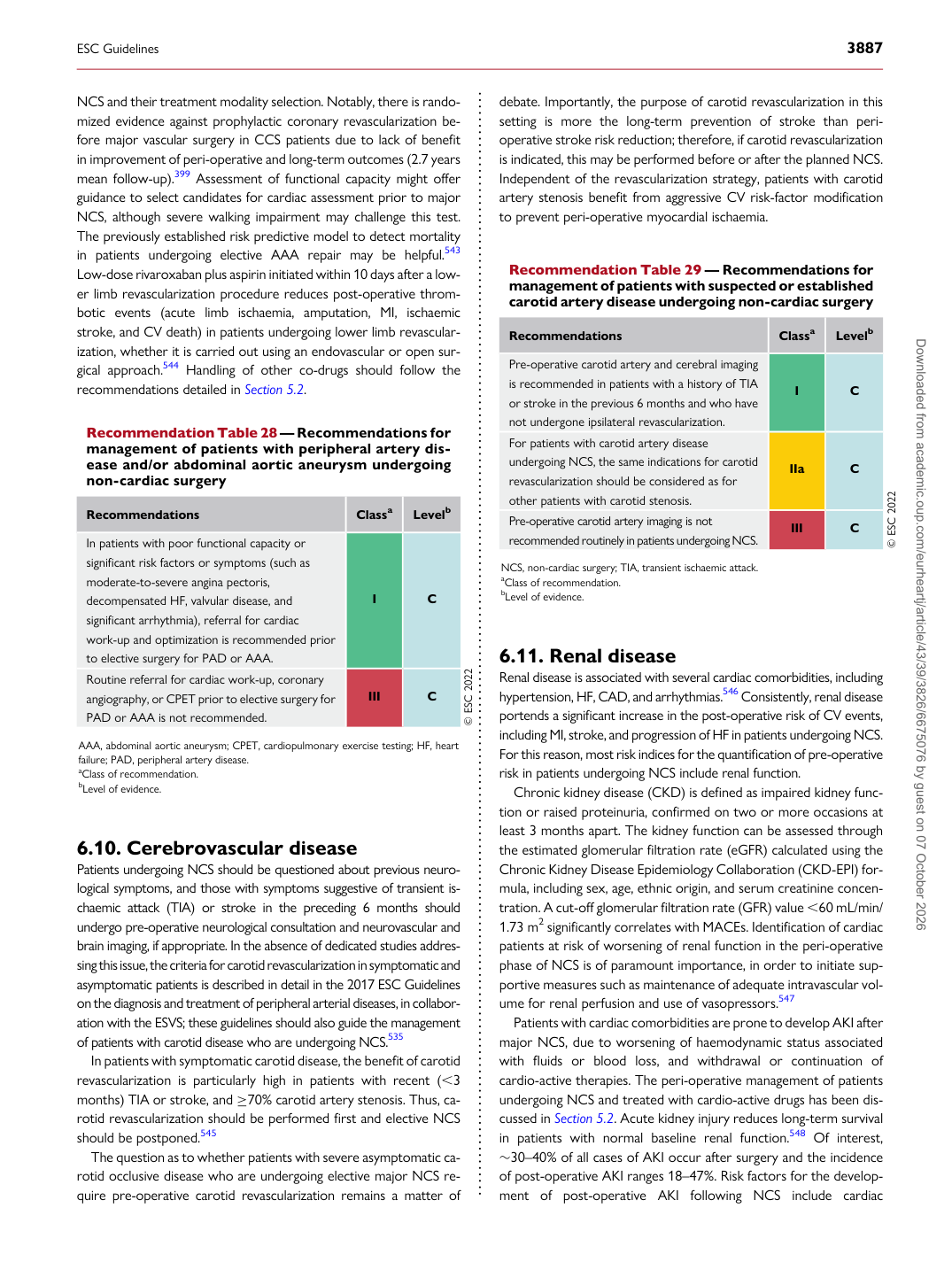
Patients undergoing NCS should be questioned about previous neurological symptoms, and those with symptoms suggestive of transient ischaemic attack (TIA) or stroke in the preceding 6 months should undergo pre-operative neurological consultation and neurovascular and brain imaging, if appropriate. In the absence of dedicated studies addressing this issue, the criteria for carotid revascularization in symptomatic and asymptomatic patients is described in detail in the 2017 ESC Guidelines on the diagnosis and treatment of peripheral arterial diseases, in collaboration with the ESVS; these guidelines should also guide the management of patients with carotid disease who are undergoing NCS.535 In patients with symptomatic carotid disease, the benefit of carotid revascularization is particularly high in patients with recent (,3 months) TIA or stroke, and ≥70% carotid artery stenosis. Thus, carotid revascularization should be performed first and elective NCS should be postponed.545 The question as to whether patients with severe asymptomatic carotid occlusive disease who are undergoing elective major NCS require pre-operative carotid revascularization remains a matter of debate. Importantly, the purpose of carotid revascularization in this setting is more the long-term prevention of stroke than perioperative stroke risk reduction; therefore, if carotid revascularization is indicated, this may be performed before or after the planned NCS. Independent of the revascularization strategy, patients with carotid artery stenosis benefit from aggressive CV risk-factor modification to prevent peri-operative myocardial ischaemia.

6.11 Renal disease

Renal disease is associated with several cardiac comorbidities, including hypertension, HF, CAD, and arrhythmias.546 Consistently, renal disease portends a significant increase in the post-operative risk of CV events, including MI, stroke, and progression of HF in patients undergoing NCS. For this reason, most risk indices for the quantification of pre-operative risk in patients undergoing NCS include renal function. Chronic kidney disease (CKD) is defined as impaired kidney function or raised proteinuria, confirmed on two or more occasions at least 3 months apart. The kidney function can be assessed through the estimated glomerular filtration rate (eGFR) calculated using the Chronic Kidney Disease Epidemiology Collaboration (CKD-EPI) formula, including sex, age, ethnic origin, and serum creatinine concentration. A cut-off glomerular filtration rate (GFR) value ,60 mL/min/ 1.73 m2 significantly correlates with MACEs. Identification of cardiac patients at risk of worsening of renal function in the peri-operative phase of NCS is of paramount importance, in order to initiate supportive measures such as maintenance of adequate intravascular volume for renal perfusion and use of vasopressors.547 Patients with cardiac comorbidities are prone to develop AKI after major NCS, due to worsening of haemodynamic status associated with fluids or blood loss, and withdrawal or continuation of cardio-active therapies. The peri-operative management of patients undergoing NCS and treated with cardio-active drugs has been discussed in Section 5.2. Acute kidney injury reduces long-term survival in patients with normal baseline renal function.548 Of interest, ≏30–40% of all cases of AKI occur after surgery and the incidence of post-operative AKI ranges 18–47%. Risk factors for the development of post-operative AKI following NCS include cardiac

Recommendation Table 28 — Recommendations for management of patients with peripheral artery disease and/or abdominal aortic aneurysm undergoing non-cardiac surgery

Recommendations Classa Levelb

In patients with poor functional capacity or significant risk factors or symptoms (such as moderate-to-severe angina pectoris, decompensated HF, valvular disease, and significant arrhythmia), referral for cardiac work-up and optimization is recommended prior to elective surgery for PAD or AAA. I C Routine referral for cardiac work-up, coronary angiography, or CPET prior to elective surgery for PAD or AAA is not recommended. III C © ESC 2022

AAA, abdominal aortic aneurysm; CPET, cardiopulmonary exercise testing; HF, heart failure; PAD, peripheral artery disease. aClass of recommendation. bLevel of evidence. Recommendation Table 29 — Recommendations for management of patients with suspected or established carotid artery disease undergoing non-cardiac surgery

Recommendations Classa Levelb

Pre-operative carotid artery and cerebral imaging is recommended in patients with a history of TIA or stroke in the previous 6 months and who have not undergone ipsilateral revascularization. I C For patients with carotid artery disease undergoing NCS, the same indications for carotid revascularization should be considered as for other patients with carotid stenosis. IIa C Pre-operative carotid artery imaging is not recommended routinely in patients undergoing NCS. III C © ESC 2022

NCS, non-cardiac surgery; TIA, transient ischaemic attack. aClass of recommendation. bLevel of evidence.

ESC Guidelines                                                                                                                                                                                     3887

Downloaded from academic.oup.com/eurheartj/article/43/39/3826/6675076 by guest on 07 October 2026