p.61 抽出テキスト
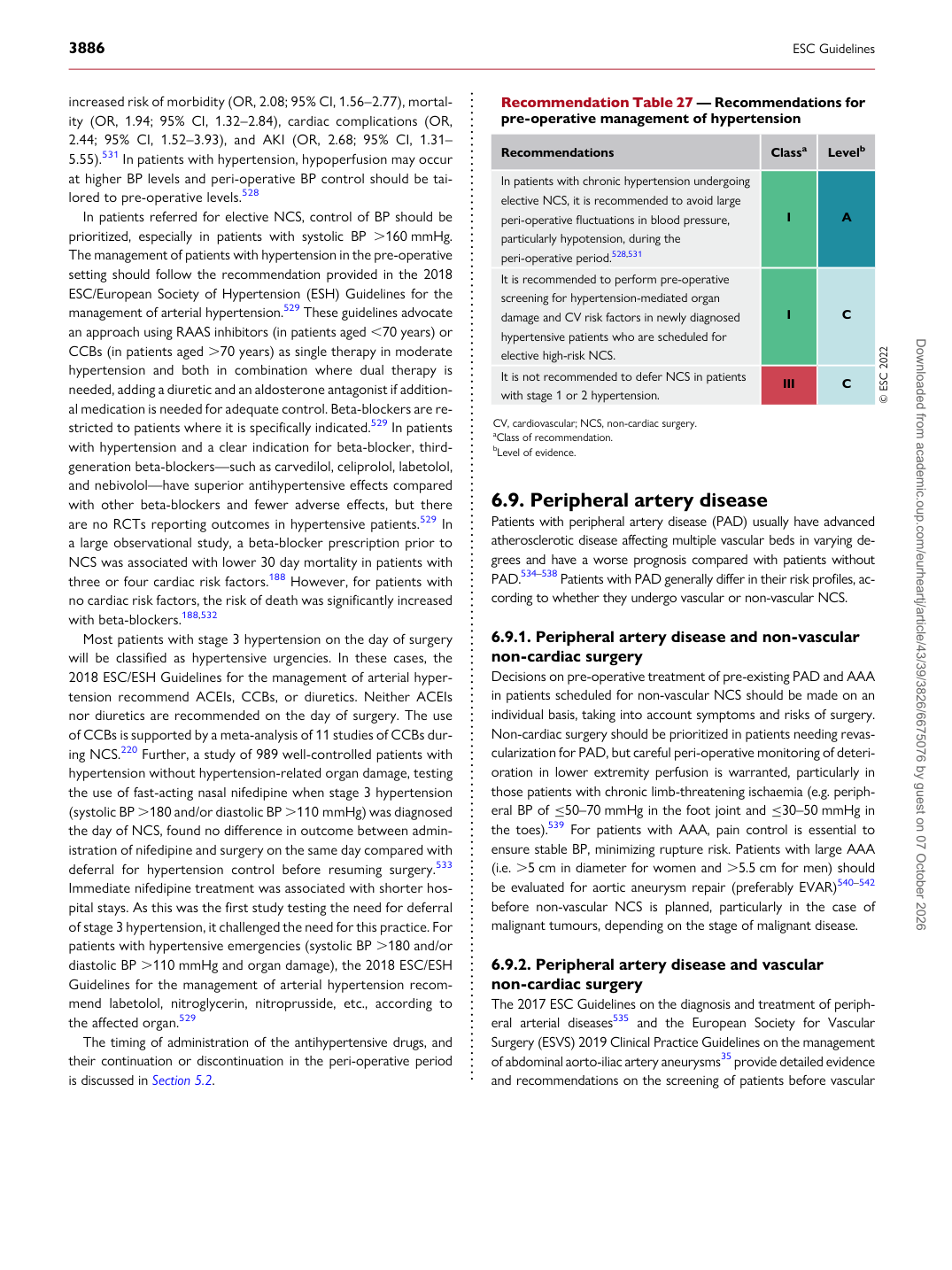
increased risk of morbidity (OR, 2.08; 95% CI, 1.56–2.77), mortality (OR, 1.94; 95% CI, 1.32–2.84), cardiac complications (OR, 2.44; 95% CI, 1.52–3.93), and AKI (OR, 2.68; 95% CI, 1.31– 5.55).531 In patients with hypertension, hypoperfusion may occur at higher BP levels and peri-operative BP control should be tailored to pre-operative levels.528 In patients referred for elective NCS, control of BP should be prioritized, especially in patients with systolic BP .160 mmHg. The management of patients with hypertension in the pre-operative setting should follow the recommendation provided in the 2018 ESC/European Society of Hypertension (ESH) Guidelines for the management of arterial hypertension.529 These guidelines advocate an approach using RAAS inhibitors (in patients aged ,70 years) or CCBs (in patients aged .70 years) as single therapy in moderate hypertension and both in combination where dual therapy is needed, adding a diuretic and an aldosterone antagonist if additional medication is needed for adequate control. Beta-blockers are restricted to patients where it is specifically indicated.529 In patients with hypertension and a clear indication for beta-blocker, thirdgeneration beta-blockers—such as carvedilol, celiprolol, labetolol, and nebivolol—have superior antihypertensive effects compared with other beta-blockers and fewer adverse effects, but there are no RCTs reporting outcomes in hypertensive patients.529 In a large observational study, a beta-blocker prescription prior to NCS was associated with lower 30 day mortality in patients with three or four cardiac risk factors.188 However, for patients with no cardiac risk factors, the risk of death was significantly increased with beta-blockers.188,532 Most patients with stage 3 hypertension on the day of surgery will be classified as hypertensive urgencies. In these cases, the 2018 ESC/ESH Guidelines for the management of arterial hypertension recommend ACEIs, CCBs, or diuretics. Neither ACEIs nor diuretics are recommended on the day of surgery. The use of CCBs is supported by a meta-analysis of 11 studies of CCBs during NCS.220 Further, a study of 989 well-controlled patients with hypertension without hypertension-related organ damage, testing the use of fast-acting nasal nifedipine when stage 3 hypertension (systolic BP .180 and/or diastolic BP .110 mmHg) was diagnosed the day of NCS, found no difference in outcome between administration of nifedipine and surgery on the same day compared with deferral for hypertension control before resuming surgery.533 Immediate nifedipine treatment was associated with shorter hospital stays. As this was the first study testing the need for deferral of stage 3 hypertension, it challenged the need for this practice. For patients with hypertensive emergencies (systolic BP .180 and/or diastolic BP .110 mmHg and organ damage), the 2018 ESC/ESH Guidelines for the management of arterial hypertension recommend labetolol, nitroglycerin, nitroprusside, etc., according to the affected organ.529 The timing of administration of the antihypertensive drugs, and their continuation or discontinuation in the peri-operative period is discussed in Section 5.2. 6.9 Peripheral artery disease

Patients with peripheral artery disease (PAD) usually have advanced atherosclerotic disease affecting multiple vascular beds in varying degrees and have a worse prognosis compared with patients without PAD.534–538 Patients with PAD generally differ in their risk profiles, according to whether they undergo vascular or non-vascular NCS.

6.9.1 Peripheral artery disease and non-vascular

non-cardiac surgery Decisions on pre-operative treatment of pre-existing PAD and AAA in patients scheduled for non-vascular NCS should be made on an individual basis, taking into account symptoms and risks of surgery. Non-cardiac surgery should be prioritized in patients needing revascularization for PAD, but careful peri-operative monitoring of deterioration in lower extremity perfusion is warranted, particularly in those patients with chronic limb-threatening ischaemia (e.g. peripheral BP of ≤50–70 mmHg in the foot joint and ≤30–50 mmHg in the toes).539 For patients with AAA, pain control is essential to ensure stable BP, minimizing rupture risk. Patients with large AAA (i.e. .5 cm in diameter for women and .5.5 cm for men) should be evaluated for aortic aneurysm repair (preferably EVAR)540–542 before non-vascular NCS is planned, particularly in the case of malignant tumours, depending on the stage of malignant disease.

6.9.2 Peripheral artery disease and vascular

non-cardiac surgery The 2017 ESC Guidelines on the diagnosis and treatment of peripheral arterial diseases535 and the European Society for Vascular Surgery (ESVS) 2019 Clinical Practice Guidelines on the management of abdominal aorto-iliac artery aneurysms35 provide detailed evidence and recommendations on the screening of patients before vascular

Recommendation Table 27 — Recommendations for pre-operative management of hypertension

Recommendations Classa Levelb

In patients with chronic hypertension undergoing elective NCS, it is recommended to avoid large peri-operative fluctuations in blood pressure, particularly hypotension, during the peri-operative period.528,531 I A It is recommended to perform pre-operative screening for hypertension-mediated organ damage and CV risk factors in newly diagnosed hypertensive patients who are scheduled for elective high-risk NCS. I C It is not recommended to defer NCS in patients with stage 1 or 2 hypertension. III C © ESC 2022

CV, cardiovascular; NCS, non-cardiac surgery. aClass of recommendation. bLevel of evidence. Downloaded from academic.oup.com/eurheartj/article/43/39/3826/6675076 by guest on 07 October 2026