p.60 抽出テキスト
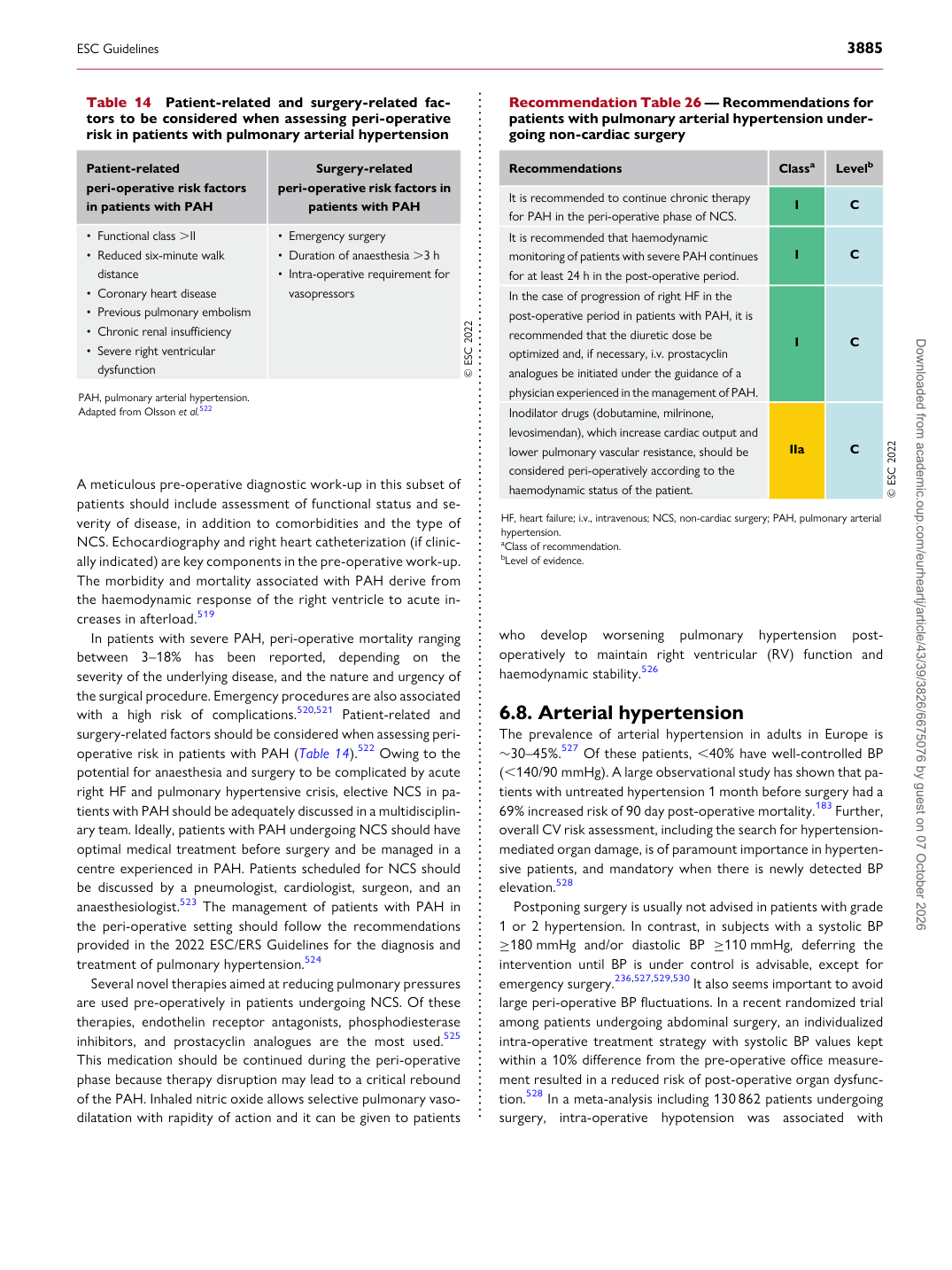
A meticulous pre-operative diagnostic work-up in this subset of patients should include assessment of functional status and severity of disease, in addition to comorbidities and the type of NCS. Echocardiography and right heart catheterization (if clinically indicated) are key components in the pre-operative work-up. The morbidity and mortality associated with PAH derive from the haemodynamic response of the right ventricle to acute increases in afterload.519 In patients with severe PAH, peri-operative mortality ranging between 3–18% has been reported, depending on the severity of the underlying disease, and the nature and urgency of the surgical procedure. Emergency procedures are also associated with a high risk of complications.520,521 Patient-related and surgery-related factors should be considered when assessing perioperative risk in patients with PAH (Table 14).522 Owing to the potential for anaesthesia and surgery to be complicated by acute right HF and pulmonary hypertensive crisis, elective NCS in patients with PAH should be adequately discussed in a multidisciplinary team. Ideally, patients with PAH undergoing NCS should have optimal medical treatment before surgery and be managed in a centre experienced in PAH. Patients scheduled for NCS should be discussed by a pneumologist, cardiologist, surgeon, and an anaesthesiologist.523 The management of patients with PAH in the peri-operative setting should follow the recommendations provided in the 2022 ESC/ERS Guidelines for the diagnosis and treatment of pulmonary hypertension.524 Several novel therapies aimed at reducing pulmonary pressures are used pre-operatively in patients undergoing NCS. Of these therapies, endothelin receptor antagonists, phosphodiesterase inhibitors, and prostacyclin analogues are the most used.525 This medication should be continued during the peri-operative phase because therapy disruption may lead to a critical rebound of the PAH. Inhaled nitric oxide allows selective pulmonary vasodilatation with rapidity of action and it can be given to patients who develop worsening pulmonary hypertension postoperatively to maintain right ventricular (RV) function and haemodynamic stability.526

6.8 Arterial hypertension

The prevalence of arterial hypertension in adults in Europe is ≏30–45%.527 Of these patients, ,40% have well-controlled BP (,140/90 mmHg). A large observational study has shown that patients with untreated hypertension 1 month before surgery had a 69% increased risk of 90 day post-operative mortality.183 Further, overall CV risk assessment, including the search for hypertensionmediated organ damage, is of paramount importance in hypertensive patients, and mandatory when there is newly detected BP elevation.528 Postponing surgery is usually not advised in patients with grade 1 or 2 hypertension. In contrast, in subjects with a systolic BP ≥180 mmHg and/or diastolic BP ≥110 mmHg, deferring the intervention until BP is under control is advisable, except for emergency surgery.236,527,529,530 It also seems important to avoid large peri-operative BP fluctuations. In a recent randomized trial among patients undergoing abdominal surgery, an individualized intra-operative treatment strategy with systolic BP values kept within a 10% difference from the pre-operative office measurement resulted in a reduced risk of post-operative organ dysfunction.528 In a meta-analysis including 130 862 patients undergoing surgery, intra-operative hypotension was associated with

Table 14 Patient-related and surgery-related factors to be considered when assessing peri-operative risk in patients with pulmonary arterial hypertension

Patient-related peri-operative risk factors in patients with PAH Surgery-related

peri-operative risk factors in

patients with PAH

• Functional class .II • Reduced six-minute walk distance • Coronary heart disease • Previous pulmonary embolism • Chronic renal insufficiency • Severe right ventricular dysfunction • Emergency surgery

• Duration of anaesthesia .3 h • Intra-operative requirement for

vasopressors

© ESC 2022

PAH, pulmonary arterial hypertension. Adapted from Olsson et al.522 Recommendation Table 26 — Recommendations for patients with pulmonary arterial hypertension undergoing non-cardiac surgery

Recommendations Classa Levelb

It is recommended to continue chronic therapy for PAH in the peri-operative phase of NCS. I C It is recommended that haemodynamic monitoring of patients with severe PAH continues for at least 24 h in the post-operative period. I C In the case of progression of right HF in the post-operative period in patients with PAH, it is recommended that the diuretic dose be optimized and, if necessary, i.v. prostacyclin analogues be initiated under the guidance of a physician experienced in the management of PAH. I C Inodilator drugs (dobutamine, milrinone, levosimendan), which increase cardiac output and lower pulmonary vascular resistance, should be considered peri-operatively according to the haemodynamic status of the patient. IIa C © ESC 2022

HF, heart failure; i.v., intravenous; NCS, non-cardiac surgery; PAH, pulmonary arterial hypertension. aClass of recommendation. bLevel of evidence.

ESC Guidelines                                                                                                                                                                                     3885

Downloaded from academic.oup.com/eurheartj/article/43/39/3826/6675076 by guest on 07 October 2026