p.59 抽出テキスト
sensitivity to central nervous system depressants and exert a respiratory depressant effect.511 Adverse events of peri-operative significance include diarrhoea, worsening renal failure, and, very rarely, bone marrow suppression, hepatotoxicity, paralysis, convulsions, and cardiopulmonary collapse. Immunosuppressive drugs such as steroids and interleukin-1 receptor antagonist agents suppress the immune system, and may increase the risk of infection and delay wound healing in the peri-operative phase.511 Imminent cardiac tamponade is an absolute contraindication for all surgical procedures, especially when a general anaesthesia is required.510,512 Before NCS, pericardial effusion should first be percutaneously drained, under local anaesthesia. In cases of small or moderate chronic pericardial effusion and constrictive pericarditis, attention should be paid to take measurements to increase cardiac pre-load. The pre-load should be optimized peri-operatively with i.v. fluids prior to general anaesthetic induction to facilitate ventricular filling. Manipulation and medication diminishing venous return to the heart should be avoided or minimized. Positive pressure ventilation might cause a dramatic decline in pre-load and should be avoided. If spontaneous breathing is not possible, ventilation with minimal inspiratory pressures (low tidal volumes, high respiratory rate) should be considered. Anaesthetics that minimize changes in heart rate, systemic vascular resistance, venous return, and myocardial contractility should be selected.189 Ketamine, a sympathetic stimulant that preserves spontaneous ventilation, is the drug of first choice. Combinations of opiates, benzodiazepines, and nitric oxide, with or without low doses of volatile anaesthetics, are acceptable for maintenance of anaesthesia. Muscle relaxants with minimal circulatory effects should be preferred, although the modest increase in heart rate observed with administration of pancuronium is also acceptable.

6.7 Pulmonary disease and pulmonary

arterial hypertension The coexistence of pulmonary disease in cardiac patients undergoing NCS may increase the operative risk. Pre-existing pulmonary disease has a significant impact on peri-operative risk, but the most common effect is an increase in the risk of post-operative pulmonary complications. These complications particularly occur after abdominal or thoracic surgery, and the risk seems to be increased in smokers. Certain respiratory conditions are associated with CV pathology and may require special cardiac risk assessment and management, in addition to dealing with the pulmonary disease per se. Three such conditions are chronic obstructive pulmonary disease (COPD), obesity hypoventilation syndrome, and pulmonary arterial hypertension (PAH).

6.7.1 Pulmonary disease

Chronic obstructive pulmonary disease is as a major cause of morbidity and mortality.513 Although patients with COPD have an increased risk of CVD, there is no evidence that COPD is related to a higher risk of peri-operative cardiac complications. However, post-operative pulmonary complications result in significant mortality and morbidity. Pre-operative evaluation, using specific postoperative pulmonary complication tools, can be used to stratify at-risk patients and enable optimal pre-operative and perioperative management.514 In patients with COPD undergoing NCS, the pre-operative treatment goals are to optimize pulmonary function and minimize post-operative respiratory complications; this includes using the pre-operative period for education, including possible cessation of smoking (2 months before surgery), instruction concerning chest physiotherapy and lung expansion manoeuvres, muscular endurance training, and re-nutrition if required. Beta-adrenergic agonists and anticholinergic agents should be continued until the day of surgery in all symptomatic COPD patients with bronchial hyper-reactivity. In some cases, short-term systemic/inhaled steroids may be considered. Where there is active pulmonary infection, appropriate antibiotics should be administered for at least 10 days and, if possible, elective NCS should be deferred.515 Obesity hypoventilation syndrome is defined as the triad of obesity, daytime hypoventilation, and sleep-disordered breathing. Although distinct from simple obesity and sleep apnoea, it is estimated that 90% patients with obesity hypoventilation syndrome also have obstructive sleep apnoea (OSA). The prevalence of obesity hypoventilation syndrome is 0.15–3% of adults and 7–22% in patients undergoing bariatric surgery.516 Obesity hypoventilation syndrome is associated with even higher morbidity, including HF (and obesity-related cardiomyopathy), angina pectoris, pulmonary hypertension (30–88%) and cor pulmonale, and increased peri-operative mortality.516 Patients at high risk of obesity hypoventilation syndrome who are undergoing NCS should be referred for additional specialist investigation of sleep-disordered breathing and pulmonary hypertension, with pre-operative initiation of appropriate positive airway pressure therapy, and planning of peri-operative techniques (anaesthetic and surgical) and post-operative positive airway pressure management within an appropriate monitored environment.516,517

6.7.2 Pulmonary arterial hypertension

Pulmonary arterial hypertension is associated with increased morbidity and mortality in patients undergoing NCS.518

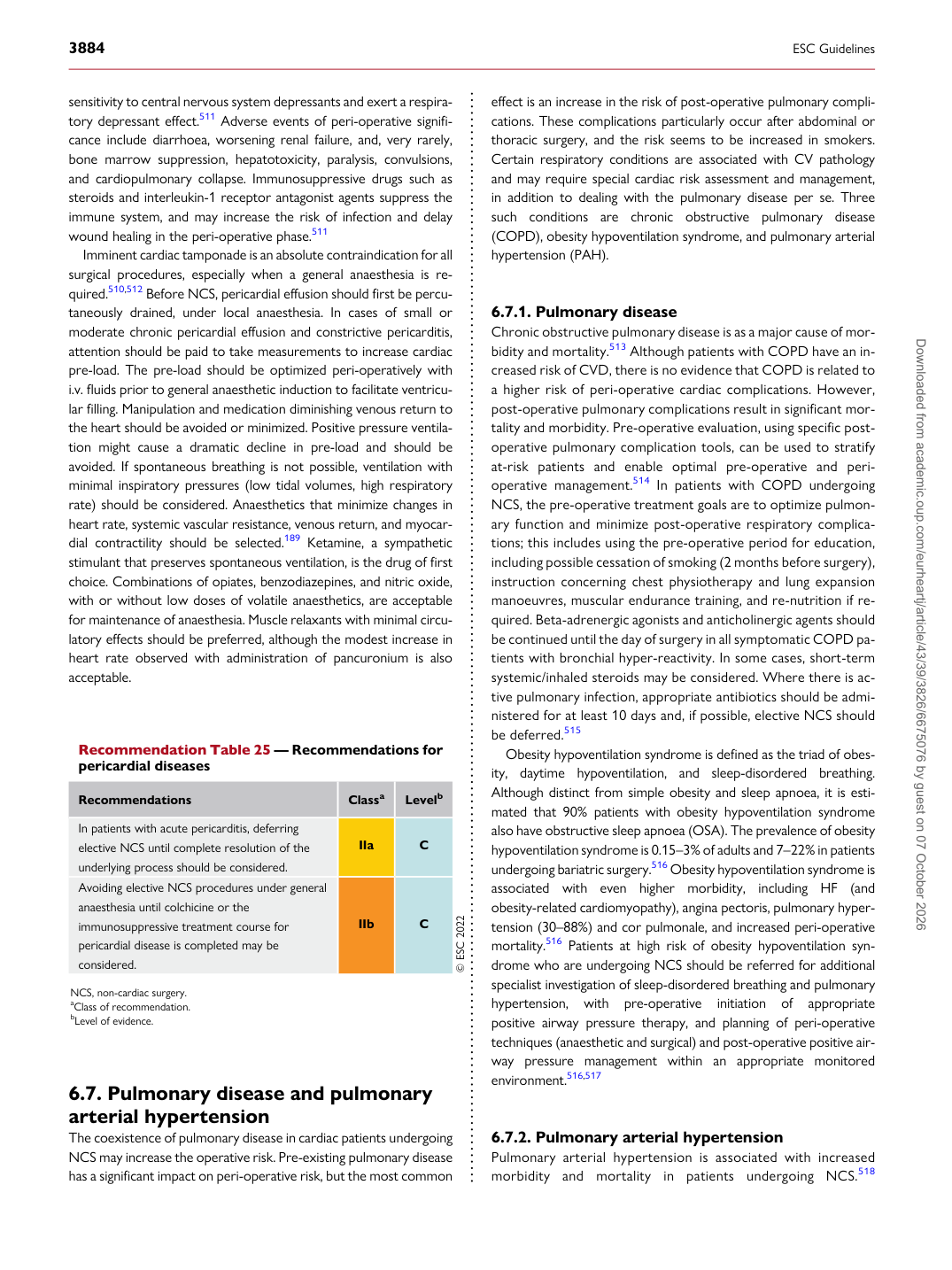
Recommendation Table 25 — Recommendations for pericardial diseases

Recommendations Classa Levelb

In patients with acute pericarditis, deferring elective NCS until complete resolution of the underlying process should be considered. IIa C Avoiding elective NCS procedures under general anaesthesia until colchicine or the immunosuppressive treatment course for pericardial disease is completed may be considered. IIb C © ESC 2022

NCS, non-cardiac surgery. aClass of recommendation. bLevel of evidence. Downloaded from academic.oup.com/eurheartj/article/43/39/3826/6675076 by guest on 07 October 2026