p.58 抽出テキスト
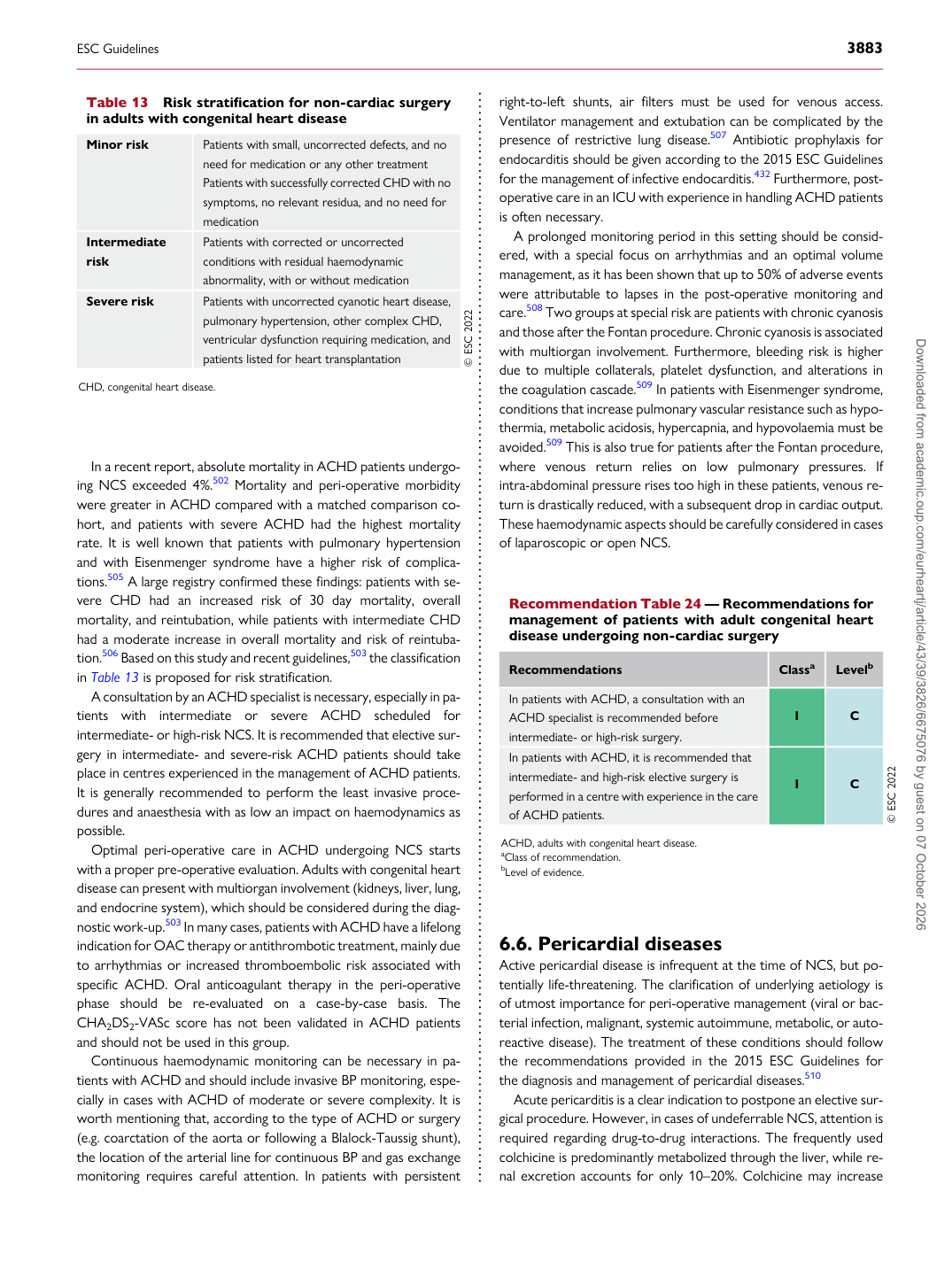
In a recent report, absolute mortality in ACHD patients undergoing NCS exceeded 4%.502 Mortality and peri-operative morbidity were greater in ACHD compared with a matched comparison cohort, and patients with severe ACHD had the highest mortality rate. It is well known that patients with pulmonary hypertension and with Eisenmenger syndrome have a higher risk of complications.505 A large registry confirmed these findings: patients with severe CHD had an increased risk of 30 day mortality, overall mortality, and reintubation, while patients with intermediate CHD had a moderate increase in overall mortality and risk of reintubation.506 Based on this study and recent guidelines,503 the classification in Table 13 is proposed for risk stratification. A consultation by an ACHD specialist is necessary, especially in patients with intermediate or severe ACHD scheduled for intermediate- or high-risk NCS. It is recommended that elective surgery in intermediate- and severe-risk ACHD patients should take place in centres experienced in the management of ACHD patients. It is generally recommended to perform the least invasive procedures and anaesthesia with as low an impact on haemodynamics as possible. Optimal peri-operative care in ACHD undergoing NCS starts with a proper pre-operative evaluation. Adults with congenital heart disease can present with multiorgan involvement (kidneys, liver, lung, and endocrine system), which should be considered during the diagnostic work-up.503 In many cases, patients with ACHD have a lifelong indication for OAC therapy or antithrombotic treatment, mainly due to arrhythmias or increased thromboembolic risk associated with specific ACHD. Oral anticoagulant therapy in the peri-operative phase should be re-evaluated on a case-by-case basis. The CHA2DS2-VASc score has not been validated in ACHD patients and should not be used in this group. Continuous haemodynamic monitoring can be necessary in patients with ACHD and should include invasive BP monitoring, especially in cases with ACHD of moderate or severe complexity. It is worth mentioning that, according to the type of ACHD or surgery (e.g. coarctation of the aorta or following a Blalock-Taussig shunt), the location of the arterial line for continuous BP and gas exchange monitoring requires careful attention. In patients with persistent right-to-left shunts, air filters must be used for venous access. Ventilator management and extubation can be complicated by the presence of restrictive lung disease.507 Antibiotic prophylaxis for endocarditis should be given according to the 2015 ESC Guidelines for the management of infective endocarditis.432 Furthermore, postoperative care in an ICU with experience in handling ACHD patients is often necessary.

A prolonged monitoring period in this setting should be considered, with a special focus on arrhythmias and an optimal volume management, as it has been shown that up to 50% of adverse events were attributable to lapses in the post-operative monitoring and care.508 Two groups at special risk are patients with chronic cyanosis and those after the Fontan procedure. Chronic cyanosis is associated with multiorgan involvement. Furthermore, bleeding risk is higher due to multiple collaterals, platelet dysfunction, and alterations in the coagulation cascade.509 In patients with Eisenmenger syndrome, conditions that increase pulmonary vascular resistance such as hypothermia, metabolic acidosis, hypercapnia, and hypovolaemia must be avoided.509 This is also true for patients after the Fontan procedure, where venous return relies on low pulmonary pressures. If intra-abdominal pressure rises too high in these patients, venous return is drastically reduced, with a subsequent drop in cardiac output. These haemodynamic aspects should be carefully considered in cases of laparoscopic or open NCS.

6.6 Pericardial diseases

Active pericardial disease is infrequent at the time of NCS, but potentially life-threatening. The clarification of underlying aetiology is of utmost importance for peri-operative management (viral or bacterial infection, malignant, systemic autoimmune, metabolic, or autoreactive disease). The treatment of these conditions should follow the recommendations provided in the 2015 ESC Guidelines for the diagnosis and management of pericardial diseases.510 Acute pericarditis is a clear indication to postpone an elective surgical procedure. However, in cases of undeferrable NCS, attention is required regarding drug-to-drug interactions. The frequently used colchicine is predominantly metabolized through the liver, while renal excretion accounts for only 10–20%. Colchicine may increase

Recommendation Table 24 — Recommendations for management of patients with adult congenital heart disease undergoing non-cardiac surgery

Recommendations Classa Levelb

In patients with ACHD, a consultation with an ACHD specialist is recommended before intermediate- or high-risk surgery. I C In patients with ACHD, it is recommended that intermediate- and high-risk elective surgery is performed in a centre with experience in the care of ACHD patients. I C © ESC 2022

ACHD, adults with congenital heart disease. aClass of recommendation. bLevel of evidence.

Table 13 Risk stratification for non-cardiac surgery in adults with congenital heart disease Minor risk Patients with small, uncorrected defects, and no

need for medication or any other treatment Patients with successfully corrected CHD with no symptoms, no relevant residua, and no need for medication

Intermediate risk Patients with corrected or uncorrected

conditions with residual haemodynamic abnormality, with or without medication

Severe risk Patients with uncorrected cyanotic heart disease,

pulmonary hypertension, other complex CHD, ventricular dysfunction requiring medication, and patients listed for heart transplantation © ESC 2022

CHD, congenital heart disease.

ESC Guidelines                                                                                                                                                                                     3883

Downloaded from academic.oup.com/eurheartj/article/43/39/3826/6675076 by guest on 07 October 2026