p.57 抽出テキスト
before procedures associated with possible EMI, or involving the anatomical location close to the device, to avoid misrecognizing and recording noise as arrhythmia or erasing the memory.498,499

6.5 Adult congenital heart disease

Adults with congenital heart disease (ACHD) account for .60% of the population with congenital heart disease (CHD).500,501 Accordingly, ACHD represent an increasing proportion of NCS admissions502 and might be at high risk of CV events. Pre-operative risk assessment in ACHD needs to focus on the underlying disease, type of surgery, residua, and sequelae.503 Coexistence of HF, pulmonary hypertension, arrhythmia, hypoxaemia, damage to other organs, and endocarditis may considerably influence the baseline risk of these patients from no additional risk to very high risk of worse prognosis.503,504 Thus, original medical and surgical reports should be obtained along with current data, which should include symptoms, exercise capacity, oxygen saturation, laboratory values (BNP, haemoglobin, creatinine, etc.), and medication.

Recommendation Table 23 — Recommendations for management of bradyarrhythmia and patients carrying cardiac implantable devices

Recommendations Classa Levelb

If indications for pacing exist according to the 2021 ESC Guidelines on cardiac pacing and cardiac resynchronization therapy,481 NCS surgery should be deferred and implantation of a permanent pacemaker should be considered. IIa C It is recommended that patients with temporarily deactivated ICDs have continuous ECG monitoring, and during the peri-operative period are accompanied by personnel skilled in early detection and treatment of arrhythmias. In high-risk patients (e.g. pacemaker-dependant or ICD patients), or if access to the torso will be difficult during the procedure, it is recommended to place transcutaneous pacing/defibrillation pads prior to NCS. I C It is recommended that all patients with CIEDs that are reprogrammed before surgery have a re-check and necessary reprogramming as soon as possible after the procedure. I C

Continued In high-risk CIED patients (e.g. with ICD or being pacing-dependant) undergoing NCS carrying a

high probability of electromagnetic interference (e.g. involving unipolar electrosurgery above the umbilical area), CIED check-up and necessary reprogramming immediately before the procedure should be considered. IIa C © ESC 2022

CIED, cardiac implantable electronic device; ECG, electrocardiogram; ICD, implantable cardioverter–defibrillator; NCS, non-cardiac surgery. aClass of recommendation. bLevel of evidence.

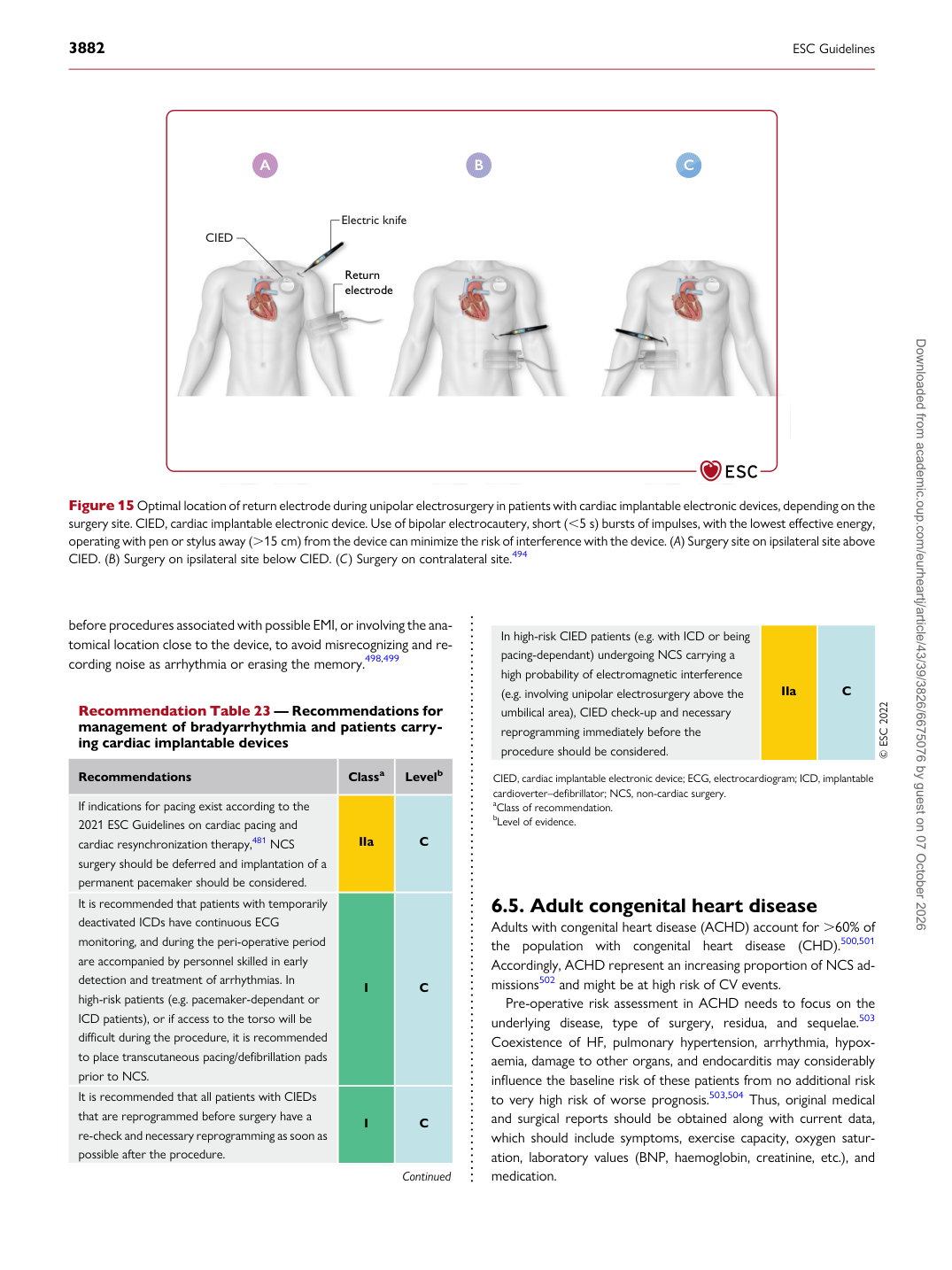
A B C

Electric knife

Return electrode

CIED

Figure 15 Optimal location of return electrode during unipolar electrosurgery in patients with cardiac implantable electronic devices, depending on the surgery site. CIED, cardiac implantable electronic device. Use of bipolar electrocautery, short (,5 s) bursts of impulses, with the lowest effective energy, operating with pen or stylus away (.15 cm) from the device can minimize the risk of interference with the device. (A) Surgery site on ipsilateral site above CIED. (B) Surgery on ipsilateral site below CIED. (C) Surgery on contralateral site.494 Downloaded from academic.oup.com/eurheartj/article/43/39/3826/6675076 by guest on 07 October 2026