p.56 抽出テキスト
6.4.5 Bradyarrhythmias

Temporary cardiac pacing during the peri-operative period should be limited to patients undergoing urgent NCS, if bradycardia is haemodynamically compromising despite i.v. chronotropic drugs, or provokes episodes of ventricular tachyarrhythmia.481 In patients undergoing elective NCS, surgery should be deferred if possible, and permanent pacemaker should be implanted, if indications for pacing are fulfilled.481 Prophylactic pacing in the settings of asymptomatic bifascicular block, with or without first-degree atrioventricular block, is generally not indicated, and chronotropic drugs (atropine, isoprenaline, adrenaline, or, alternatively, aminophylline, dopamine, or glucagon in beta-blocker or CCB overdosing) are usually effective. Patients with bifascicular bundle branch block or prolonged His-ventricular interval are at an increased risk of developing complete heart block.482,483 Equipment needed to perform emergent transcutaneous pacing and personnel able to perform such a procedure should be immediately available during NCS in patients with bifascicular block; alternatively, a permanent pacemaker may be implanted.481

6.4.6 Management of patients with cardiac

implantable electronic devices Patients with CIEDs can undergo NCS, pending adequate perioperative device management. A pre-operative check should have been performed at least once within the 12 months preceding surgery for pacemaker patients and within 6 months for patients with ICD, in the absence of any malfunction (remote monitoring can also be used for check-ups).484,485 In pacing-dependent patients, patients with biventricular pacing for CRT, and ICD-recipients undergoing elective NCS associated with risk of electromagnetic interference (EMI) (e.g. involving the use of unipolar electrocoagulation, especially above the umbilicus), CIED check and reprogramming should be performed immediately before surgery. In pacemakerdependent patients, devices should be reprogrammed to nonsensing or asynchronous pacing mode to protect against inhibition of the pacemaker. This can be performed in the majority of pacemaker models by placing a magnet over the pacemaker can.486,487 However, magnet mode in modern pacemakers, except Medtronic and Sorin/Livanova/Microport, is programmable and may not be asynchronous pacing; thus, magnet application is not a universal remedy against EMI-induced malfunction. Furthermore, asynchronous pacing may lead to pacing on the T wave, which can provoke VT/ VF. However, the risk of clinically significant EMI is low487–489 and a practical solution would be to monitor the patient via plethysmography or an arterial line, and limit the use of electrocautery if pauses occur during ECG monitoring.

Patients with leadless pacemakers may safely undergo surgery, with precautions similar to patients with conventional pacemakers, avoiding EMI and after reprogramming the pacemaker into nonsensing mode in pacing-dependent patients (due to its intracardiac location and lack of a Hall-effect sensor/reed switch, this device cannot be temporarily reprogrammed to an asynchronous mode with a magnet applied over the body of the pacemaker).490,491 In patients with ICDs undergoing NCS with anticipated risk of EMI, arrhythmia detection or antiarrhythmic therapies through the device should be switched off before NCS,492 or a magnet should be put over the device.488,489,492 All modern ICDs will respond to magnet application by inhibiting antitachycardia therapy, while the brady pacing is left intact. Deactivation by programming mandates telemetry and cardioversion equipment until reactivation, which may be impractical. Furthermore, there is a risk that the patient is discharged without the device being reactivated. These factors would favour the use of a magnet instead of deactivation. In some patients where the device is inaccessible for magnet application, a magnet cannot be used and reprogramming is mandatory. From this point onwards, throughout the whole procedure until reactivation of the ICD, the patient should have continuous ECG monitoring, and personnel skilled in early detection of arrhythmias, defibrillation, and cardiopulmonary resuscitation manoeuvres should be present. As soon as possible after NCS, it is recommended that the ICD is checked and therapies switched on.485 Patients with subcutaneous ICD can undergo surgery after switching off the antiarrhythmic therapy or magnet application; however, if thoracic surgery is planned, especially with a median sternotomy, the surgeon should be aware of the presence of the ICD and the course of the subcutaneous electrode. This can prevent mechanical damage of the lead, the direct use of electrocautery on the electrode, or the placement of sternal wires in close proximity to the sensing electrodes.493 In pacing-dependent patients, patients with CRT, and ICD patients, EMI with the device should be avoided (e.g. with electrocautery). Use of bipolar electrocautery, short bursts of impulses limited to several seconds (,5 s), with the lowest effective energy, and operating with a pen or stylus away from the device (.15 cm) can minimize the risk of interference with the device. In the case of unipolar electrocoagulation, the electrosurgical unit should be connected in a way that keeps the current circuit away from the CIED can and electrodes. However, the manufacturer’s recommendations should be considered (usually recommending placement of the indifferent electrode on the opposite site of the body to the one operated on, but possibly close to the surgical site, on a wellvascularized, muscular area). Consequently, the indifferent return pad should be placed as far away from the CIED as possible, keeping the surgical site between the CIED and the return electrode (Figure 15).494–497 In patients with implantable loop recorders (especially those not undergoing remote monitoring and regular downloads of the CIED memory), the device memory download is to be considered

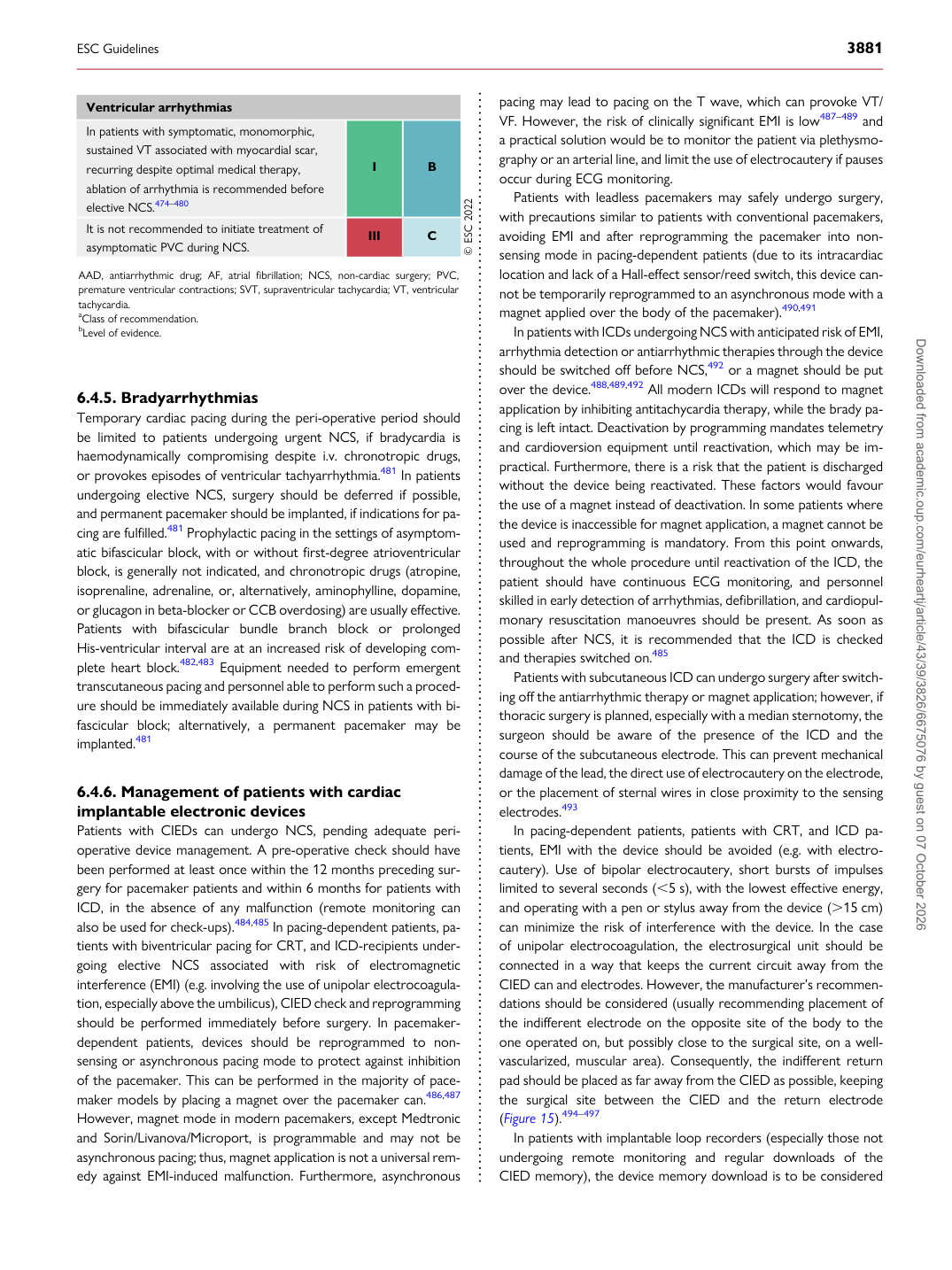
Ventricular arrhythmias In patients with symptomatic, monomorphic, sustained VT associated with myocardial scar, recurring despite optimal medical therapy, ablation of arrhythmia is recommended before elective NCS.474–480 I B It is not recommended to initiate treatment of asymptomatic PVC during NCS. III C © ESC 2022

AAD, antiarrhythmic drug; AF, atrial fibrillation; NCS, non-cardiac surgery; PVC, premature ventricular contractions; SVT, supraventricular tachycardia; VT, ventricular tachycardia. aClass of recommendation. bLevel of evidence.

ESC Guidelines                                                                                                                                                                                     3881

Downloaded from academic.oup.com/eurheartj/article/43/39/3826/6675076 by guest on 07 October 2026