p.55 抽出テキスト
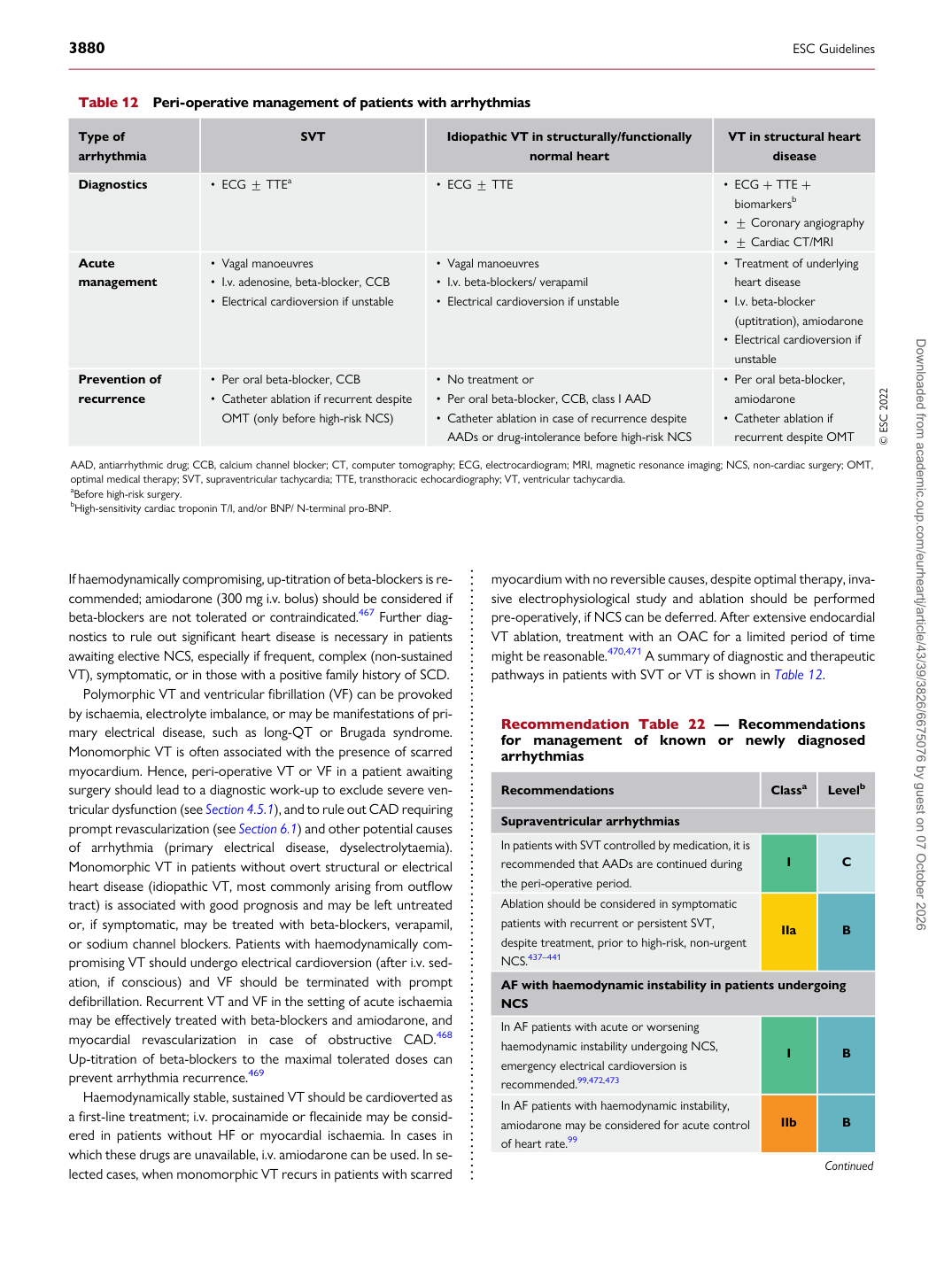
If haemodynamically compromising, up-titration of beta-blockers is recommended; amiodarone (300 mg i.v. bolus) should be considered if beta-blockers are not tolerated or contraindicated.467 Further diagnostics to rule out significant heart disease is necessary in patients awaiting elective NCS, especially if frequent, complex (non-sustained VT), symptomatic, or in those with a positive family history of SCD. Polymorphic VT and ventricular fibrillation (VF) can be provoked by ischaemia, electrolyte imbalance, or may be manifestations of primary electrical disease, such as long-QT or Brugada syndrome. Monomorphic VT is often associated with the presence of scarred myocardium. Hence, peri-operative VT or VF in a patient awaiting surgery should lead to a diagnostic work-up to exclude severe ventricular dysfunction (see Section 4.5.1), and to rule out CAD requiring prompt revascularization (see Section 6.1) and other potential causes of arrhythmia (primary electrical disease, dyselectrolytaemia). Monomorphic VT in patients without overt structural or electrical heart disease (idiopathic VT, most commonly arising from outflow tract) is associated with good prognosis and may be left untreated or, if symptomatic, may be treated with beta-blockers, verapamil, or sodium channel blockers. Patients with haemodynamically compromising VT should undergo electrical cardioversion (after i.v. sedation, if conscious) and VF should be terminated with prompt defibrillation. Recurrent VT and VF in the setting of acute ischaemia may be effectively treated with beta-blockers and amiodarone, and myocardial revascularization in case of obstructive CAD.468 Up-titration of beta-blockers to the maximal tolerated doses can prevent arrhythmia recurrence.469 Haemodynamically stable, sustained VT should be cardioverted as a first-line treatment; i.v. procainamide or flecainide may be considered in patients without HF or myocardial ischaemia. In cases in which these drugs are unavailable, i.v. amiodarone can be used. In selected cases, when monomorphic VT recurs in patients with scarred myocardium with no reversible causes, despite optimal therapy, invasive electrophysiological study and ablation should be performed pre-operatively, if NCS can be deferred. After extensive endocardial VT ablation, treatment with an OAC for a limited period of time might be reasonable.470,471 A summary of diagnostic and therapeutic pathways in patients with SVT or VT is shown in Table 12.

Table 12 Peri-operative management of patients with arrhythmias

Type of arrhythmia SVT Idiopathic VT in structurally/functionally

normal heart VT in structural heart

disease

Diagnostics • ECG +TTEa • ECG +TTE • ECG + TTE +

biomarkersb • +Coronary angiography • +Cardiac CT/MRI

Acute management • Vagal manoeuvres • I.v. adenosine, beta-blocker, CCB

• Electrical cardioversion if unstable • Vagal manoeuvres • I.v. beta-blockers/ verapamil

• Electrical cardioversion if unstable • Treatment of underlying heart disease

• I.v. beta-blocker (uptitration), amiodarone • Electrical cardioversion if

unstable

Prevention of recurrence • Per oral beta-blocker, CCB

• Catheter ablation if recurrent despite

OMT (only before high-risk NCS) • No treatment or

• Per oral beta-blocker, CCB, class I AAD • Catheter ablation in case of recurrence despite AADs or drug-intolerance before high-risk NCS • Per oral beta-blocker,

amiodarone • Catheter ablation if recurrent despite OMT © ESC 2022

AAD, antiarrhythmic drug; CCB, calcium channel blocker; CT, computer tomography; ECG, electrocardiogram; MRI, magnetic resonance imaging; NCS, non-cardiac surgery; OMT, optimal medical therapy; SVT, supraventricular tachycardia; TTE, transthoracic echocardiography; VT, ventricular tachycardia. aBefore high-risk surgery. bHigh-sensitivity cardiac troponin T/I, and/or BNP/ N-terminal pro-BNP.

Recommendation Table 22 — Recommendations for management of known or newly diagnosed arrhythmias

Recommendations Classa Levelb

Supraventricular arrhythmias In patients with SVT controlled by medication, it is recommended that AADs are continued during the peri-operative period. I C Ablation should be considered in symptomatic patients with recurrent or persistent SVT, despite treatment, prior to high-risk, non-urgent NCS.437–441 IIa B AF with haemodynamic instability in patients undergoing NCS In AF patients with acute or worsening haemodynamic instability undergoing NCS, emergency electrical cardioversion is recommended.99,472,473 I B In AF patients with haemodynamic instability, amiodarone may be considered for acute control of heart rate.99 IIb B

Continued Downloaded from academic.oup.com/eurheartj/article/43/39/3826/6675076 by guest on 07 October 2026