p.53 抽出テキスト
In this case, a percutaneous mitral commissurotomy (PMC) should be considered before high-risk NCS. Otherwise, a multidisciplinary team should manage patients with moderate-to-severe MS who are ineligible for PMC, and NCS should be performed only if necessary. Intermediate-risk NCS may be performed in asymptomatic patients with severe MS with appropriate intra-operative and post-operative haemodynamic monitoring, if valve morphology is unsuitable for PMC.

6.3.2.3 Aortic valve regurgitation

In patients with mild-to-moderate aortic valve regurgitation (AR), NCS can be performed without additional risk. Patients with severe AR in whom valvular intervention is needed should be treated before intermediate-or-high-risk elective NCS (see Recommendation Table 21 and the 2021 ESC/EACTS Guidelines for the management of valvular heart disease).245

6.3.2.4 Mitral valve regurgitation

In patients with severe symptomatic mitral valve regurgitation (MR), the type of valve disease (primary or secondary) and LV function should be assessed. Patients with secondary MR, especially of ischaemic aetiology, are at increased risk of CV complications during NCS.430 Patients with severe symptomatic MR fulfilling the intervention criteria should be referred for valve treatment before intermediate- or high-risk elective NCS. In case of symptomatic moderate-to-severe secondary MR, patients meeting the Cardiovascular Outcomes Assessment of the MitraClip Percutaneous Therapy for Heart Failure Patients With Functional Mitral Regurgitation (COAPT) criteria should be considered for transcatheter edge-to-edge treatment before NCS (Figure 14).245,431 In patients with severe primary MR with symptoms or asymptomatic with LV dysfunction, valve repair is the recommended therapy (see Recommendation Table 21 and the 2021 ESC/ EACTS Guidelines for the management of valvular heart disease245). In patients with reduced LVEF and concomitant AR or MR, intra-operative haemodynamic monitoring, heart rate control, and careful fluid balance are crucial to avoid haemodynamic deterioration, especially during high-risk surgery.

6.3.2.5 Patients with prosthetic valve(s)

Patients who have undergone previous surgical correction of VHD and have a prosthetic valve can undergo NCS provided that there is no evidence of valve dysfunction. In current practice, the main problem is the need for a modification of the anticoagulation regimen in the peri-operative period; this is discussed in detail in Section 5.3.

6.3.2.6 Prophylaxis of infective endocarditis

Prophylaxis against infective endocarditis in patients requiring NCS should be consistent with the 2015 ESC Guidelines for the management of infective endocarditis.432

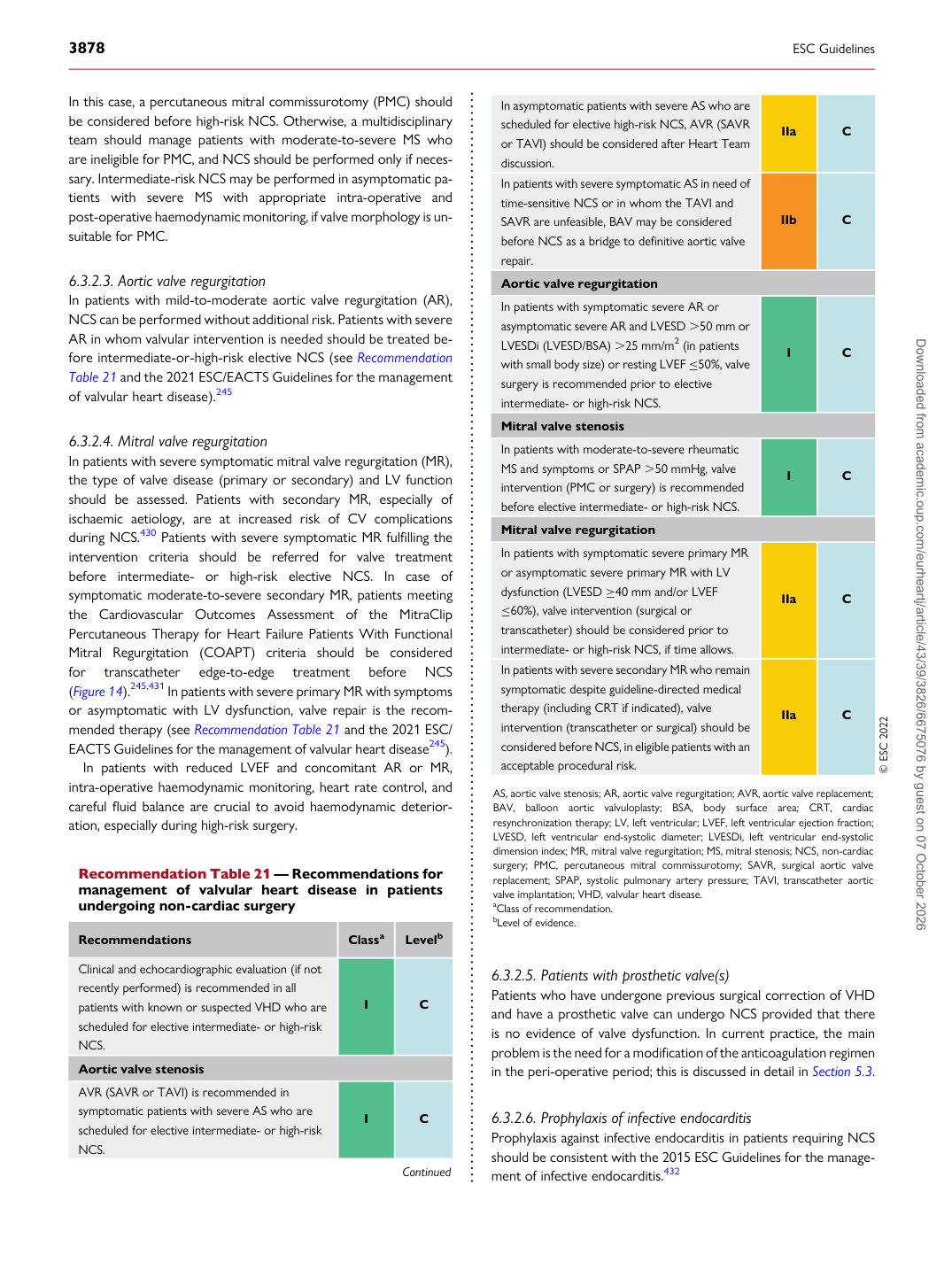
Recommendation Table 21 — Recommendations for management of valvular heart disease in patients undergoing non-cardiac surgery

Recommendations Classa Levelb

Clinical and echocardiographic evaluation (if not recently performed) is recommended in all patients with known or suspected VHD who are scheduled for elective intermediate- or high-risk NCS. I C Aortic valve stenosis AVR (SAVR or TAVI) is recommended in symptomatic patients with severe AS who are scheduled for elective intermediate- or high-risk NCS. I C

Continued In asymptomatic patients with severe AS who are

scheduled for elective high-risk NCS, AVR (SAVR or TAVI) should be considered after Heart Team discussion. IIa C In patients with severe symptomatic AS in need of time-sensitive NCS or in whom the TAVI and SAVR are unfeasible, BAV may be considered before NCS as a bridge to definitive aortic valve repair. IIb C Aortic valve regurgitation In patients with symptomatic severe AR or asymptomatic severe AR and LVESD .50 mm or LVESDi (LVESD/BSA) .25 mm/m2 (in patients with small body size) or resting LVEF ≤50%, valve surgery is recommended prior to elective intermediate- or high-risk NCS. I C Mitral valve stenosis In patients with moderate-to-severe rheumatic MS and symptoms or SPAP .50 mmHg, valve intervention (PMC or surgery) is recommended before elective intermediate- or high-risk NCS. I C Mitral valve regurgitation In patients with symptomatic severe primary MR or asymptomatic severe primary MR with LV dysfunction (LVESD ≥40 mm and/or LVEF ≤60%), valve intervention (surgical or transcatheter) should be considered prior to intermediate- or high-risk NCS, if time allows. IIa C In patients with severe secondary MR who remain symptomatic despite guideline-directed medical therapy (including CRT if indicated), valve intervention (transcatheter or surgical) should be considered before NCS, in eligible patients with an acceptable procedural risk. IIa C © ESC 2022

AS, aortic valve stenosis; AR, aortic valve regurgitation; AVR, aortic valve replacement; BAV, balloon aortic valvuloplasty; BSA, body surface area; CRT, cardiac resynchronization therapy; LV, left ventricular; LVEF, left ventricular ejection fraction; LVESD, left ventricular end-systolic diameter; LVESDi, left ventricular end-systolic dimension index; MR, mitral valve regurgitation; MS, mitral stenosis; NCS, non-cardiac surgery; PMC, percutaneous mitral commissurotomy; SAVR, surgical aortic valve replacement; SPAP, systolic pulmonary artery pressure; TAVI, transcatheter aortic valve implantation; VHD, valvular heart disease. aClass of recommendation. bLevel of evidence. Downloaded from academic.oup.com/eurheartj/article/43/39/3826/6675076 by guest on 07 October 2026