p.51 抽出テキスト
variable and depends on the severity of VHD and type of NCS. It is particularly increased in patients with obstructive valve pathology, for example symptomatic AS or MS, where perioperative volume shifts and arrhythmia may lead to rapid decompensation.424

6.3.2 Pre-operative management strategies and

risk-reduction strategy Clinical and echocardiographic evaluation is recommended in all patients with known or suspected VHD who are scheduled for elective intermediate-or-high-risk NCS. Patients in whom mild-to-moderate VHD was diagnosed .1 year earlier should have clinical and echocardiographic re-assessment. Heart team discussion may be helpful in patients with significant VHD. The risks of valvular intervention and the risk of NCS-related complications should be estimated and communicated to the patient and the surgical team.

6.3.2.1 Aortic valve stenosis

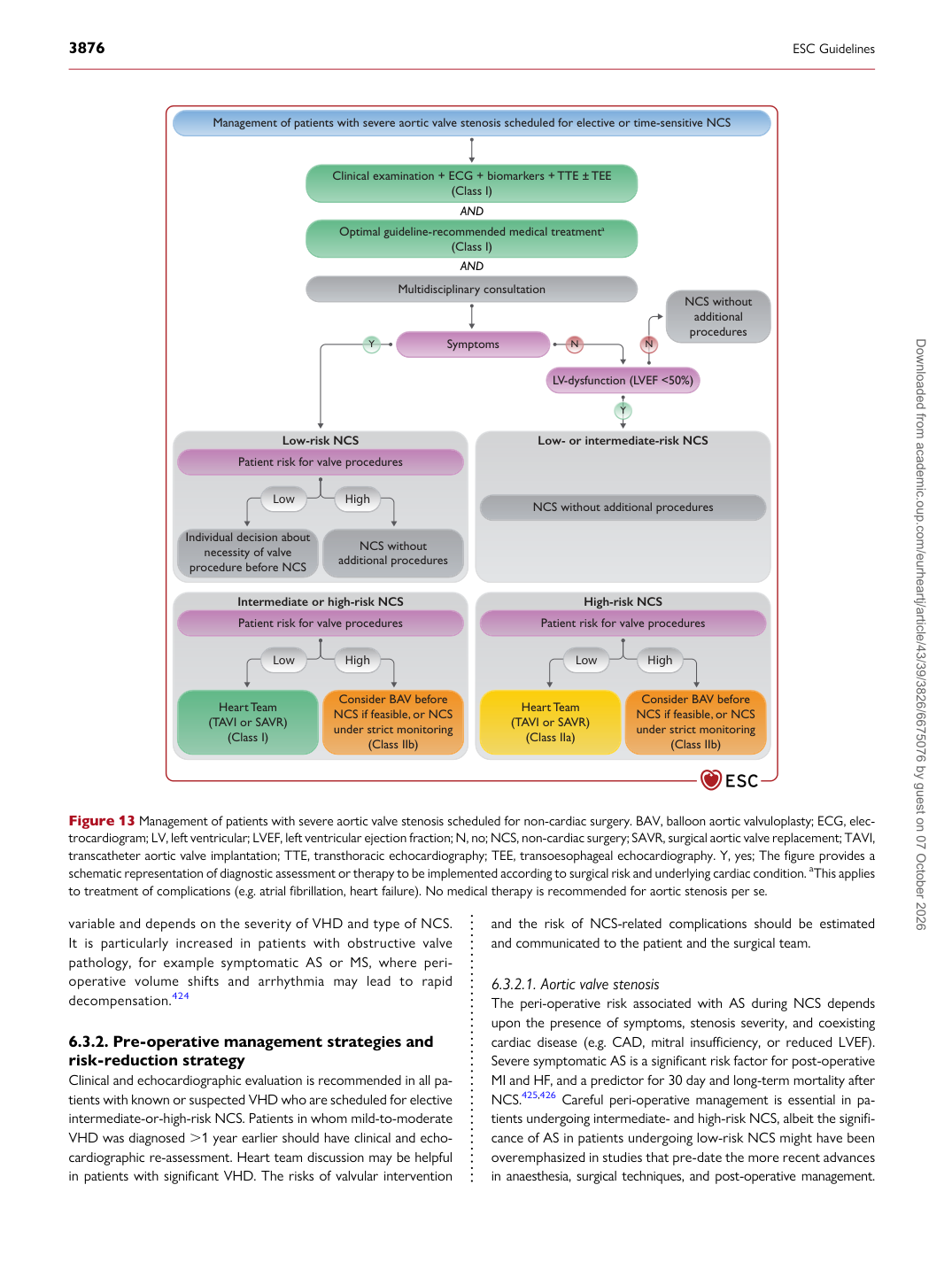
The peri-operative risk associated with AS during NCS depends upon the presence of symptoms, stenosis severity, and coexisting cardiac disease (e.g. CAD, mitral insufficiency, or reduced LVEF). Severe symptomatic AS is a significant risk factor for post-operative MI and HF, and a predictor for 30 day and long-term mortality after NCS.425,426 Careful peri-operative management is essential in patients undergoing intermediate- and high-risk NCS, albeit the significance of AS in patients undergoing low-risk NCS might have been overemphasized in studies that pre-date the more recent advances in anaesthesia, surgical techniques, and post-operative management.

Clinical examination + ECG + biomarkers + TTE ± TEE

(Class I)

Optimal guideline-recommended medical treatmenta

(Class I)

Low-risk NCS Patient risk for valve procedures AND

AND

Intermediate or high-risk NCS Patient risk for valve procedures

Low High

Low High Low- or intermediate-risk NCS

High-risk NCS Patient risk for valve procedures

Low High

Management of patients with severe aortic valve stenosis scheduled for elective or time-sensitive NCS

Multidisciplinary consultation

Symptoms

Individual decision about necessity of valve procedure before NCS NCS without additional procedures

Heart Team (TAVI or SAVR)

(Class I) Consider BAV before NCS if feasible, or NCS under strict monitoring

(Class IIb) NCS without additional procedures

Heart Team (TAVI or SAVR)

(Class IIa) Consider BAV before NCS if feasible, or NCS under strict monitoring

(Class IIb)

LV-dysfunction (LVEF <50%)

NCS without

additional procedures Y

Y

N N

Figure 13 Management of patients with severe aortic valve stenosis scheduled for non-cardiac surgery. BAV, balloon aortic valvuloplasty; ECG, electrocardiogram; LV, left ventricular; LVEF, left ventricular ejection fraction; N, no; NCS, non-cardiac surgery; SAVR, surgical aortic valve replacement; TAVI, transcatheter aortic valve implantation; TTE, transthoracic echocardiography; TEE, transoesophageal echocardiography. Y, yes; The figure provides a schematic representation of diagnostic assessment or therapy to be implemented according to surgical risk and underlying cardiac condition. aThis applies to treatment of complications (e.g. atrial fibrillation, heart failure). No medical therapy is recommended for aortic stenosis per se. Downloaded from academic.oup.com/eurheartj/article/43/39/3826/6675076 by guest on 07 October 2026