p.50 抽出テキスト
The management of patients with cardiac implantable electronic devices (CIEDs) undergoing NCS is discussed in Section 6.4.5. In patients with resynchronization devices (cardiac resynchronization therapy [CRT]), it is recommended to keep the device on to provide better haemodynamic stability.

6.2.3 Hypertrophic obstructive cardiomyopathy

Patients with hypertrophic cardiomyopathy with LV outflow tract obstruction (HOCM) have an increased risk of complications during NCS and require additional attention.418 It is recommended to perform TTE before NCS in order to determine the extent of the hypertrophy, obstruction, and diastolic function.419 Avoidance of prolonged pre-operative fasting and dehydration is important to maintain stroke volume and reduce the risk of increased obstruction. Furthermore, it is important to avoid vasodilating anaesthetic agents and maintain neutral fluid balance during the peri-operative period. The heart rate should be kept low (60–65 beats per minute [b.p.m.]) and AF should be avoided. Medication used to treat LV outflow tract obstruction should remain on board during NCS.

6.2.4 Patients with ventricular assist devices

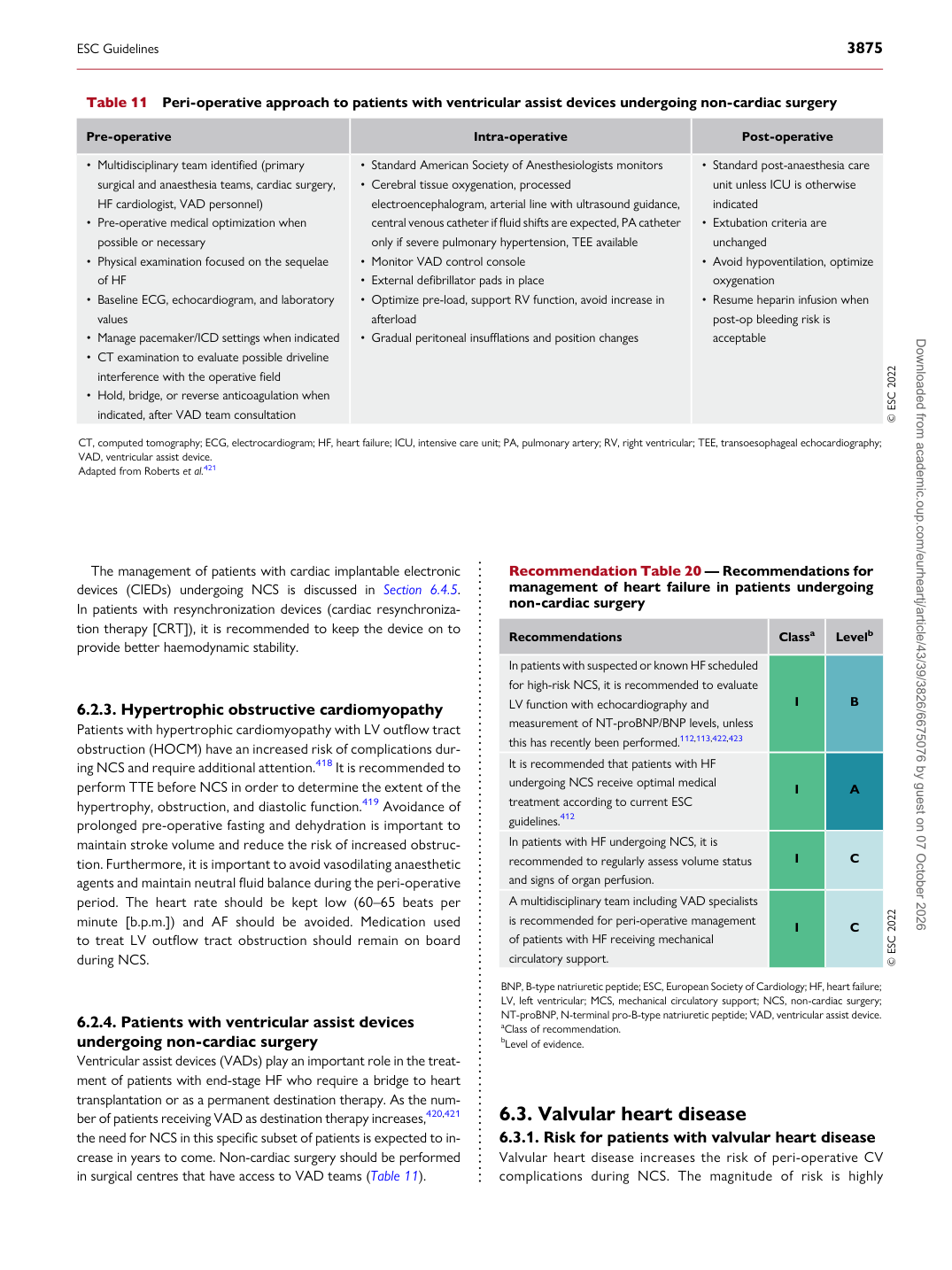
undergoing non-cardiac surgery Ventricular assist devices (VADs) play an important role in the treatment of patients with end-stage HF who require a bridge to heart transplantation or as a permanent destination therapy. As the number of patients receiving VAD as destination therapy increases,420,421 the need for NCS in this specific subset of patients is expected to increase in years to come. Non-cardiac surgery should be performed in surgical centres that have access to VAD teams (Table 11). 6.3 Valvular heart disease

6.3.1. Risk for patients with valvular heart disease Valvular heart disease increases the risk of peri-operative CV complications during NCS. The magnitude of risk is highly

Table 11 Peri-operative approach to patients with ventricular assist devices undergoing non-cardiac surgery

Pre-operative Intra-operative Post-operative

• Multidisciplinary team identified (primary surgical and anaesthesia teams, cardiac surgery,

HF cardiologist, VAD personnel) • Pre-operative medical optimization when possible or necessary • Physical examination focused on the sequelae of HF • Baseline ECG, echocardiogram, and laboratory

values • Manage pacemaker/ICD settings when indicated • CT examination to evaluate possible driveline

interference with the operative field • Hold, bridge, or reverse anticoagulation when indicated, after VAD team consultation • Standard American Society of Anesthesiologists monitors • Cerebral tissue oxygenation, processed

electroencephalogram, arterial line with ultrasound guidance, central venous catheter if fluid shifts are expected, PA catheter only if severe pulmonary hypertension, TEE available • Monitor VAD control console • External defibrillator pads in place • Optimize pre-load, support RV function, avoid increase in

afterload • Gradual peritoneal insufflations and position changes • Standard post-anaesthesia care unit unless ICU is otherwise

indicated • Extubation criteria are unchanged • Avoid hypoventilation, optimize oxygenation • Resume heparin infusion when

post-op bleeding risk is acceptable

© ESC 2022

CT, computed tomography; ECG, electrocardiogram; HF, heart failure; ICU, intensive care unit; PA, pulmonary artery; RV, right ventricular; TEE, transoesophageal echocardiography; VAD, ventricular assist device. Adapted from Roberts et al.421

Recommendation Table 20 — Recommendations for management of heart failure in patients undergoing non-cardiac surgery

Recommendations Classa Levelb

In patients with suspected or known HF scheduled for high-risk NCS, it is recommended to evaluate LV function with echocardiography and measurement of NT-proBNP/BNP levels, unless this has recently been performed.112,113,422,423 I B It is recommended that patients with HF undergoing NCS receive optimal medical treatment according to current ESC guidelines.412 I A In patients with HF undergoing NCS, it is recommended to regularly assess volume status and signs of organ perfusion. I C A multidisciplinary team including VAD specialists is recommended for peri-operative management of patients with HF receiving mechanical circulatory support. I C © ESC 2022

BNP, B-type natriuretic peptide; ESC, European Society of Cardiology; HF, heart failure; LV, left ventricular; MCS, mechanical circulatory support; NCS, non-cardiac surgery; NT-proBNP, N-terminal pro-B-type natriuretic peptide; VAD, ventricular assist device. aClass of recommendation. bLevel of evidence.

ESC Guidelines                                                                                                                                                                                     3875

Downloaded from academic.oup.com/eurheartj/article/43/39/3826/6675076 by guest on 07 October 2026