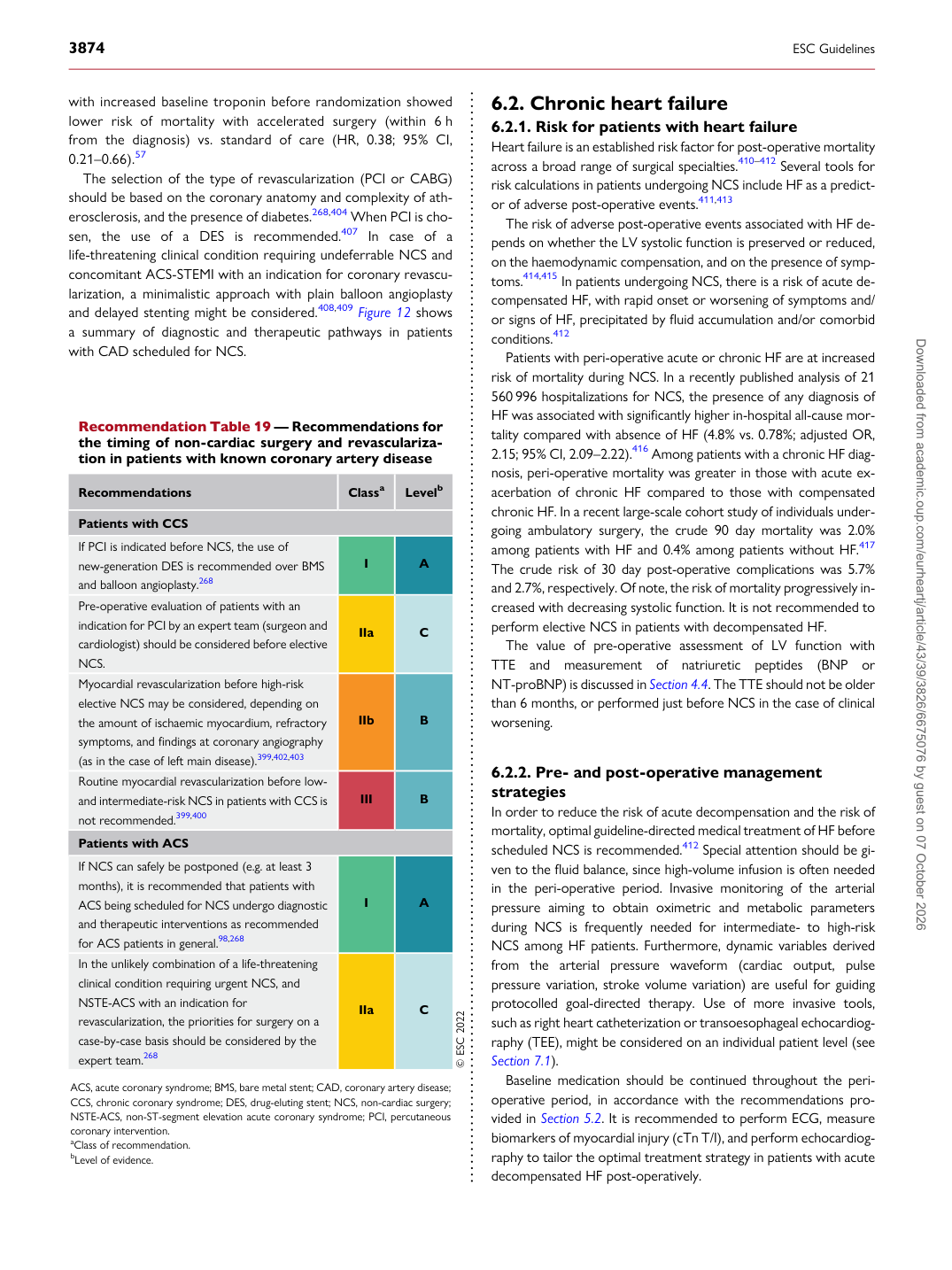
p.49 抽出テキスト
with increased baseline troponin before randomization showed lower risk of mortality with accelerated surgery (within 6 h from the diagnosis) vs. standard of care (HR, 0.38; 95% CI, 0.21–0.66).57 The selection of the type of revascularization (PCI or CABG) should be based on the coronary anatomy and complexity of atherosclerosis, and the presence of diabetes.268,404 When PCI is chosen, the use of a DES is recommended.407 In case of a life-threatening clinical condition requiring undeferrable NCS and concomitant ACS-STEMI with an indication for coronary revascularization, a minimalistic approach with plain balloon angioplasty and delayed stenting might be considered.408,409 Figure 12 shows a summary of diagnostic and therapeutic pathways in patients with CAD scheduled for NCS. 6.2 Chronic heart failure

6.2.1. Risk for patients with heart failure Heart failure is an established risk factor for post-operative mortality across a broad range of surgical specialties.410–412 Several tools for risk calculations in patients undergoing NCS include HF as a predictor of adverse post-operative events.411,413 The risk of adverse post-operative events associated with HF depends on whether the LV systolic function is preserved or reduced, on the haemodynamic compensation, and on the presence of symptoms.414,415 In patients undergoing NCS, there is a risk of acute decompensated HF, with rapid onset or worsening of symptoms and/ or signs of HF, precipitated by fluid accumulation and/or comorbid conditions.412 Patients with peri-operative acute or chronic HF are at increased risk of mortality during NCS. In a recently published analysis of 21 560 996 hospitalizations for NCS, the presence of any diagnosis of HF was associated with significantly higher in-hospital all-cause mortality compared with absence of HF (4.8% vs. 0.78%; adjusted OR, 2.15; 95% CI, 2.09–2.22).416 Among patients with a chronic HF diagnosis, peri-operative mortality was greater in those with acute exacerbation of chronic HF compared to those with compensated chronic HF. In a recent large-scale cohort study of individuals undergoing ambulatory surgery, the crude 90 day mortality was 2.0% among patients with HF and 0.4% among patients without HF.417 The crude risk of 30 day post-operative complications was 5.7% and 2.7%, respectively. Of note, the risk of mortality progressively increased with decreasing systolic function. It is not recommended to perform elective NCS in patients with decompensated HF. The value of pre-operative assessment of LV function with TTE and measurement of natriuretic peptides (BNP or NT-proBNP) is discussed in Section 4.4. The TTE should not be older than 6 months, or performed just before NCS in the case of clinical worsening.

6.2.2 Pre- and post-operative management

strategies In order to reduce the risk of acute decompensation and the risk of mortality, optimal guideline-directed medical treatment of HF before scheduled NCS is recommended.412 Special attention should be given to the fluid balance, since high-volume infusion is often needed in the peri-operative period. Invasive monitoring of the arterial pressure aiming to obtain oximetric and metabolic parameters during NCS is frequently needed for intermediate- to high-risk NCS among HF patients. Furthermore, dynamic variables derived from the arterial pressure waveform (cardiac output, pulse pressure variation, stroke volume variation) are useful for guiding protocolled goal-directed therapy. Use of more invasive tools, such as right heart catheterization or transoesophageal echocardiography (TEE), might be considered on an individual patient level (see Section 7.1). Baseline medication should be continued throughout the perioperative period, in accordance with the recommendations provided in Section 5.2. It is recommended to perform ECG, measure biomarkers of myocardial injury (cTn T/I), and perform echocardiography to tailor the optimal treatment strategy in patients with acute decompensated HF post-operatively.

Recommendation Table 19 — Recommendations for the timing of non-cardiac surgery and revascularization in patients with known coronary artery disease

Recommendations Classa Levelb

Patients with CCS If PCI is indicated before NCS, the use of new-generation DES is recommended over BMS and balloon angioplasty.268 I A Pre-operative evaluation of patients with an indication for PCI by an expert team (surgeon and cardiologist) should be considered before elective NCS. IIa C Myocardial revascularization before high-risk elective NCS may be considered, depending on the amount of ischaemic myocardium, refractory symptoms, and findings at coronary angiography (as in the case of left main disease).399,402,403 IIb B Routine myocardial revascularization before lowand intermediate-risk NCS in patients with CCS is not recommended.399,400 III B Patients with ACS If NCS can safely be postponed (e.g. at least 3 months), it is recommended that patients with ACS being scheduled for NCS undergo diagnostic and therapeutic interventions as recommended for ACS patients in general.98,268 I A In the unlikely combination of a life-threatening clinical condition requiring urgent NCS, and NSTE-ACS with an indication for revascularization, the priorities for surgery on a case-by-case basis should be considered by the expert team.268 IIa C © ESC 2022

ACS, acute coronary syndrome; BMS, bare metal stent; CAD, coronary artery disease; CCS, chronic coronary syndrome; DES, drug-eluting stent; NCS, non-cardiac surgery; NSTE-ACS, non-ST-segment elevation acute coronary syndrome; PCI, percutaneous coronary intervention. aClass of recommendation. bLevel of evidence. Downloaded from academic.oup.com/eurheartj/article/43/39/3826/6675076 by guest on 07 October 2026