p.48 抽出テキスト
patients should be treated according to the 2020 ESC Guidelines for the management of acute coronary syndromes in patients presenting without persistent ST-segment elevation,98 with an early (,24 h) or immediate (,2 h) invasive strategy, respectively. In low-risk groups amenable to a selective invasive strategy, the decision-making should be consistent with the approach for CCS patients.

In a post hoc analyses of the HIP-ATTACK (HIP Fracture Accelerated Surgical TreaTment And Care tracK) trial, patients

Optimize guideline-recommended

medical therapy

(Class I )

Optimize guideline-recommended

medical therapy

(Class I )

Diagnostic and therapeutic pathways according to ACS Guidelines and

individual basis

(Class I)

Cardiologist–surgeon–anaesthesist

discussion regarding myocardial revascularization options and antithrombotic strategy dependent

on the options and acceptable time interval to postpone NCS Low-risk NCS

No further screening

Intermediate-risk NCS Clinical examination + ECG

+ biomarkersa (Class I)

Symptoms or abnormal ECG or poor exercise tolerance

or elevated biomarkers

Elevated hs-troponin or stress-induced ischaemia

High-risk NCS

Functional capacityb (Class IIa)

Clinical examination + ECG

+ biomarkersa (Class I) Functional capacityb (Class IIa)

± TTE ± stress imaging

± TTE ± stress imaging

ICAc ± iwFR/FFR

Symptoms or abnormal ECG or poor exercise tolerance

or elevated biomarkers N

N

N

Y

Y

CCS ACS

Management of  patients with ACS or CCS scheduled for NCS

Y

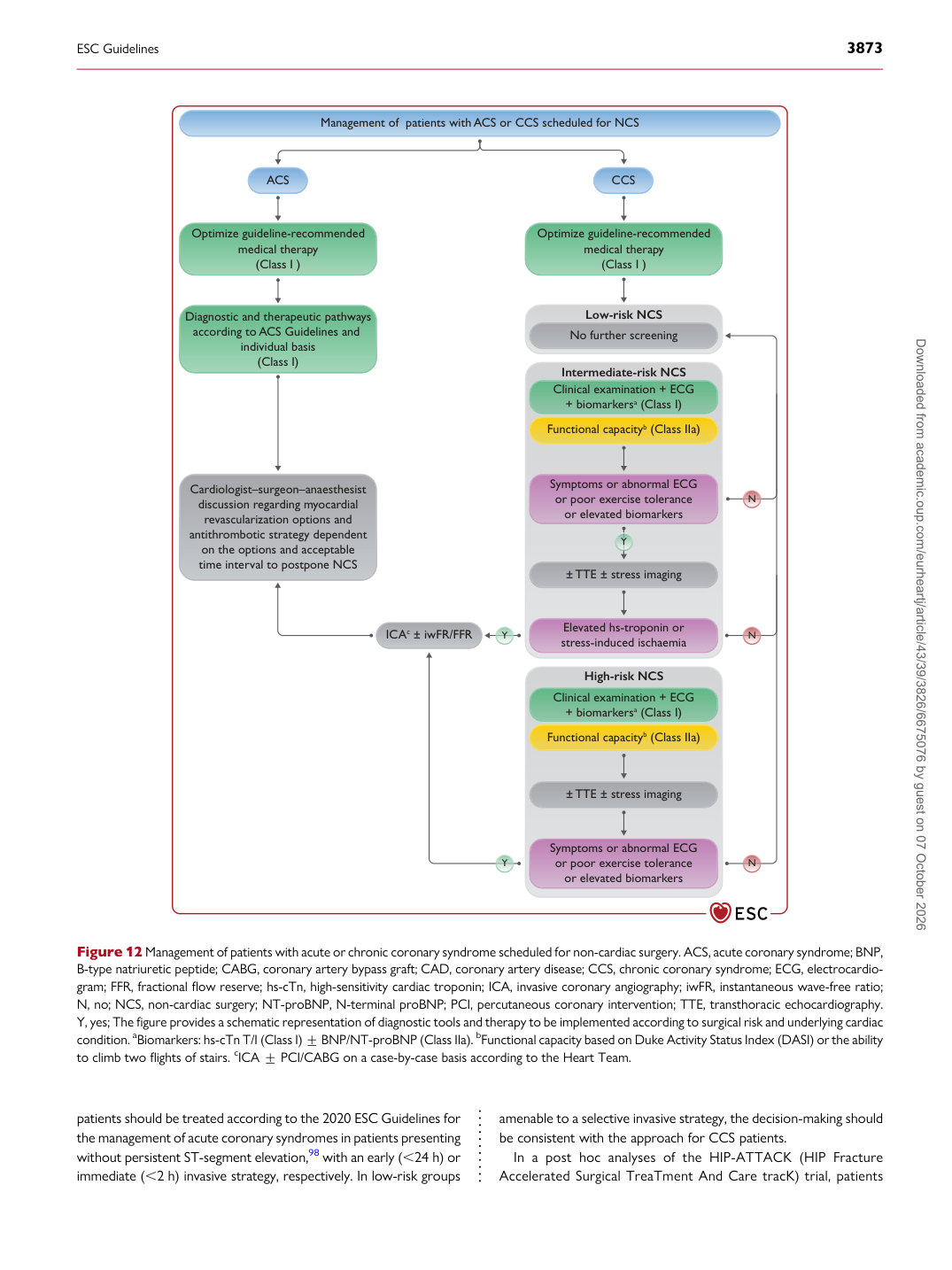
Figure 12 Management of patients with acute or chronic coronary syndrome scheduled for non-cardiac surgery. ACS, acute coronary syndrome; BNP, B-type natriuretic peptide; CABG, coronary artery bypass graft; CAD, coronary artery disease; CCS, chronic coronary syndrome; ECG, electrocardiogram; FFR, fractional flow reserve; hs-cTn, high-sensitivity cardiac troponin; ICA, invasive coronary angiography; iwFR, instantaneous wave-free ratio; N, no; NCS, non-cardiac surgery; NT-proBNP, N-terminal proBNP; PCI, percutaneous coronary intervention; TTE, transthoracic echocardiography. Y, yes; The figure provides a schematic representation of diagnostic tools and therapy to be implemented according to surgical risk and underlying cardiac condition. aBiomarkers: hs-cTn T/I (Class I) +BNP/NT-proBNP (Class IIa). bFunctional capacity based on Duke Activity Status Index (DASI) or the ability to climb two flights of stairs. cICA +PCI/CABG on a case-by-case basis according to the Heart Team.

ESC Guidelines                                                                                                                                                                                     3873

Downloaded from academic.oup.com/eurheartj/article/43/39/3826/6675076 by guest on 07 October 2026