p.46 抽出テキスト
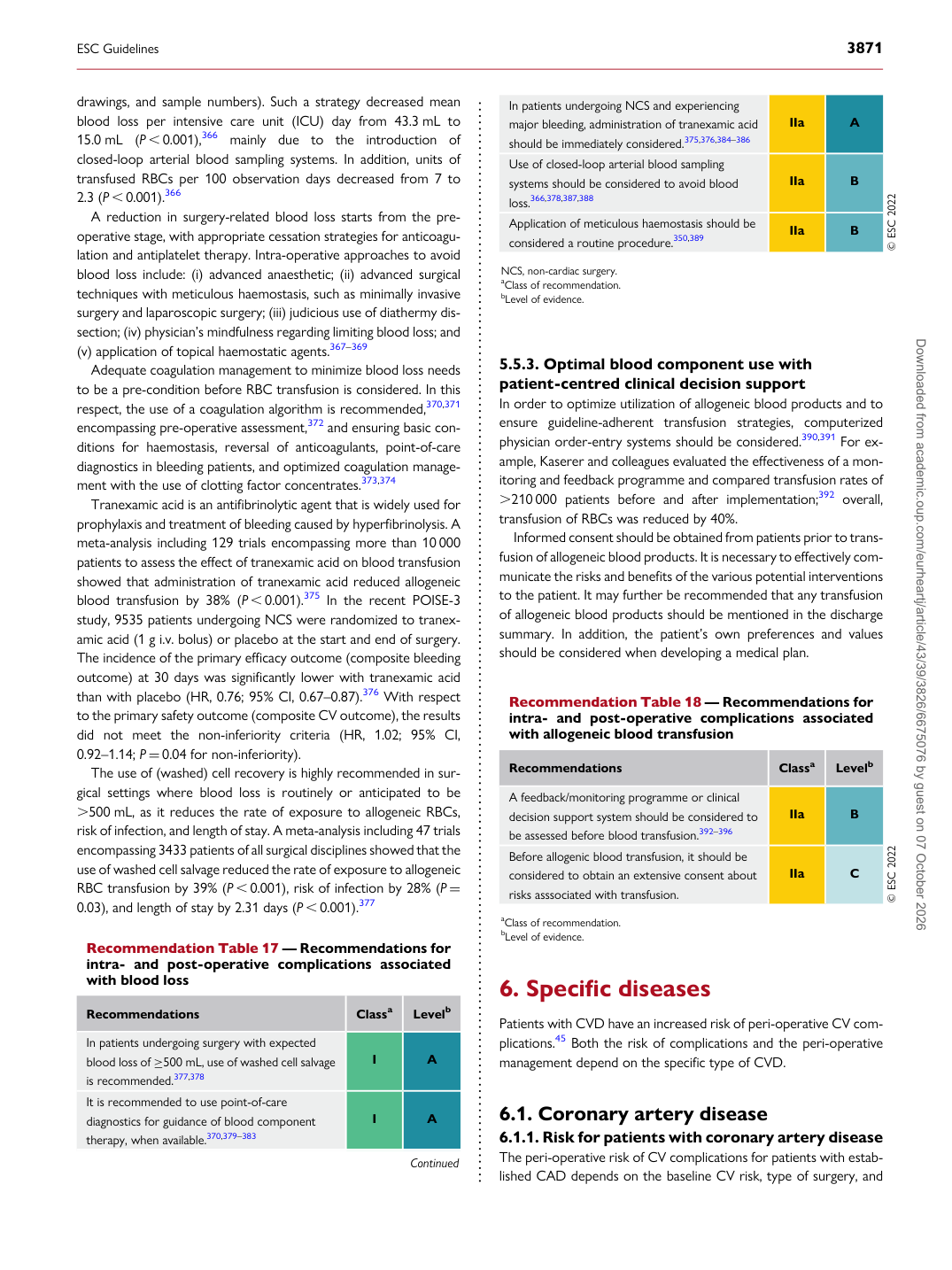
drawings, and sample numbers). Such a strategy decreased mean blood loss per intensive care unit (ICU) day from 43.3 mL to 15.0 mL (P , 0.001),366 mainly due to the introduction of closed-loop arterial blood sampling systems. In addition, units of transfused RBCs per 100 observation days decreased from 7 to 2.3 (P , 0.001).366 A reduction in surgery-related blood loss starts from the preoperative stage, with appropriate cessation strategies for anticoagulation and antiplatelet therapy. Intra-operative approaches to avoid blood loss include: (i) advanced anaesthetic; (ii) advanced surgical techniques with meticulous haemostasis, such as minimally invasive surgery and laparoscopic surgery; (iii) judicious use of diathermy dissection; (iv) physician’s mindfulness regarding limiting blood loss; and (v) application of topical haemostatic agents.367–369 Adequate coagulation management to minimize blood loss needs to be a pre-condition before RBC transfusion is considered. In this respect, the use of a coagulation algorithm is recommended,370,371 encompassing pre-operative assessment,372 and ensuring basic conditions for haemostasis, reversal of anticoagulants, point-of-care diagnostics in bleeding patients, and optimized coagulation management with the use of clotting factor concentrates.373,374 Tranexamic acid is an antifibrinolytic agent that is widely used for prophylaxis and treatment of bleeding caused by hyperfibrinolysis. A meta-analysis including 129 trials encompassing more than 10 000 patients to assess the effect of tranexamic acid on blood transfusion showed that administration of tranexamic acid reduced allogeneic blood transfusion by 38% (P , 0.001).375 In the recent POISE-3 study, 9535 patients undergoing NCS were randomized to tranexamic acid (1 g i.v. bolus) or placebo at the start and end of surgery. The incidence of the primary efficacy outcome (composite bleeding outcome) at 30 days was significantly lower with tranexamic acid than with placebo (HR, 0.76; 95% CI, 0.67–0.87).376 With respect to the primary safety outcome (composite CV outcome), the results did not meet the non-inferiority criteria (HR, 1.02; 95% CI, 0.92–1.14; P = 0.04 for non-inferiority). The use of (washed) cell recovery is highly recommended in surgical settings where blood loss is routinely or anticipated to be .500 mL, as it reduces the rate of exposure to allogeneic RBCs, risk of infection, and length of stay. A meta-analysis including 47 trials encompassing 3433 patients of all surgical disciplines showed that the use of washed cell salvage reduced the rate of exposure to allogeneic RBC transfusion by 39% (P , 0.001), risk of infection by 28% (P = 0.03), and length of stay by 2.31 days (P , 0.001).377 5.5.3 Optimal blood component use with

patient-centred clinical decision support In order to optimize utilization of allogeneic blood products and to ensure guideline-adherent transfusion strategies, computerized physician order-entry systems should be considered.390,391 For example, Kaserer and colleagues evaluated the effectiveness of a monitoring and feedback programme and compared transfusion rates of .210 000 patients before and after implementation;392 overall, transfusion of RBCs was reduced by 40%. Informed consent should be obtained from patients prior to transfusion of allogeneic blood products. It is necessary to effectively communicate the risks and benefits of the various potential interventions to the patient. It may further be recommended that any transfusion of allogeneic blood products should be mentioned in the discharge summary. In addition, the patient’s own preferences and values should be considered when developing a medical plan.

6 Specific diseases

Patients with CVD have an increased risk of peri-operative CV complications.45 Both the risk of complications and the peri-operative management depend on the specific type of CVD.

6.1 Coronary artery disease

6.1.1. Risk for patients with coronary artery disease The peri-operative risk of CV complications for patients with established CAD depends on the baseline CV risk, type of surgery, and

Recommendation Table 17 — Recommendations for intra- and post-operative complications associated with blood loss

Recommendations Classa Levelb

In patients undergoing surgery with expected blood loss of ≥500 mL, use of washed cell salvage is recommended.377,378 I A It is recommended to use point-of-care diagnostics for guidance of blood component therapy, when available.370,379–383 I A

Continued In patients undergoing NCS and experiencing

major bleeding, administration of tranexamic acid should be immediately considered.375,376,384–386 IIa A Use of closed-loop arterial blood sampling systems should be considered to avoid blood loss.366,378,387,388 IIa B Application of meticulous haemostasis should be considered a routine procedure.350,389 IIa B © ESC 2022

NCS, non-cardiac surgery. aClass of recommendation. bLevel of evidence.

Recommendation Table 18 — Recommendations for intra- and post-operative complications associated with allogeneic blood transfusion

Recommendations Classa Levelb

A feedback/monitoring programme or clinical decision support system should be considered to be assessed before blood transfusion.392–396 IIa B Before allogenic blood transfusion, it should be considered to obtain an extensive consent about risks asssociated with transfusion. IIa C © ESC 2022 aClass of recommendation. bLevel of evidence.

ESC Guidelines                                                                                                                                                                                     3871

Downloaded from academic.oup.com/eurheartj/article/43/39/3826/6675076 by guest on 07 October 2026