p.45 抽出テキスト
of serious adverse events, major cardiac and cerebrovascular events, allogenic blood transfusion requirements, and length of stay were increased in patients with ID. Based on the possibility of preserving the patients’ own blood resources and to enable safe handling of donor blood, the World Health Assembly (WHA) has endorsed the Patient Blood Management (PBM) approach (WHA63.12). Patient Blood Management is a patient-centred and multidisciplinary approach to manage anaemia, minimize iatrogenic blood loss and bleeding, and harness tolerance to anaemia in an effort to improve patient outcome.350–355 A comprehensive PBM programme addressing all three PBM pillars was associated with reduced transfusion need of RBC units, and lower complication and mortality rates.350

5.5.1 Pre-operative anaemia—diagnosis and

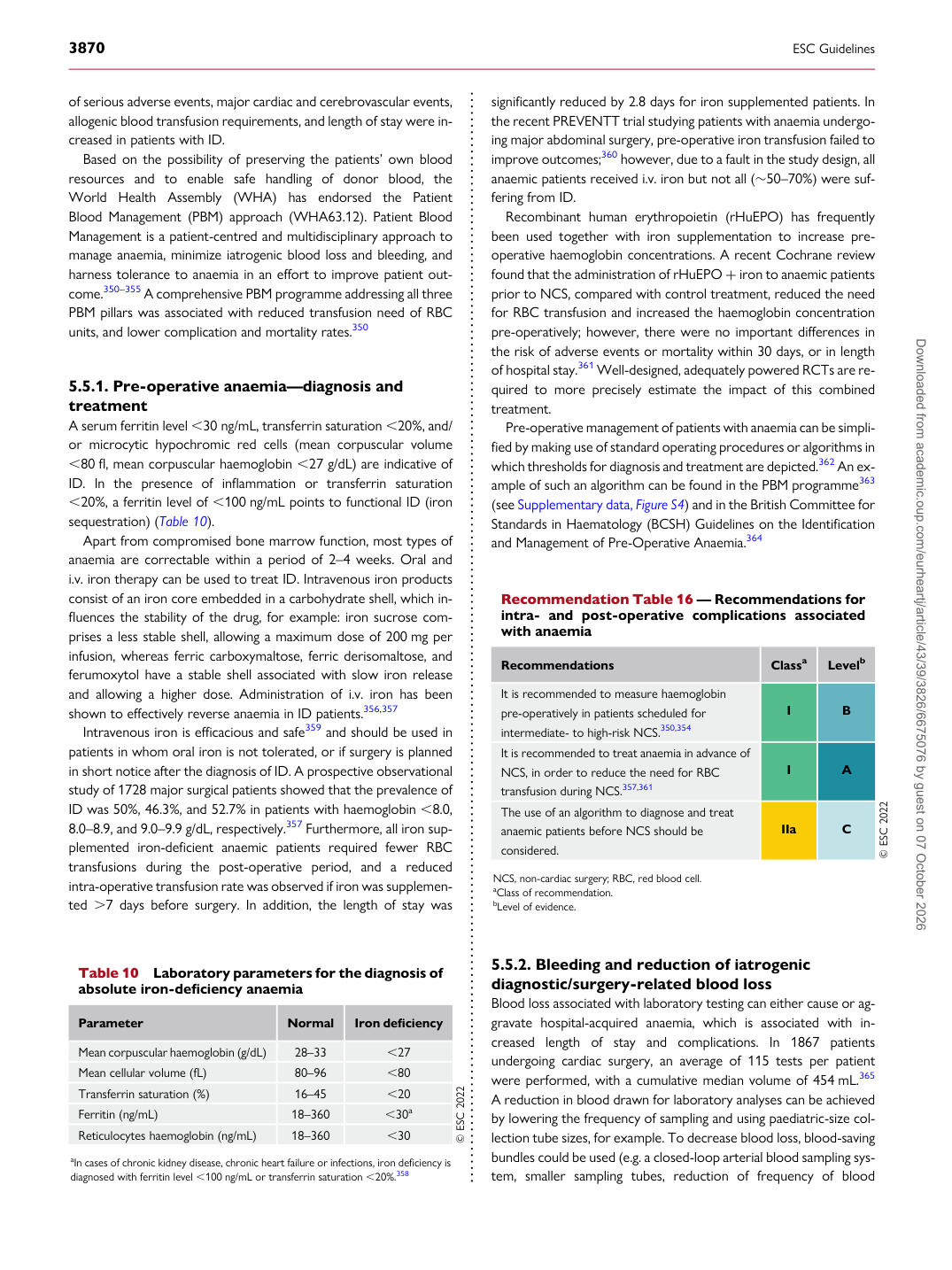
treatment A serum ferritin level ,30 ng/mL, transferrin saturation ,20%, and/ or microcytic hypochromic red cells (mean corpuscular volume ,80 fl, mean corpuscular haemoglobin ,27 g/dL) are indicative of ID. In the presence of inflammation or transferrin saturation ,20%, a ferritin level of ,100 ng/mL points to functional ID (iron sequestration) (Table 10). Apart from compromised bone marrow function, most types of anaemia are correctable within a period of 2–4 weeks. Oral and i.v. iron therapy can be used to treat ID. Intravenous iron products consist of an iron core embedded in a carbohydrate shell, which influences the stability of the drug, for example: iron sucrose comprises a less stable shell, allowing a maximum dose of 200 mg per infusion, whereas ferric carboxymaltose, ferric derisomaltose, and ferumoxytol have a stable shell associated with slow iron release and allowing a higher dose. Administration of i.v. iron has been shown to effectively reverse anaemia in ID patients.356,357 Intravenous iron is efficacious and safe359 and should be used in patients in whom oral iron is not tolerated, or if surgery is planned in short notice after the diagnosis of ID. A prospective observational study of 1728 major surgical patients showed that the prevalence of ID was 50%, 46.3%, and 52.7% in patients with haemoglobin ,8.0, 8.0–8.9, and 9.0–9.9 g/dL, respectively.357 Furthermore, all iron supplemented iron-deficient anaemic patients required fewer RBC transfusions during the post-operative period, and a reduced intra-operative transfusion rate was observed if iron was supplemented .7 days before surgery. In addition, the length of stay was significantly reduced by 2.8 days for iron supplemented patients. In the recent PREVENTT trial studying patients with anaemia undergoing major abdominal surgery, pre-operative iron transfusion failed to improve outcomes;360 however, due to a fault in the study design, all anaemic patients received i.v. iron but not all (≏50–70%) were suffering from ID.

Recombinant human erythropoietin (rHuEPO) has frequently been used together with iron supplementation to increase preoperative haemoglobin concentrations. A recent Cochrane review found that the administration of rHuEPO + iron to anaemic patients prior to NCS, compared with control treatment, reduced the need for RBC transfusion and increased the haemoglobin concentration pre-operatively; however, there were no important differences in the risk of adverse events or mortality within 30 days, or in length of hospital stay.361 Well-designed, adequately powered RCTs are required to more precisely estimate the impact of this combined treatment. Pre-operative management of patients with anaemia can be simplified by making use of standard operating procedures or algorithms in which thresholds for diagnosis and treatment are depicted.362 An example of such an algorithm can be found in the PBM programme363 (see Supplementary data, Figure S4) and in the British Committee for Standards in Haematology (BCSH) Guidelines on the Identification and Management of Pre-Operative Anaemia.364

5.5.2 Bleeding and reduction of iatrogenic

diagnostic/surgery-related blood loss Blood loss associated with laboratory testing can either cause or aggravate hospital-acquired anaemia, which is associated with increased length of stay and complications. In 1867 patients undergoing cardiac surgery, an average of 115 tests per patient were performed, with a cumulative median volume of 454 mL.365 A reduction in blood drawn for laboratory analyses can be achieved by lowering the frequency of sampling and using paediatric-size collection tube sizes, for example. To decrease blood loss, blood-saving bundles could be used (e.g. a closed-loop arterial blood sampling system, smaller sampling tubes, reduction of frequency of blood

Table 10 Laboratory parameters for the diagnosis of absolute iron-deficiency anaemia

Parameter Normal Iron deficiency

Mean corpuscular haemoglobin (g/dL) 28–33 ,27 Mean cellular volume (fL) 80–96 ,80 Transferrin saturation (%) 16–45 ,20 Ferritin (ng/mL) 18–360 ,30a Reticulocytes haemoglobin (ng/mL) 18–360 ,30 © ESC 2022 aIn cases of chronic kidney disease, chronic heart failure or infections, iron deficiency is diagnosed with ferritin level ,100 ng/mL or transferrin saturation ,20%.358 Recommendation Table 16 — Recommendations for intra- and post-operative complications associated with anaemia

Recommendations Classa Levelb

It is recommended to measure haemoglobin pre-operatively in patients scheduled for intermediate- to high-risk NCS.350,354 I B It is recommended to treat anaemia in advance of NCS, in order to reduce the need for RBC transfusion during NCS.357,361 I A The use of an algorithm to diagnose and treat anaemic patients before NCS should be considered. IIa C © ESC 2022

NCS, non-cardiac surgery; RBC, red blood cell. aClass of recommendation. bLevel of evidence. Downloaded from academic.oup.com/eurheartj/article/43/39/3826/6675076 by guest on 07 October 2026