p.44 抽出テキスト
5.4 Peri-operative thromboprophylaxis

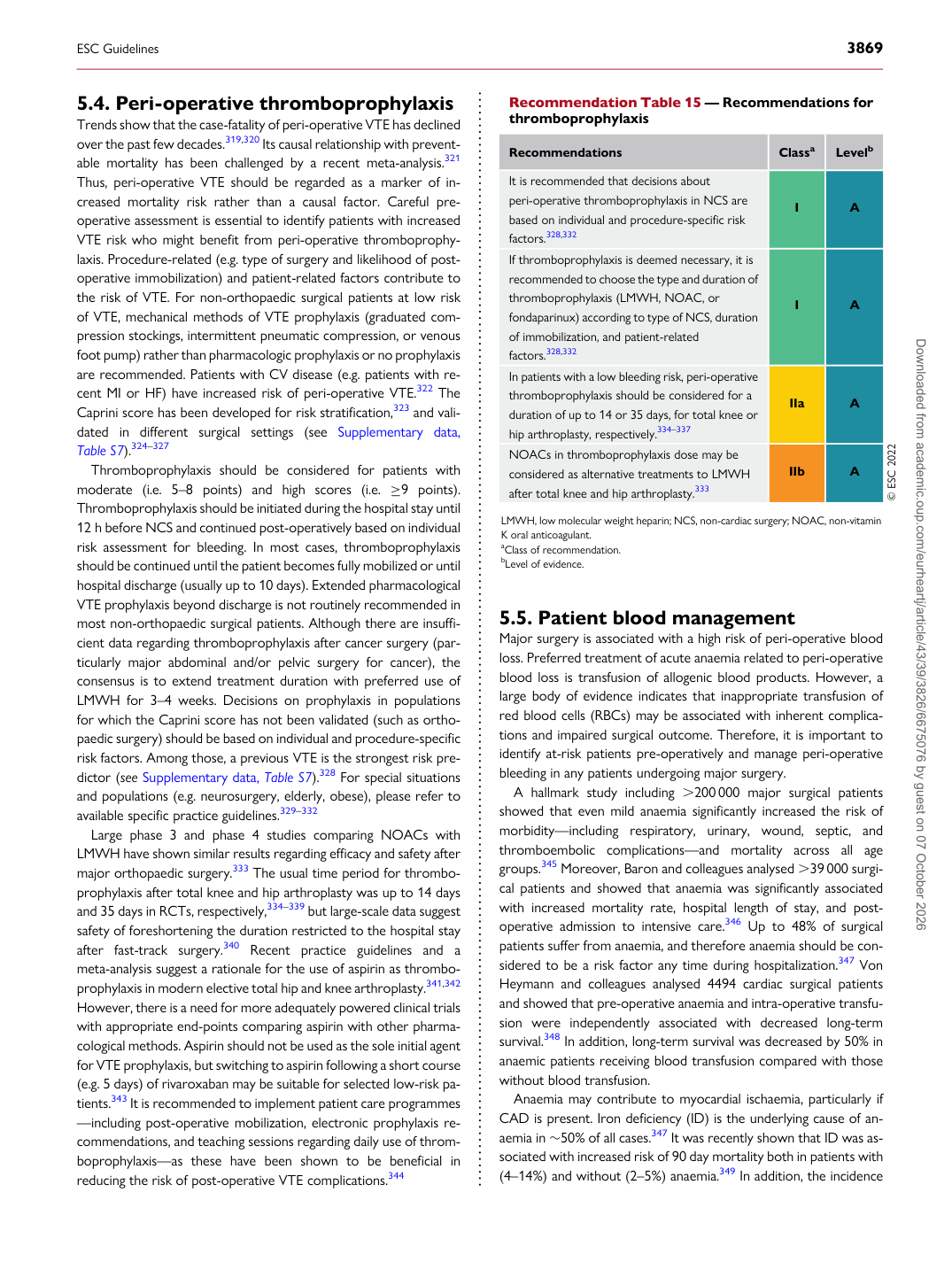
Trends show that the case-fatality of peri-operative VTE has declined over the past few decades.319,320 Its causal relationship with preventable mortality has been challenged by a recent meta-analysis.321 Thus, peri-operative VTE should be regarded as a marker of increased mortality risk rather than a causal factor. Careful preoperative assessment is essential to identify patients with increased VTE risk who might benefit from peri-operative thromboprophylaxis. Procedure-related (e.g. type of surgery and likelihood of postoperative immobilization) and patient-related factors contribute to the risk of VTE. For non-orthopaedic surgical patients at low risk of VTE, mechanical methods of VTE prophylaxis (graduated compression stockings, intermittent pneumatic compression, or venous foot pump) rather than pharmacologic prophylaxis or no prophylaxis are recommended. Patients with CV disease (e.g. patients with recent MI or HF) have increased risk of peri-operative VTE.322 The Caprini score has been developed for risk stratification,323 and validated in different surgical settings (see Supplementary data, Table S7).324–327 Thromboprophylaxis should be considered for patients with moderate (i.e. 5–8 points) and high scores (i.e. ≥9 points). Thromboprophylaxis should be initiated during the hospital stay until 12 h before NCS and continued post-operatively based on individual risk assessment for bleeding. In most cases, thromboprophylaxis should be continued until the patient becomes fully mobilized or until hospital discharge (usually up to 10 days). Extended pharmacological VTE prophylaxis beyond discharge is not routinely recommended in most non-orthopaedic surgical patients. Although there are insufficient data regarding thromboprophylaxis after cancer surgery (particularly major abdominal and/or pelvic surgery for cancer), the consensus is to extend treatment duration with preferred use of LMWH for 3–4 weeks. Decisions on prophylaxis in populations for which the Caprini score has not been validated (such as orthopaedic surgery) should be based on individual and procedure-specific risk factors. Among those, a previous VTE is the strongest risk predictor (see Supplementary data, Table S7).328 For special situations and populations (e.g. neurosurgery, elderly, obese), please refer to available specific practice guidelines.329–332 Large phase 3 and phase 4 studies comparing NOACs with LMWH have shown similar results regarding efficacy and safety after major orthopaedic surgery.333 The usual time period for thromboprophylaxis after total knee and hip arthroplasty was up to 14 days and 35 days in RCTs, respectively,334–339 but large-scale data suggest safety of foreshortening the duration restricted to the hospital stay after fast-track surgery.340 Recent practice guidelines and a meta-analysis suggest a rationale for the use of aspirin as thromboprophylaxis in modern elective total hip and knee arthroplasty.341,342 However, there is a need for more adequately powered clinical trials with appropriate end-points comparing aspirin with other pharmacological methods. Aspirin should not be used as the sole initial agent for VTE prophylaxis, but switching to aspirin following a short course (e.g. 5 days) of rivaroxaban may be suitable for selected low-risk patients.343 It is recommended to implement patient care programmes —including post-operative mobilization, electronic prophylaxis recommendations, and teaching sessions regarding daily use of thromboprophylaxis—as these have been shown to be beneficial in reducing the risk of post-operative VTE complications.344 5.5 Patient blood management

Major surgery is associated with a high risk of peri-operative blood loss. Preferred treatment of acute anaemia related to peri-operative blood loss is transfusion of allogenic blood products. However, a large body of evidence indicates that inappropriate transfusion of red blood cells (RBCs) may be associated with inherent complications and impaired surgical outcome. Therefore, it is important to identify at-risk patients pre-operatively and manage peri-operative bleeding in any patients undergoing major surgery. A hallmark study including .200 000 major surgical patients showed that even mild anaemia significantly increased the risk of morbidity—including respiratory, urinary, wound, septic, and thromboembolic complications—and mortality across all age groups.345 Moreover, Baron and colleagues analysed .39 000 surgical patients and showed that anaemia was significantly associated with increased mortality rate, hospital length of stay, and postoperative admission to intensive care.346 Up to 48% of surgical patients suffer from anaemia, and therefore anaemia should be considered to be a risk factor any time during hospitalization.347 Von Heymann and colleagues analysed 4494 cardiac surgical patients and showed that pre-operative anaemia and intra-operative transfusion were independently associated with decreased long-term survival.348 In addition, long-term survival was decreased by 50% in anaemic patients receiving blood transfusion compared with those without blood transfusion. Anaemia may contribute to myocardial ischaemia, particularly if CAD is present. Iron deficiency (ID) is the underlying cause of anaemia in ≏50% of all cases.347 It was recently shown that ID was associated with increased risk of 90 day mortality both in patients with (4–14%) and without (2–5%) anaemia.349 In addition, the incidence

Recommendation Table 15 — Recommendations for thromboprophylaxis

Recommendations Classa Levelb

It is recommended that decisions about peri-operative thromboprophylaxis in NCS are based on individual and procedure-specific risk factors.328,332 I A If thromboprophylaxis is deemed necessary, it is recommended to choose the type and duration of thromboprophylaxis (LMWH, NOAC, or fondaparinux) according to type of NCS, duration of immobilization, and patient-related factors.328,332 I A In patients with a low bleeding risk, peri-operative thromboprophylaxis should be considered for a duration of up to 14 or 35 days, for total knee or hip arthroplasty, respectively.334–337 IIa A NOACs in thromboprophylaxis dose may be considered as alternative treatments to LMWH after total knee and hip arthroplasty.333 IIb A © ESC 2022

LMWH, low molecular weight heparin; NCS, non-cardiac surgery; NOAC, non-vitamin K oral anticoagulant. aClass of recommendation. bLevel of evidence.

ESC Guidelines                                                                                                                                                                                     3869

Downloaded from academic.oup.com/eurheartj/article/43/39/3826/6675076 by guest on 07 October 2026