p.43 抽出テキスト
tranexamic acid mouthwash or compressive gauze). Most professional statements on dental surgery advise uninterrupted NOAC, but these recommendations are mostly based on expert consensus, while some studies are currently ongoing.315–317

5.3.2.2.6 When to restart non-vitamin K antagonist oral anticoa-

gulants after interventions. In general, NOAC can be restarted 6–8 h after interventions with rapid and complete haemostasis. When the bleeding risk with full-dose anticoagulation resumption outweighs the risk of thromboembolic events, therapeutic anticoagulation may be postponed to .48–72 h after the procedure, using prophylactic post-operative thromboprophylaxis until the resumption of full-dose NOAC is deemed safe (Figure 9).240 Post-operative heparin administration should also be considered in patients unable to take oral therapy. Off-label use of reduced-dose NOACs to attenuate the risk of post-operative bleeding is not recommended, as there is no evidence informing such an approach.

5.3.2.3 Combination therapy (antiplatelet and anticoagulant)

In general, according to the 2020 ESC Guidelines for the diagnosis and management of atrial fibrillation developed in collaboration with the European Association for Cardio-Thoracic Surgery (EACTS), dual antithrombotic therapy should be adopted in most patients with AF and a recent PCI.99 Elective surgery should be postponed until the period when antiplatelet therapy can be safely discontinued in combination therapy (6 months after elective PCI or 12 months after ACS).268 Peri-operative handling of NOACs should follow the above recommendations (Figures 9 and 10). In urgent/ emergency surgery with high bleeding risk, operative measures to reduce bleeding and/or reversal strategies of anticoagulation might be applied. In patients receiving combination therapy for other indications (e.g. TAVI and AF), according to recent trial results, antiplatelet therapy can be safely discontinued before NCS.318 In patients receiving low-dose OACs as part of a vascular protection strategy, rivaroxaban should be paused for at least 24 h before surgery and resumed according to the post-operative bleeding risk.

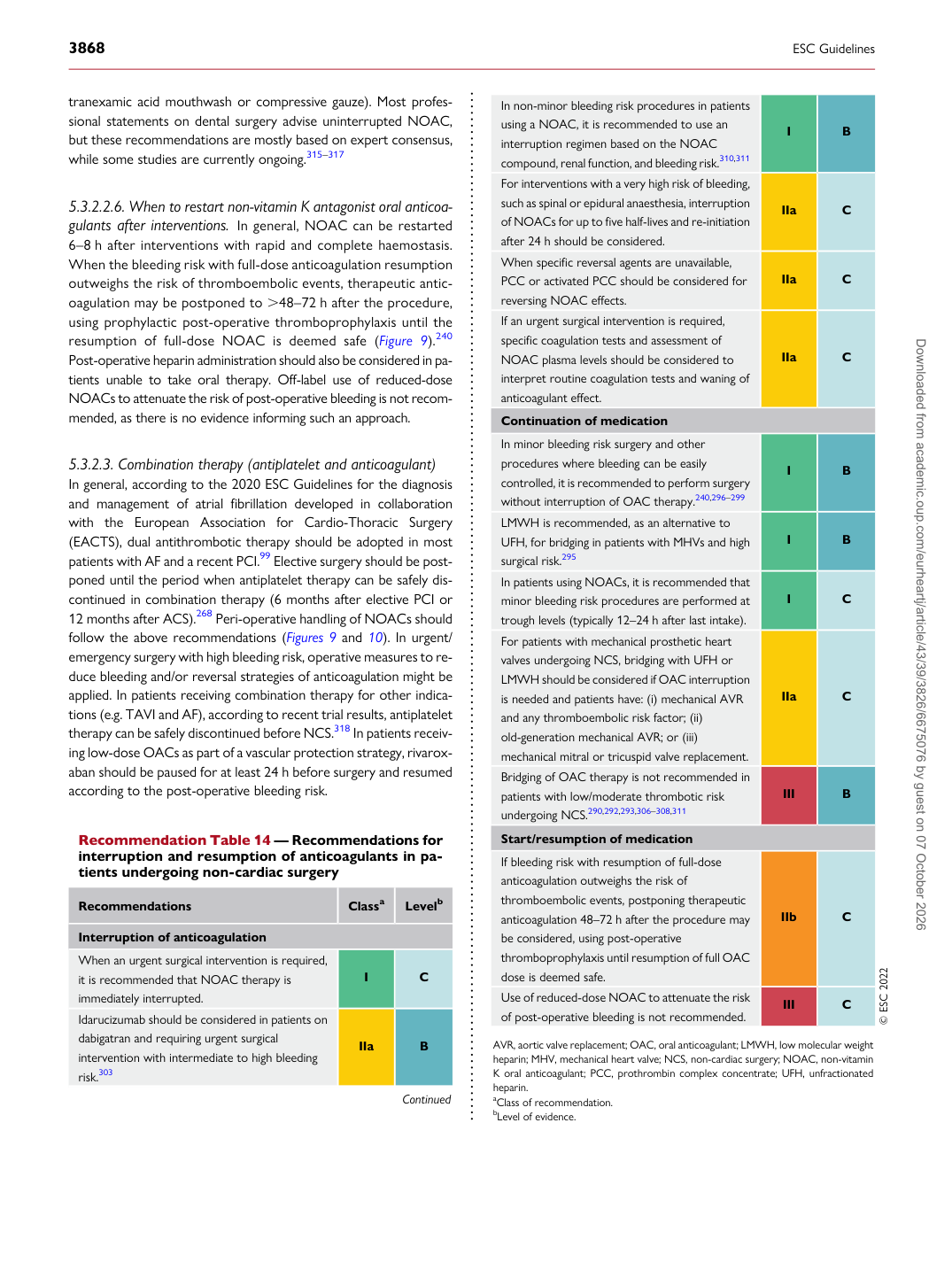
Recommendation Table 14 — Recommendations for interruption and resumption of anticoagulants in patients undergoing non-cardiac surgery

Recommendations Classa Levelb

Interruption of anticoagulation When an urgent surgical intervention is required, it is recommended that NOAC therapy is immediately interrupted. I C Idarucizumab should be considered in patients on dabigatran and requiring urgent surgical intervention with intermediate to high bleeding risk.303 IIa B

Continued In non-minor bleeding risk procedures in patients

using a NOAC, it is recommended to use an interruption regimen based on the NOAC compound, renal function, and bleeding risk.310,311 I B For interventions with a very high risk of bleeding, such as spinal or epidural anaesthesia, interruption of NOACs for up to five half-lives and re-initiation after 24 h should be considered. IIa C When specific reversal agents are unavailable, PCC or activated PCC should be considered for reversing NOAC effects. IIa C If an urgent surgical intervention is required, specific coagulation tests and assessment of NOAC plasma levels should be considered to interpret routine coagulation tests and waning of anticoagulant effect. IIa C Continuation of medication In minor bleeding risk surgery and other procedures where bleeding can be easily controlled, it is recommended to perform surgery without interruption of OAC therapy.240,296–299 I B LMWH is recommended, as an alternative to UFH, for bridging in patients with MHVs and high surgical risk.295 I B In patients using NOACs, it is recommended that minor bleeding risk procedures are performed at trough levels (typically 12–24 h after last intake). I C For patients with mechanical prosthetic heart valves undergoing NCS, bridging with UFH or LMWH should be considered if OAC interruption is needed and patients have: (i) mechanical AVR and any thromboembolic risk factor; (ii) old-generation mechanical AVR; or (iii) mechanical mitral or tricuspid valve replacement. IIa C Bridging of OAC therapy is not recommended in patients with low/moderate thrombotic risk undergoing NCS.290,292,293,306–308,311 III B Start/resumption of medication If bleeding risk with resumption of full-dose anticoagulation outweighs the risk of thromboembolic events, postponing therapeutic anticoagulation 48–72 h after the procedure may be considered, using post-operative thromboprophylaxis until resumption of full OAC dose is deemed safe. IIb C Use of reduced-dose NOAC to attenuate the risk of post-operative bleeding is not recommended. III C © ESC 2022

AVR, aortic valve replacement; OAC, oral anticoagulant; LMWH, low molecular weight heparin; MHV, mechanical heart valve; NCS, non-cardiac surgery; NOAC, non-vitamin K oral anticoagulant; PCC, prothrombin complex concentrate; UFH, unfractionated heparin. aClass of recommendation. bLevel of evidence. Downloaded from academic.oup.com/eurheartj/article/43/39/3826/6675076 by guest on 07 October 2026