p.40 抽出テキスト
Whereas the open-label prospective trial testing the specific reversal agent idarucizumab in patients on dabigatran enrolled participants experiencing acute major bleeding or requiring urgent surgical intervention,303 the trial with the reversal agent andexanet alpha for FXa inhibitors included only patients with acute major bleeding under therapy, but not those requiring urgent surgery.304 However, the off-label use of andexanet alpha in life-threatening situations requiring an immediate intervention may be considered, bearing in mind that andexanet alpha non-specifically binds all FXa inhibitors, which may have important implications for further treatment, including the administration of UFH or LMWH.240 When specific reversal agents are unavailable, prothrombin complex concentrate (PCC) or activated PCC should be considered, although there is a lack of evidence on their efficacy and safety for emergency procedures in patients taking a NOAC.290,305 Performing immediate or urgent surgery under general rather than spinal anaesthesia is prudent, in order to reduce the risk of epidural haematoma.

Prior to unplanned surgery, the full panel of coagulation blood tests (see Supplementary data, Table S6) should be obtained in order to assess the patient’s coagulation status. The indication for reversal (and/or non-specific haemostatic) agents is primarily governed by the patient’s clinical presentation, but initial assessment of coagulation

Stopping and re-initiation of NOAC therapy in elective NCS according to the periprocedural risk of bleeding in patients with normal renal function

NOAC type Frequency of NOAC administration

-3 -2 -1 NCS 1 2

STOP START Days

Rivaroxaban Edoxaban

Low bleeding risk NCS Dabigatran

Apixaban Twice

daily

Once daily Twice

daily

Once daily No NOAC No bridgingc Twice

daily

Once daily Twice

daily Consider restarting NOAC in the

evening Once

daily

Riva r oxaban Edoxaban

Dabigatran Apixaban

Consider r esta r ting N O A C in the

e v ening

No N OA C No bridging c

Rivaroxaban Edoxaban

High bleeding risk NCS Dabigatran

Apixaban Twice

daily

Once daily Restart NOAC ≥48–72 h after surgery

No NOAC Consider prophylactic

dose heparin post-operatively

No NOAC No bridgingc

Riva r oxaban Edoxaban

Dabigatran Apixaban

No N OA C No bridging c Resta r t

N O A C ≥ 48 – 72 h aft a er surge r y y

No N OA C Consider p r op h ylactic

dose heparin post-operati v e l y

Rivaroxaban Edoxaban

Minor bleeding risk NCS Dabigatran

Apixaban Twice

daily

Once daily Twice

daily

Once daily May skip the evening dosea

Once dailyb Twice

daily

Once daily Twice

daily

Restart NOAC ≥6 h after surgery Once

daily

Riva r oxaban Edoxaban

Dabigatran Apixaban

Resta r t N O A C ≥ 6 h after surge r y

M a y skip the

a a e v ening dose a

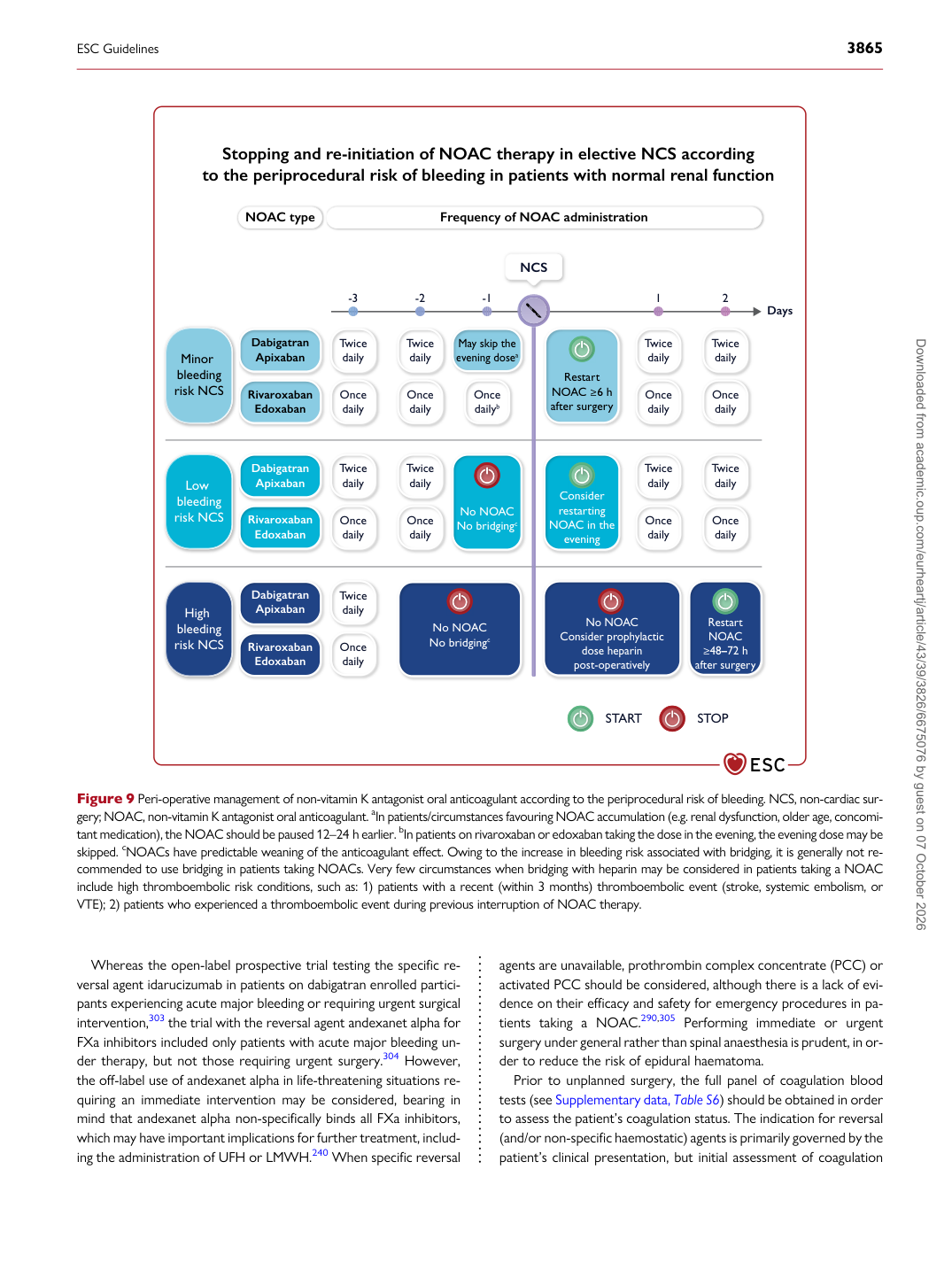
Figure 9 Peri-operative management of non-vitamin K antagonist oral anticoagulant according to the periprocedural risk of bleeding. NCS, non-cardiac surgery; NOAC, non-vitamin K antagonist oral anticoagulant. aIn patients/circumstances favouring NOAC accumulation (e.g. renal dysfunction, older age, concomitant medication), the NOAC should be paused 12–24 h earlier. bIn patients on rivaroxaban or edoxaban taking the dose in the evening, the evening dose may be skipped. cNOACs have predictable weaning of the anticoagulant effect. Owing to the increase in bleeding risk associated with bridging, it is generally not recommended to use bridging in patients taking NOACs. Very few circumstances when bridging with heparin may be considered in patients taking a NOAC include high thromboembolic risk conditions, such as: 1) patients with a recent (within 3 months) thromboembolic event (stroke, systemic embolism, or VTE); 2) patients who experienced a thromboembolic event during previous interruption of NOAC therapy.

ESC Guidelines                                                                                                                                                                                     3865

Downloaded from academic.oup.com/eurheartj/article/43/39/3826/6675076 by guest on 07 October 2026