p.38 抽出テキスト
5.3.2 Oral anticoagulants

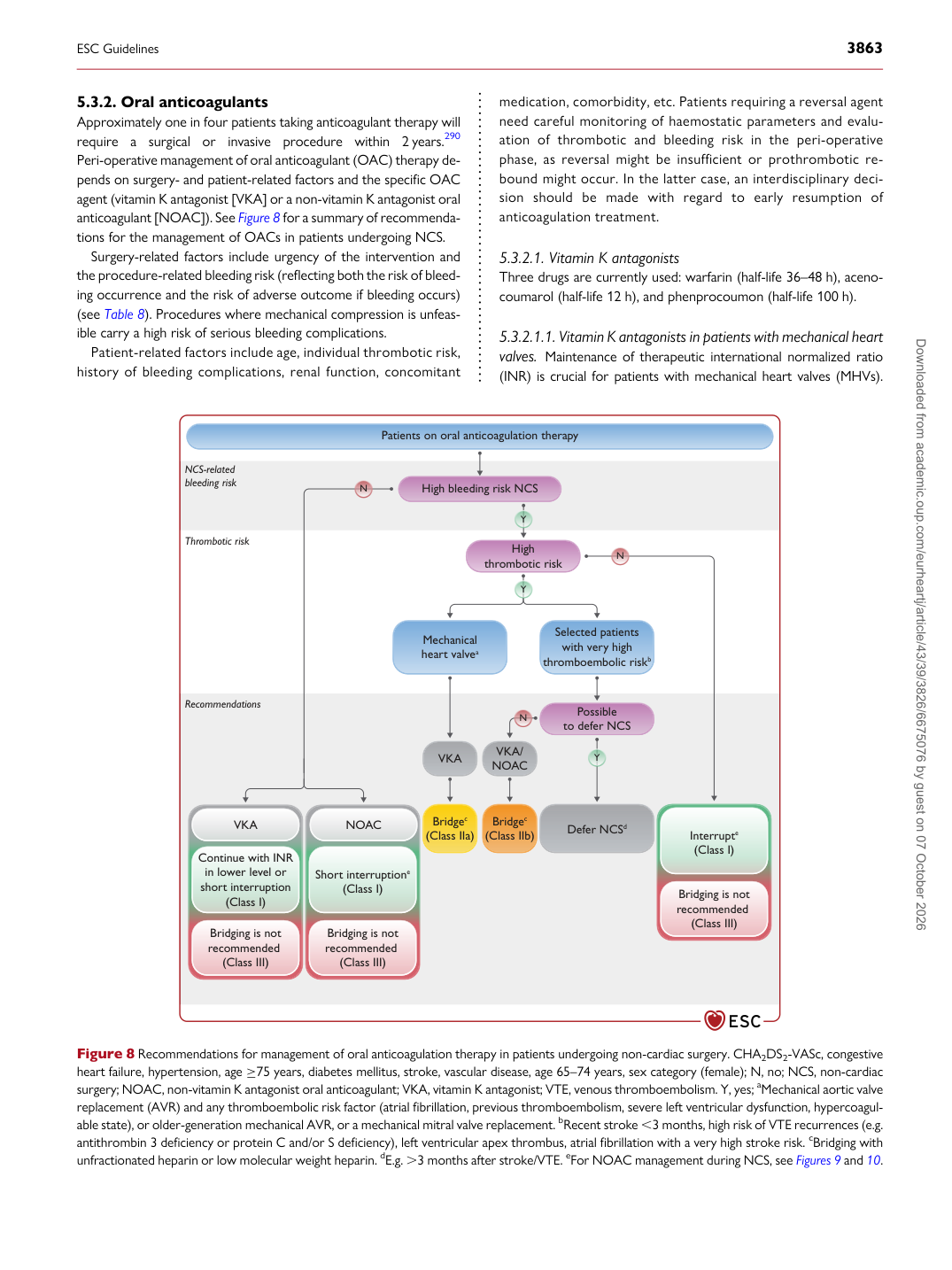
Approximately one in four patients taking anticoagulant therapy will require a surgical or invasive procedure within 2 years.290 Peri-operative management of oral anticoagulant (OAC) therapy depends on surgery- and patient-related factors and the specific OAC agent (vitamin K antagonist [VKA] or a non-vitamin K antagonist oral anticoagulant [NOAC]). See Figure 8 for a summary of recommendations for the management of OACs in patients undergoing NCS. Surgery-related factors include urgency of the intervention and the procedure-related bleeding risk (reflecting both the risk of bleeding occurrence and the risk of adverse outcome if bleeding occurs) (see Table 8). Procedures where mechanical compression is unfeasible carry a high risk of serious bleeding complications. Patient-related factors include age, individual thrombotic risk, history of bleeding complications, renal function, concomitant medication, comorbidity, etc. Patients requiring a reversal agent need careful monitoring of haemostatic parameters and evaluation of thrombotic and bleeding risk in the peri-operative phase, as reversal might be insufficient or prothrombotic rebound might occur. In the latter case, an interdisciplinary decision should be made with regard to early resumption of anticoagulation treatment.

5.3.2.1 Vitamin K antagonists

Three drugs are currently used: warfarin (half-life 36–48 h), acenocoumarol (half-life 12 h), and phenprocoumon (half-life 100 h).

5.3.2.1.1 Vitamin K antagonists in patients with mechanical heart

valves. Maintenance of therapeutic international normalized ratio (INR) is crucial for patients with mechanical heart valves (MHVs).

N

N

N

Patients on oral anticoagulation therapy

Y

Y Y

High bleeding risk NCS

VKA VKA/ NOAC

Continue with INR in lower level or short interruption

(Class I)

Bridging is not recommended

(Class III) Short interruptione

(Class I)

Bridging is not recommended

(Class III) Interrupte

(Class I)

Bridging is not recommended

(Class III)

Defer NCSd

Possible to defer NCS

High thrombotic risk

Selected patients with very high thromboembolic riskb

Mechanical heart valvea

NOAC

VKA

NCS-related bleeding risk

Thrombotic risk

Recommendations

Bridgec (Class IIa) Bridgec

(Class IIb)

Figure 8 Recommendations for management of oral anticoagulation therapy in patients undergoing non-cardiac surgery. CHA2DS2-VASc, congestive heart failure, hypertension, age ≥75 years, diabetes mellitus, stroke, vascular disease, age 65–74 years, sex category (female); N, no; NCS, non-cardiac surgery; NOAC, non-vitamin K antagonist oral anticoagulant; VKA, vitamin K antagonist; VTE, venous thromboembolism. Y, yes; aMechanical aortic valve replacement (AVR) and any thromboembolic risk factor (atrial fibrillation, previous thromboembolism, severe left ventricular dysfunction, hypercoagulable state), or older-generation mechanical AVR, or a mechanical mitral valve replacement. bRecent stroke ,3 months, high risk of VTE recurrences (e.g. antithrombin 3 deficiency or protein C and/or S deficiency), left ventricular apex thrombus, atrial fibrillation with a very high stroke risk. cBridging with unfractionated heparin or low molecular weight heparin. dE.g. .3 months after stroke/VTE. eFor NOAC management during NCS, see Figures 9 and 10.

ESC Guidelines                                                                                                                                                                                     3863

Downloaded from academic.oup.com/eurheartj/article/43/39/3826/6675076 by guest on 07 October 2026